
Table of Contents
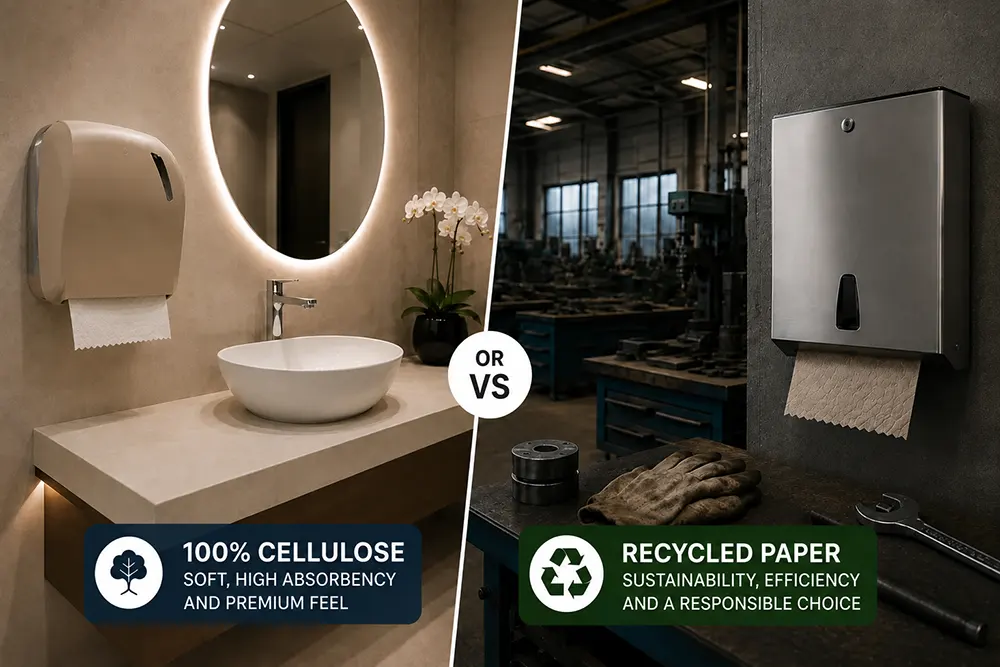
Cellulose or recycled paper – Cellulose is the better choice when absorption, softness, and the visual impression of a premium service are the priority, while recycled paper is the better choice when environmental responsibility and cost efficiency are the priority in high-volume consumption. For certain types of business facilities, combining both materials according to the type of room delivers the best results.
This difference in resource consumption is one of the main arguments in favor of recycled paper, but it is not the only factor to consider. Fiber quality, the number of recycling cycles, and the intended use of the product all have an equal impact on the final decision.
If you are interested in which professional paper products are made from 100% cellulose and which are made from recycled materials, read our detailed guide to paper hygiene products: Paper hygiene products: A complete guide to types, systems, and applications
Cellulose or recycled paper: Which material properties determine the choice?
Cellulose or recycled paper should be selected based on the material’s properties: fiber length and strength, usage intensity, and the company’s environmental goals. Longer and stronger fibers give cellulose greater absorbency. Recycled fibers become shorter with each recycling cycle. As a result, the paper loses some absorbency and strength. However, it retains the advantages of a lower cost and reduced environmental impact.
Hospitality venues, healthcare facilities, and business premises with high foot traffic have different priorities. A restaurant evaluates cost and aesthetics differently than a hospital, where absorbency and hygiene are essential. That is why there is no universal answer—there is only the answer that fits the specific environment.
What is cellulose and why is it used in paper products such as toilet paper and paper towels?
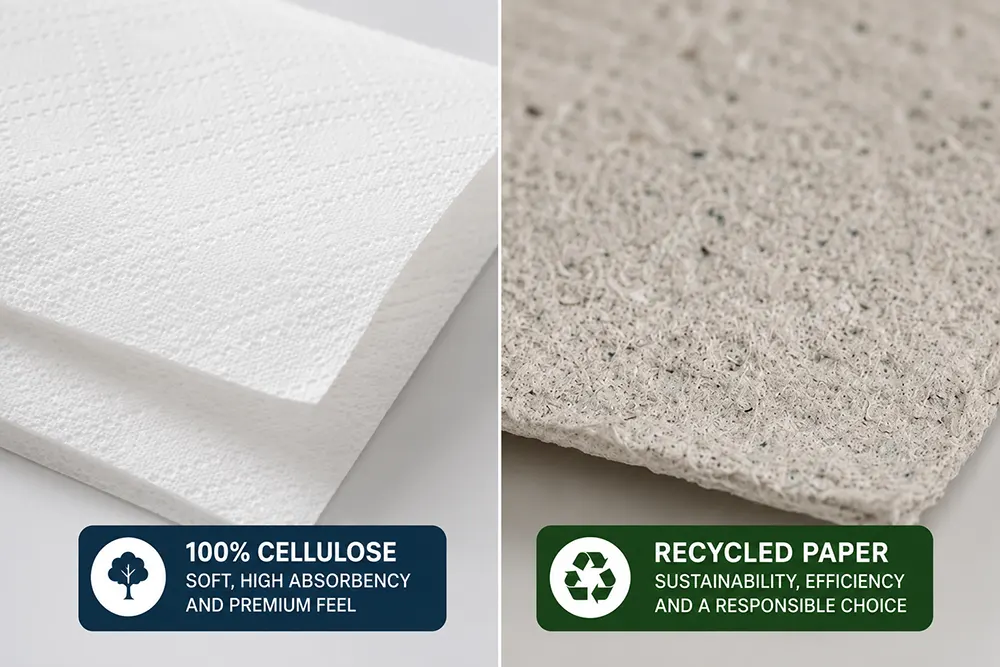
Manufacturers obtain cellulose from natural wood fibers, most commonly softwood or fast-growing species such as eucalyptus. They then process it using either a chemical or mechanical method before turning it into paper. Cellulose fibers are longer and stronger than recycled fibers, giving paper greater absorbency, softness, and tear resistance.
Because of these properties, cellulose is most commonly used for professional paper products made from 100% cellulose, where absorbency is critical. These include professional paper towels used in kitchens, toilet paper for facilities with high hygiene standards, and hand towels used in healthcare facilities. The softness of cellulose paper also enhances the impression of a premium service, making it especially important in the hospitality and hotel industries.
The disadvantage is the price. Cellulose production requires logging and an energy-intensive processing method, which increases the final product cost.
Table: Paper products made from 100% cellulose
| Product | Available in 100% cellulose | Typical application |
| Centerfeed paper towels | Yes | Kitchens, high-traffic restrooms |
| Autocut paper towels | Yes | Areas where sheet-by-sheet consumption control is important |
| Kitchen paper towels | Yes | Kitchens |
| Paper towel rolls | Yes | Restrooms with high hygiene standards |
| Jumbo paper towels | Yes | High-traffic facilities |
| Interfold toilet paper | Yes | Business premises
Offices |
| Jumbo toilet paper rolls | Yes | High-traffic facilities |
| Toilet paper rolls | Yes | Commercial facilities
Hospitality |
| Paper toilet seat covers | Yes | Healthcare facilities, public buildings with high hygiene standards |
What are recycled paper towels?
Manufacturers make recycled paper towels from fibers recovered by processing previously used paper instead of fresh cellulose. They retain their basic absorbent function but have slightly shorter and weaker fibers, making them more suitable for areas with moderate usage than for high-traffic professional kitchens.
What are the advantages of recycled paper?
Manufacturers produce recycled paper by processing previously used paper, extending the life cycle of the fibers and reducing the need to cut new trees. Manufacturers produce recycled paper at a lower unit cost than cellulose paper while using less water, energy, and fewer raw materials, reducing its environmental impact.
According to epa.gov, recycling one ton of office paper saves an amount of energy equivalent to the energy contained in 322 gallons of gasoline.
In addition to its lower cost, using recycled fibers reduces pressure on forest resources and supports the circular economy, which has become an increasingly important factor in corporate ESG reporting.
What are the disadvantages of recycled paper?
The main disadvantage of recycled paper is the gradual weakening of its fibers with each recycling cycle, which directly affects the absorbency and strength of the finished product. For this reason, recycled paper is not always the ideal choice for areas where absorbency is the priority, such as busy kitchens or high-traffic restrooms.
Quality manufacturers address this by combining recycled and cellulose fibers, creating a balance between cost, performance, and environmental impact.
Is recycled paper hygienically safe?
Yes. High-quality recycled paper undergoes processing, purification, and quality control, making it safe for everyday use in commercial facilities. It is important to choose products from reputable manufacturers that meet current quality standards.
How does paper quality affect overall consumption in commercial facilities?
Paper quality can significantly affect overall consumption. Paper with better absorbency and greater strength often allows users to achieve the same result using fewer sheets, reducing the frequency of dispenser refills and the amount of waste.
This does not mean that more expensive paper is always the more cost-effective choice. It is important to consider the total cost of use rather than just the package price. In high-traffic facilities, the difference in consumption becomes noticeable over time, especially when users combine high-quality paper with appropriate dispensers that control sheet dispensing.
How should you choose between cellulose and recycled paper based on the type of facility?
The choice between cellulose and recycled paper depends on the type of facility, the expected user experience, and the intensity of use. Hotels, restaurants, and healthcare facilities most commonly choose cellulose, while schools, manufacturing plants, and other facilities choose recycled paper when sustainability and efficient consumption matter more than creating a premium impression.
Table: Choosing paper by facility type
| Facility type | Recommendation |
| Hotel | 100% cellulose |
| Restaurant | 100% cellulose |
| Office building | Cellulose or a combination |
| School | Recycled paper or a combination |
| Factory | Recycled paper |
| Warehouse | Recycled paper |
| Healthcare facility | 100% cellulose |
When is cellulose the better choice, and when is recycled paper?
Cellulose paper is the better choice when softness, absorbency, and a high-quality user experience are the priorities. Recycled paper is an excellent solution when sustainability and cost optimization are more important. In many commercial facilities, combining both materials according to the purpose of the space and the expected intensity of use delivers the best results.
Table: Cellulose vs recycled paper
| If your priority is… | Choose |
| Maximum absorbency | 100% cellulose |
| Softness and a premium impression | 100% cellulose |
| Sustainability | Recycled paper |
| High daily consumption in workshops | Recycled paper |
| Hotels and restaurants | 100% cellulose |
| Industry and manufacturing plants | Recycled paper |
Case study: Elektrodistribucija Srbije
Problem
The administrative building and workshops at Elektrodistribucija Srbije had different requirements when it came to paper hygiene products. In the restrooms used daily by employees and visitors, quality and a pleasant user experience were important, while in the workshops, durable paper and efficient consumption were the priorities.
Solution
In the administrative building restrooms, 100% cellulose Autocut paper towels were introduced together with Autocut dispensers, as well as 100% cellulose toilet paper rolls in Mini Jumbo dispensers. In the workshops and service areas, recycled paper towels, which are suitable for intensive daily use and high consumption, were introduced.
Result
- paper hygiene products tailored to the purpose of each area
- a higher level of comfort in restrooms used by employees and visitors
- more efficient consumption in workshops and service areas
- simplified procurement and maintenance planning
FAQ
Does recycled paper have lower absorbency than cellulose paper?
Yes, recycled paper fibers are shorter and weaker, which reduces absorbency compared to pure cellulose.
Can 100% cellulose paper towels and recycled paper towels be used in the same dispensers?
Yes, most dispensers accommodate both types of paper towels without requiring any equipment replacement.
Is recycled paper always cheaper than cellulose paper?
On average, yes, but the price difference depends on the supplier, fiber quality, and the number of recycling cycles.
Which material is recommended for hospitality venues?
Hotels, restaurants, and other guest-facing facilities often choose cellulose because of its softness and the premium impression it creates.
Is 100% cellulose paper always white?
No. Paper made from 100% cellulose is not always white. Its shade depends on the type of cellulose and the manufacturing process, so it can range from naturally light to bright white. Color does not determine paper quality. Absorbency, strength, and softness are much more important indicators.
How many times can paper fibers be recycled?
Paper fibers can be recycled an average of 5 to 7 times. With each recycling cycle, the fibers become shorter and lose some of their strength, which is why manufacturers often add new cellulose fibers during the production of recycled paper to maintain the product’s quality, absorbency, and durability.
Every facility has different requirements.
Hotels, restaurants, offices, and manufacturing plants do not use paper in the same way. That is why we recommend a solution tailored specifically to your facility rather than a one-size-fits-all product.
Subscribe to the LUU newsletter and stay up to date with our latest offers.