
Table of Contents
Does bleached toilet paper contain harmful chemicals? Bleached toilet paper contains harmful chemicals only if the production process and raw material control are inadequate; the white color itself does not prove this. Safety depends on the pulp bleaching method, the control of residual substances, and other additives in the finished product. Modern processes may use ECF bleaching without elemental chlorine gas or TCF processes without chlorine compounds for bleaching.
The European Commission includes toilet paper among tissue products in its criteria for the EU Ecolabel and sets limits on hazardous substances for certified products. The criteria cover chemicals used during production, chlorine, certain dyes, biocides and lotions, as well as requirements related to the safety of the final product.
Whether toilet paper is white or not is not as important as the raw material it is made from. Read what professional toilet paper made from 100% cellulose looks like on our blog: Professional toilet paper for commercial facilities: The perfect balance of a gentle touch, superior cleanliness and optimal savings.
Why is toilet paper bleached in the first place?
Bleaching is primarily used during pulp processing to remove or alter the substances responsible for the naturally darker color of the fibers and produce a lighter, more uniform product. The bleaching process itself does not determine the quality of toilet paper because the raw material, fiber processing, number of plies, grammage and other production processes also affect the final characteristics.
Cellulose fibers do not naturally occur as a completely white material. During pulp production, cellulose must be separated from other wood components, including lignin, which contributes to the color of the raw material.
Is chlorine used to bleach toilet paper?
Chlorine-based chemicals may be used, but this does not necessarily mean that elemental chlorine gas is used. The ECF process does not use elemental chlorine as a bleaching agent but may use chlorine dioxide. TCF processes also exist and use neither chlorine nor chlorine compounds for bleaching.
The difference between elemental chlorine and chlorine dioxide is important. The term “chlorine-free” can therefore be confusing if it does not specify which process it refers to.
What does ECF mean for bleached toilet paper?
ECF stands for “Elemental Chlorine Free” and refers to pulp that has not been bleached with elemental chlorine gas. This process may use chlorine dioxide, so ECF does not mean that no chlorine compounds were used in production. Its key characteristic is the absence of elemental chlorine as a bleaching agent.
This distinction is important when reading product labels and technical documentation.
A scientific study published in Regulatory Toxicology and Pharmacology analyzed different forms of chlorine compounds in ECF-bleached pulp intended for sanitary products. The authors found low levels of residual chlorine and concluded that the substances analyzed in the tested products did not pose a health risk at the exposure levels considered.
Therefore, the ECF label should not be interpreted as “completely chlorine-free,” but more precisely as free from elemental chlorine in the bleaching process.
What is the difference between ECF and TCF bleaching?
The main difference lies in the chemistry of the process. ECF bleaching does not use elemental chlorine, but it may use chlorine dioxide. TCF, or “Totally Chlorine Free,” refers to bleaching without chlorine or chlorine compounds. Both approaches differ from older processes based on elemental chlorine, but the label itself does not determine all the properties of the finished paper.
The TCF process may use other agents to achieve the desired pulp whiteness. However, the fact that a product is TCF does not automatically mean that it is higher quality, softer or more suitable for every user.
When comparing products, you should therefore consider the complete specification rather than a single label taken out of context.
Table: Difference between ECF, TCF and unbleached toilet paper
The most important differences between ECF, TCF and unbleached paper can be seen in the way the pulp is processed:
| Process / paper type | Elemental chlorine | Chlorine dioxide | Other bleaching agents | What the label actually means |
| ECF | No | May be used | May be used | The pulp has not been bleached with elemental chlorine |
| TCF | No | No | Yes | Neither chlorine nor chlorine compounds are used for bleaching |
| Unbleached paper | Not used for bleaching | Not used for bleaching | No additional bleaching process | The pulp has not been additionally bleached to the desired degree of whiteness |
Therefore, the safety of toilet paper cannot be assessed solely by its color or ECF/TCF label, but by the entire production process, composition and product documentation.
Do traces of production chemicals remain in bleached toilet paper?
Certain residual substances can be detected in finished pulp, but their presence alone does not mean that they pose a health risk. Their chemical form, concentration and potential user exposure are important. Safety should therefore be assessed by analyzing the specific product rather than assuming that every trace of a substance means it is harmful.
Is unbleached toilet paper automatically safer than bleached toilet paper?
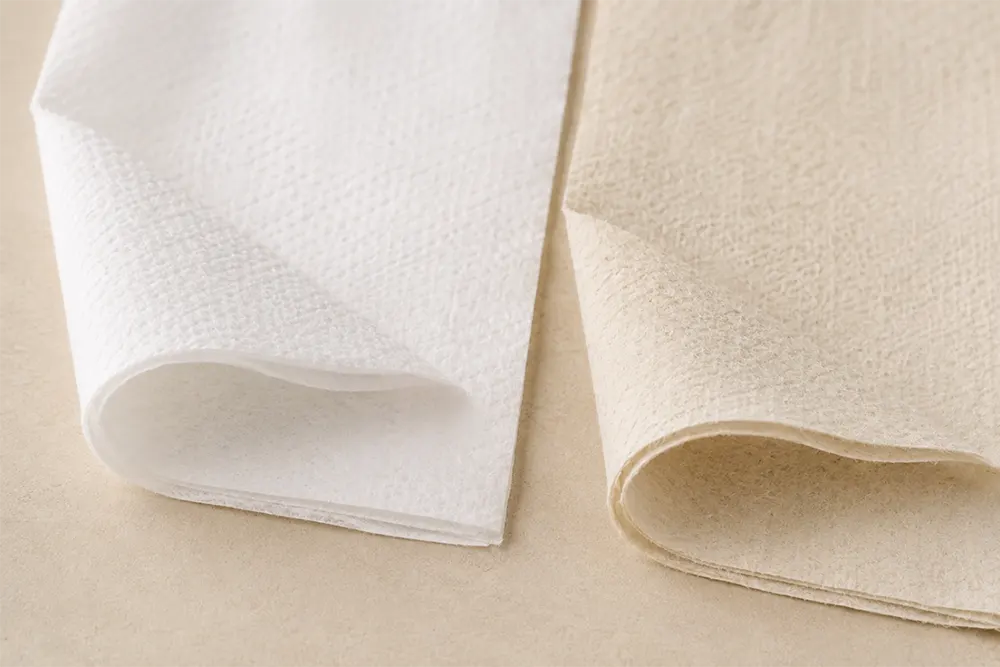
No. The perception that a “natural” or darker color automatically indicates less chemical processing is incorrect – some unbleached products still undergo processes to remove impurities or add binders, just without the final bleaching step. When assessing a product, its composition, production process, any additives, control of residual substances and manufacturer documentation matter more than the color of the finished toilet paper itself.
Can fragrances, dyes and lotions matter more than bleaching itself?
Yes, especially for people with sensitive skin. Toilet paper may contain fragrances, dyes, lotions, preservatives or other functional additives that are not directly related to pulp bleaching. Therefore, assessing the composition should not end with the question of whether the paper has been bleached; it should also include the additional ingredients in the finished product.
How can you check whether bleached toilet paper is suitable for a commercial facility?
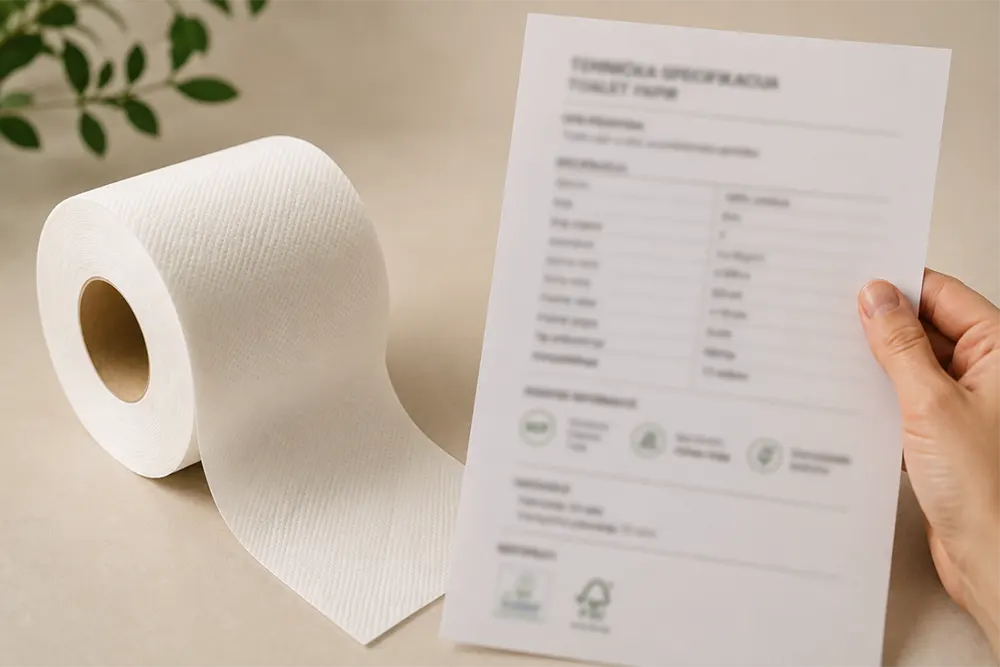
When purchasing bleached toilet paper, you should check the product’s technical documentation, fiber origin, relevant certifications and information about any fragrances, dyes or lotions. The number of plies, grammage, dispenser compatibility and consumption are also important for commercial facilities. If there is any uncertainty about the specification or suitable format, you can check additional information before making the purchase.
Does bleached toilet paper contain harmful chemicals? -FAQ
Does white toilet paper mean it was bleached with chlorine?
No. The white color does not reveal which bleaching process was used. The pulp may have been produced using the ECF process without elemental chlorine or the TCF process without chlorine compounds for bleaching. If the production method matters when purchasing the product, you should check the technical documentation or certifications for that specific product instead of drawing conclusions based solely on its color.
Is TCF toilet paper the same as unbleached paper?
No. TCF paper may be bleached, but the process does not use chlorine or chlorine compounds as bleaching agents. Unbleached paper, by contrast, has not undergone a process that further bleaches the pulp to the desired level of brightness. Therefore, “TCF” and “unbleached” describe two different product characteristics.
Is “chemical-free” a realistic label for toilet paper?
The term “chemical-free” is not an accurate description of toilet paper because cellulose fibers themselves consist of chemical compounds. While paper production involves various physical and chemical processes. It is more useful to check which specific substances were used or restricted and whether the product has appropriate documentation and relevant certifications.
The practical rule is simple: do not assess toilet paper by its color, but by the product specification.
About the author:
Milja Tonić – SEO Content Strategist & Copywriter
Milja Tonić is an SEO Content Strategist and Copywriter at LUU. In cooperation with the sales and technical teams, she prepares content about professional paper hygiene products, dispensers and hygiene management in commercial facilities.
Subscribe to the LUU newsletter and stay up to date with the latest offers.