
Table of Contents
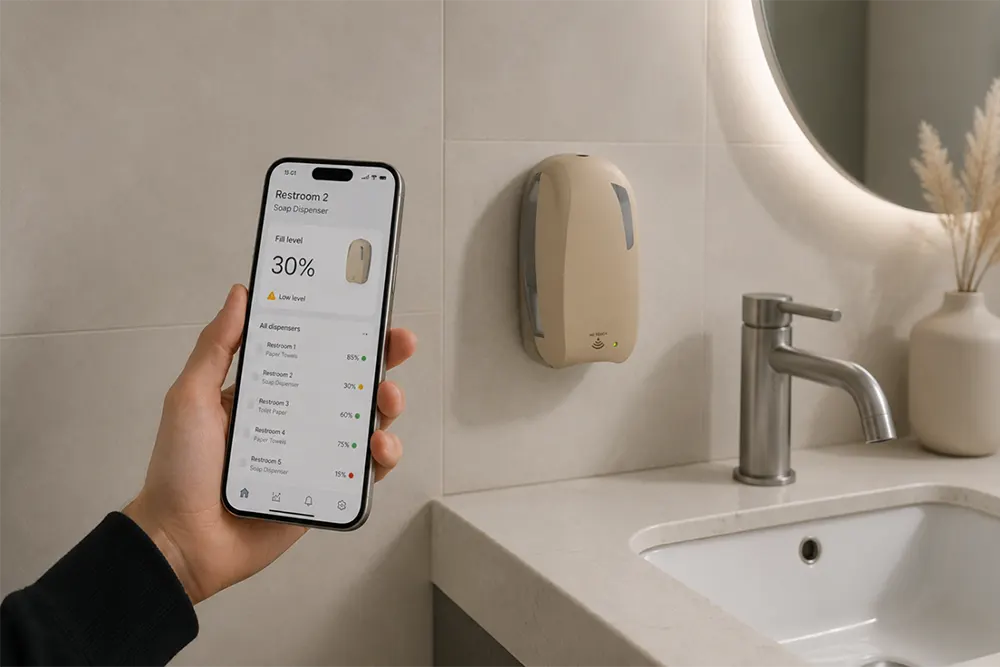
How ai and iot are transforming paper hygiene management? Smart sensors installed in dispensers monitor soap, paper towel, and toilet paper levels in real time. IoT software automatically notifies staff when supplies need replenishing. This eliminates manual inspections and prevents dispensers from running completely empty. It also enables procurement planning based on actual consumption data.
According to iso.org, IoT standards ensure device interoperability, data security, and user privacy, supporting the seamless integration of smart technologies into everyday life. Equipment compliance directly affects data accuracy and the stability of inventory monitoring systems in areas such as facility management.
IoT software is a valuable solution, but the first step is to choose professional paper hygiene products that best meet the needs of your facility. To learn how, read our blog: Paper hygiene products: A complete guide to types, systems, and applications.
What exactly does an IoT sensor installed in a dispenser monitor?
An IoT sensor installed in a dispenser monitors the fill level of toilet paper, paper towels, or soap in real time. It sends this information over the internet to a central system or application used by the maintenance staff. The sensor records every inventory level change as soon as it occurs.
In addition to the current status, the sensor collects consumption data for each individual dispenser. This allows facility managers to identify usage patterns. For example, they can determine which restroom has the highest traffic during the week. Based on these insights, they can schedule replenishment instead of relying on guesswork.
How does AI use IoT sensor data to predict consumption?
AI uses data collected by IoT sensors by analyzing historical consumption patterns for each dispenser and predicting when inventory will reach a critical level again. This approach eliminates the need for staff to rely on fixed inspection schedules, which often do not reflect the actual usage of the facility.
This approach is known as predictive maintenance. The system does not wait for the dispenser to become empty. Instead, it estimates in advance when that will happen. The prediction is based on average consumption per day, hour, or even visitor type. This significantly reduces the number of situations in which users encounter an empty dispenser.
How do customizable notification thresholds help staff in their daily work?
Customizable notification thresholds help staff in the following way: the software sends an alert through the application as soon as the material level in the dispenser falls below a predefined percentage, such as 30%, 50%, or 20%. It does not wait until the dispenser is completely empty. This gives staff enough time to respond promptly.
Different facilities have different requirements. A location with a high number of users and strict hygiene standards can set a higher threshold (50%) to allow more time for replenishment, while less frequently used facilities can set a lower threshold (20%) to optimize the number of unnecessary inspections.
Does IoT software for dispensers reduce maintenance costs?
Yes, IoT software for dispensers reduces maintenance costs. It eliminates the need for routine manual inspections of every restroom to check inventory levels. Instead, staff respond only to actual notifications. This frees up time for other tasks and reduces the number of unnecessary maintenance visits.

Is installing IoT inventory monitoring software mandatory with dispensers?
No, installing IoT inventory monitoring software is not mandatory with dispensers. These systems are usually offered as an optional solution that can be added upon request. The decision depends on the size of the facility, the number of dispensers, and the need for more detailed insights into material consumption.
Smaller facilities with fewer users can still rely on standard manual inventory monitoring without the additional cost of installing sensors. Larger business complexes, hospitals, or educational institutions with dozens of dispensers usually benefit much more from an automated system because of the size of the area that needs to be covered.
What is the difference between IoT software and an IoT sensor?
An IoT sensor is the physical component installed inside a dispenser that measures how much material remains. IoT software is the program that receives, processes, and converts this data into notifications for staff through an application. The sensor collects the information, while the software transforms it into a specific action or analysis.
Table: Comparison of traditional maintenance and AI- and IoT-powered paper hygiene management
| Traditional maintenance | AI and IoT maintenance |
| Manual inspections | Automatic monitoring |
| Fixed schedule | Predictive planning |
| Possible empty dispensers | Timely replenishment |
| Estimated consumption | Analysis of actual data |
| More inspections | Fewer inspections |
How ai and iot are transforming paper hygiene management – Benefits
AI and IoT systems for paper hygiene management provide several advantages. These include real-time inventory monitoring, automatic replenishment notifications, consumption forecasting based on historical data, and more efficient maintenance planning. As a result, they reduce the number of unnecessary inspections. They also simplify staff workflow and improve the availability of consumables in commercial facilities.
How ai and iot are transforming paper hygiene management? – Real-world experience
A large business complex with more than 120 toilet paper dispensers, paper towel dispensers, and soap dispensers relied for years on a predefined inspection schedule.
Staff checked every dispenser every day, even though many of them were almost full.
After introducing IoT sensors and software with AI-powered consumption analysis, every dispenser started sending real-time inventory data. The system automatically sent notifications whenever the material level dropped below 30%, while AI used historical data to predict which dispensers would require replenishment during the following hours.
Results after six months of use (based on the facility’s internal data):
- the number of routine inspections decreased by 38%
- no cases of completely empty dispensers were recorded in the busiest restrooms
- the time staff previously spent checking inventory was redirected to other maintenance tasks
- paper hygiene product procurement became more accurate thanks to actual consumption data instead of estimates
This example shows that the greatest value of AI and IoT systems lies not only in automatic notifications but also in data-driven decision-making. This enables more efficient facility maintenance and ensures more reliable availability of paper hygiene products for end users.
How ai and iot are transforming paper hygiene management – FAQ
Do IoT sensors for dispensers require an internet connection?
Yes, the sensors require an internet connection or a local wireless network so they can send inventory data to the central system or application. Before installation, it is necessary to verify that the facility has a stable network infrastructure.
Which facilities benefit the most from smart inventory monitoring?
Facilities with a large number of dispensers and high user traffic benefit the most, including business complexes, hospitals, educational institutions, and shopping centers, where manually checking every dispenser is time-consuming and increases the risk of oversight.
Can the notification threshold be changed later?
Yes, the notification threshold can usually be adjusted later to match the changing needs of the facility. If the selected percentage proves too high or too low, it can be modified without replacing the equipment itself.
When technology works in the background, users notice only what matters most: flawless hygiene.
About the author:
Milja Tonić – SEO Content Strategist & Copywriter
Milja Tonić is an SEO Content Strategist and Copywriter at LUU.rs, specializing in creating expert content on professional hygiene, paper hygiene products, dispensers, and facility management.
The expert articles published on this blog are the result of thorough research, an analytical approach, and professional editorial work, applying the latest SEO standards and best practices for Google Search and AI search (SGE/AI Overview).
Subscribe to the LUU newsletter and stay up to date with our latest offers.