
Table of Contents
How to choose the most absorbent paper towels? They are selected based on fiber quality, the number of plies, and the paper manufacturing process.
In addition, embossing, paper bulk, and wet strength are important. Together, these factors determine how quickly and how much liquid a paper towel can absorb and retain during use.
It is very important to choose the right paper towels that meet the needs of your business facility. To learn how to do that, read our detailed blog: Paper towels in commercial facilities: Everything you need to know about types, savings, and hygiene.
How to choose the most absorbent paper towels based on the type of commercial facility?
Paper towels with the highest absorbency should be selected according to the type of commercial facility and the intended use. Restaurants, kitchens, and production facilities require paper towels that quickly absorb large amounts of liquid and maintain their strength when wet.
For offices, schools, and administrative buildings, more economical options designed for everyday hand drying are often sufficient. When paper towels match the intended use of the facility, they improve efficiency, reduce consumption, and lower overall maintenance costs.
How many plies should a paper towel have for the best absorbency?
The number of plies directly affects the absorbency of paper towels, but it is not the only factor. The paper manufacturing technology has an equally significant impact. Two-ply and three-ply paper towels retain more liquid per sheet thanks to their larger surface area for capillary water retention. Single-ply models allow liquid to pass through more quickly and require more frequent replacement.
A higher number of plies also increases the wet strength of the paper towel. This is especially important when wiping up thicker or greasier liquids in the food service and manufacturing industries.
A study published in the journal BioResources examined this topic. It found that absorbency and wet strength are the two characteristics that have the greatest impact on the actual performance of paper towels during use.
Do cellulose fibers absorb better than recycled paper?
The composition and structure of the fibers affect the absorbency of a paper towel, but they are not the only factors. The arrangement of the fibers, as well as the size and distribution of the pores between them, determine how liquid moves through the paper by capillary action. They also determine how much water the paper towel can retain. 100% cellulose paper towels generally provide greater softness, more consistent quality, and better wet strength. The characteristics of recycled paper towels may vary depending on the fiber quality and the manufacturing technology.
For kitchens and areas where large amounts of liquid are frequently spilled, cellulose paper towels are often the more reliable choice. They offer an excellent combination of absorbency and wet strength.
Industrial workshops and production halls have different requirements because they need to absorb not only water but also grease and machine oils. For this reason, industrial paper towels with a stronger, textured structure withstand intensive wiping more effectively. Recycled paper remains an economical and more environmentally friendly option where maximum absorbency is not essential.
How does capillary action affect liquid absorption in paper towels?
Capillary action is the physical process by which a paper towel draws liquid through microscopic channels between cellulose fibers without the need for external pressure. The more numerous and evenly distributed these channels are, the faster and more evenly the liquid is absorbed, allowing the sheet to retain a larger amount of liquid before leakage or breakthrough occurs.
This explains why two paper towels with the same basis weight can have completely different absorbency: the density and arrangement of the fibers are far more important than the weight of the paper itself. That is why manufacturers of premium paper towels focus more on fiber structure and manufacturing technology than simply increasing the number of plies or the paper weight.
What actually determines the absorbency of a paper towel?
The absorbency of a paper towel depends on a combination of fiber quality, the number of plies, paper bulk, embossing, fiber arrangement, and wet strength. None of these characteristics alone is a sufficient indicator of quality. Only their combined effect determines how quickly and how much liquid a paper towel can absorb.
How to test the absorbency of paper towels before purchasing?
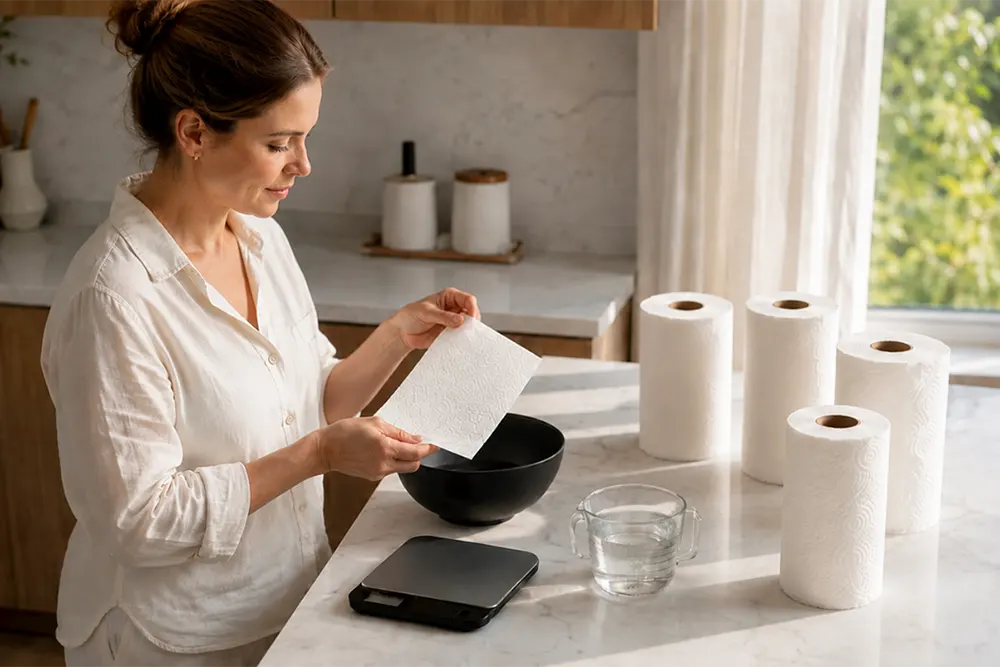
The absorbency test is carried out by:
- placing a sheet of paper towel in a shallow container and gradually pouring water over it until it is completely saturated
- then measuring the amount of liquid absorbed
- a smaller number of sheets needed to clean the same amount of spilled liquid is a reliable indicator of higher absorbency and lower long-term consumption
A simple preliminary test before signing a paper towel supply contract: pour the same volume of water onto one sheet of each paper towel and compare the time required for complete absorption and the surface area covered by the liquid.
Does embossing improve the absorbency of paper towels?
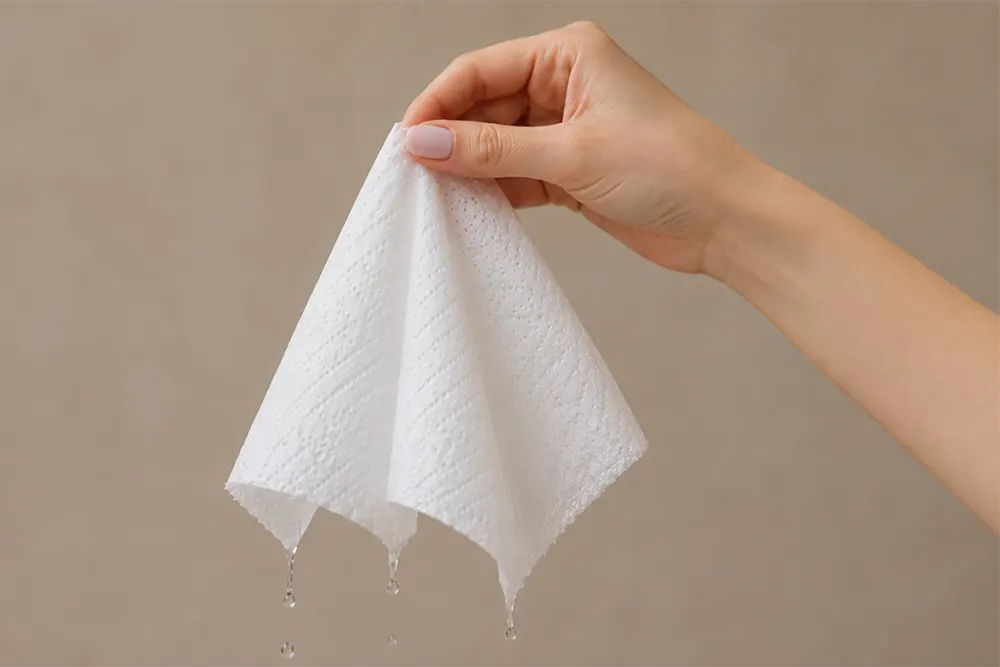
Embossing, the textured pattern on the surface of the paper, increases the contact area of the sheet and the number of micro-pockets that retain liquid. In addition, embossing increases the paper bulk and creates a more favorable porous structure. This can contribute to a higher absorbency capacity compared to completely smooth paper. Paper towels with a more pronounced embossed texture often provide a better balance of absorbency, softness, and wet strength.
This characteristic is especially evident in premium product lines designed for HoReCa facilities. They combine high absorbency with a more pleasant user experience and a professional product appearance.
Are absorption speed and absorption capacity the same?
Absorption speed indicates how quickly a paper towel draws liquid from a surface. Absorption capacity refers to the total amount of liquid that a sheet can retain before becoming saturated. A paper towel may begin absorbing liquid quickly while still having a low overall capacity. That is why you should consider both characteristics when making your choice.
Absorption speed is important for hand drying and quickly cleaning small spills. High absorption capacity is more important in kitchens, restaurants, and areas where larger amounts of liquid are cleaned regularly.
How to carry out a comparable absorbency test?
For each paper towel, take a sheet of the same size and measure its weight while dry. Immerse it in water under identical conditions, then allow the excess water to drain for the same period of time. After that, weigh it again. The difference between the wet and dry weight indicates the approximate amount of water retained.
In addition to capacity, measure how long the paper towel takes to absorb a specific amount of water and check whether it tears during wiping. For more reliable results, repeat the test at least three times and compare the average values.
Table: How to evaluate the quality of a paper towel before purchasing
| What to check? | Good sign | Poor sign |
| Absorbency | Absorbs and retains liquid quickly | Liquid remains on the surface |
| Wet strength | Does not tear when wet | Falls apart during the first wipe |
| Number of sheets required | 1–2 sheets for the same task | Requires more sheets |
| Embossing | Pronounced textured pattern | Completely smooth paper |
| Fibers | Consistent structure and quality | Rough structure and inconsistent quality |
How to choose the most absorbent paper towels – Practical experience: An international restaurant in Vršac
Problem: A large international restaurant in Vršac, serving around 250 guests per day, experienced high paper towel consumption because the towels quickly became saturated and tore apart. As a result, both employees and guests often used more sheets than necessary.
Solution: After a trial period, the restaurant introduced two-ply 100% cellulose kitchen paper towels with pronounced embossing and greater wet strength.
Result: Over the following three months, average paper towel consumption decreased by approximately 24%, while the staff reported that liquid spills were cleaned up faster and with fewer sheets.
How to choose the most absorbent paper towels – FAQ
Does a higher number of plies always mean better absorbency?
Not always. The number of plies helps, but the paper manufacturing technology and fiber quality often have a greater impact than the thickness of the sheet itself.
Can recycled paper provide satisfactory absorbency?
Yes, for lighter tasks such as wiping tables or drying hands. However, for intensive cleaning in kitchens, cellulose paper towels remain the more reliable choice.
Does paper basis weight determine absorbency?
Paper basis weight is one of the factors that affects the characteristics of a paper towel, but it is not, by itself, a sufficient indicator of its absorbency. Overall performance also depends on fiber quality, the number of plies, paper bulk, embossing, and the manufacturing process.
How can you identify a paper towel that will tear when wet?
A paper towel that tears easily when wet usually has lower wet strength. A simple way to check is to wet a sheet and try wiping a surface with it. If it maintains its shape without falling apart or leaving fibers behind, it is a higher-quality product.
Which is more important: absorption speed or absorption capacity?
Both characteristics are important because they serve different purposes. Absorption speed determines how quickly a paper towel removes liquid from a surface. Absorption capacity indicates the total amount of liquid it can retain. For professional use, the best choice is a paper towel that offers a good balance of both properties.
Does embossing only improve the appearance of a paper towel?
No. Embossing does more than improve the appearance of the paper. It also increases the paper bulk and creates a textured structure that can improve the distribution and retention of liquid. As a result, high-quality embossed paper towels often provide greater absorbency and a more pleasant user experience.
Fewer sheets. Greater performance.
A highly absorbent paper towel is not measured by its thickness but by its performance. When a single sheet does more, you save time, materials, and costs. That is where a smarter choice begins.
Subscribe to the LUU newsletter and stay up to date with the latest offers.