
Table of Contents
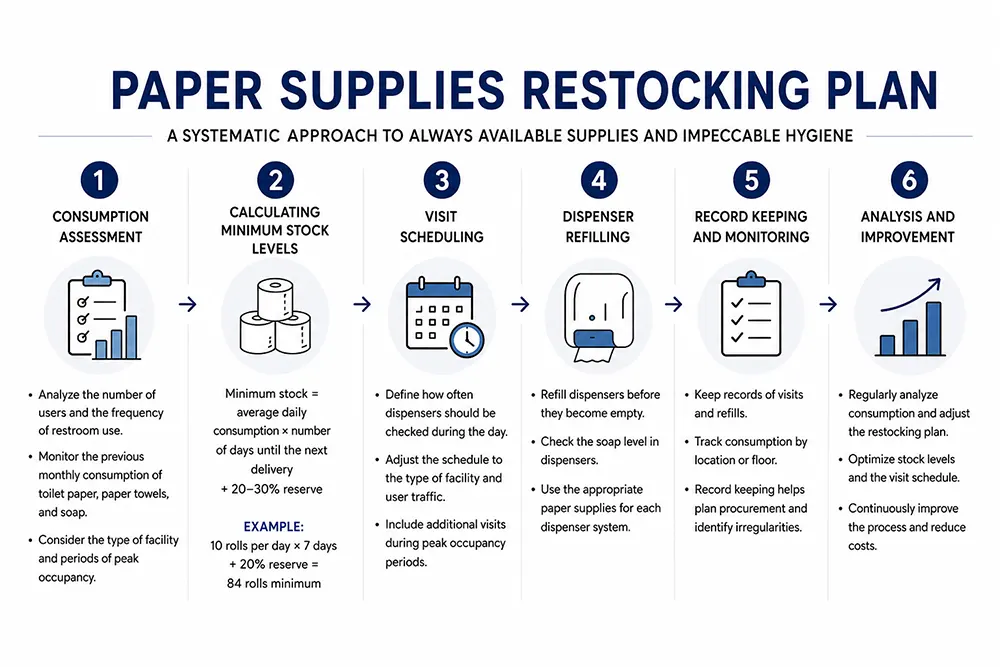
A paper supplies restocking plan for commercial buildings is created through several steps. These include analyzing consumption and determining the inspection schedule. It also includes defining minimum stock levels and assigning responsibilities to personnel responsible for replenishing paper towels and toilet paper. Such a plan ensures that toilet paper, paper towels, and soap are available at all times. The result is fewer emergency restocking tasks and more efficient maintenance.
According to minrzs.gov.rs, employers are required to provide employees with appropriate hygiene conditions in the workplace, including regular restroom restocking.
If you want to learn which paper supplies are necessary for a commercial building to operate efficiently, read our comprehensive blog: Paper supplies: A complete guide to types, systems, and applications
What should a paper supplies restocking plan for commercial buildings include?
A paper supplies restocking plan for commercial buildings should include a dispenser inspection schedule and a consumption assessment. It should also include minimum stock levels, responsible personnel, and procedures for ordering consumable supplies. Clearly defined steps enable timely replenishment. They also improve work organization and maintain hygiene standards throughout the commercial building.
A paper supplies restocking plan should also include:
- checking the quantity of toilet paper during every inspection
- checking paper towels
- reporting damaged or malfunctioning dispensers
- reporting low stock levels before supplies run out
Paper supplies restocking plan for commercial buildings – How to estimate consumption?
Paper supplies consumption is estimated based on:
- the number of users
- the frequency of restroom use
- the type of facility
- previous monthly consumption of paper towels and toilet paper
Analyzing this data enables more accurate purchasing and restocking planning, reducing unnecessary costs and the risk of shortages.

How do you determine how often dispensers should be restocked?
The frequency of dispenser restocking depends on several factors. These include the number of users, dispenser capacity, and the intensity of facility usage. In busy commercial buildings, inspections are often required several times a day. In smaller offices, replenishment once a day or according to actual consumption is sufficient.
How do you calculate the minimum stock of paper supplies?
The minimum stock of paper supplies is calculated using the following formula: average daily consumption × the number of days until the next delivery. A reserve of 20% to 30% is then added to cover unexpected increases in consumption or delivery delays.
For example, if the daily consumption is 10 rolls of toilet paper and deliveries are made every 7 days, the minimum stock is 70 rolls. With the additional reserve, the recommended stock ranges from 84 to 91 rolls.
How much interfold toilet paper does a company with 100 employees use per day?
One pack of interfold toilet paper contains 200 sheets. A company with 100 employees consumes an average of about 9 packs per day when the paper is dispensed through controlled dispensers. Without dispensers, consumption can increase to approximately 13.5 packs per day. This happens because users take more sheets each time they use the paper.
Toilet paper consumption depends on user habits as well as the dispensing method. Dispensers limit the amount of paper dispensed with each pull. Open packs often result in users taking more sheets than necessary.
Calculation assumptions:
- 100 employees
- an average of 3 restroom visits per person per day
- one pack contains 200 sheets
| Usage method | Average sheets per use | Daily consumption | Packs of 200 sheets |
| Toilet paper in a dispenser | 6 | 1,800 sheets | 9 |
| Toilet paper without a dispenser | 9 | 2,700 sheets | 13.5 |
How much paper towel is used daily in a company with 100 employees?
One pack of interfold paper towels contains 200 sheets. A company with 100 employees uses an average of about 3 packs per day when the towels are dispensed through dispensers. Without dispensers, consumption can increase to approximately 6 packs per day. This happens because users take more towels than they actually need.
The dispensing method has a significant impact on total paper towel consumption. Dispensers provide controlled dispensing of one or two towels at a time. Open packs often lead to unnecessary waste.
Calculation assumptions:
- 100 employees
- an average of 3 hand washes per person per day
- one pack contains 200 interfold paper towels
| Usage method | Average towels per hand wash | Daily consumption | Packs of 200 sheets |
| Interfold paper towels in a dispenser | 2 | 600 sheets | 3 |
| Interfold paper towels without a dispenser | 4 | 1,200 sheets | 6 |
Table: Example of a paper supplies restocking plan
| Facility type | Dispenser inspection | Restocking | Stock check | |
| Office (up to 50 employees) | Once a day | As needed | Once a week | |
| Office building | 2–3 times a day | Daily | Twice a week | |
| Hotel | Several times a day | As needed | 2–3 times a week | |
| Restaurant or café | 2–4 times a day | Daily | Twice a week | |
| Healthcare facility | Several times a day | Continuous | Daily | |
| School or university | Before classes and during breaks | Daily | Twice a week |
What determines the frequency of paper supplies restocking?
The frequency of restocking depends on several factors. These include the number of employees and visitors, the restroom layout, the type of dispenser, the intensity of facility use, and the type of paper supplies. The higher the user traffic, the more frequent the inspections should be. Timely replenishment then becomes even more important for maintaining hygiene.
Are paper towels consumed faster than toilet paper?
Yes, in most commercial buildings, paper towels are consumed faster than toilet paper because people use them after every hand wash. For this reason, paper towel dispensers should be checked more frequently, especially during peak usage periods.
When should restocking be carried out during working hours?
If paper supplies run out during the day, replenishing them only after working hours is often not enough. Facilities with heavy user traffic require regular inspections throughout the day. Their purpose is to check restrooms, common areas, and the availability of consumable supplies.
What are the most common mistakes when planning paper supplies restocking?
The most common mistakes are irregular dispenser inspections and inaccurate consumption estimates. Other mistakes include insufficient stock levels and waiting until the paper runs out before replenishing it. This approach increases the number of emergency restocking tasks. It also leads to user dissatisfaction and unnecessary maintenance costs.
Who should be responsible for paper supplies restocking?
Paper supplies restocking is usually the responsibility of the cleaning staff or the facility management team. Clearly defined responsibilities and an inspection schedule ensure regular checks. They also enable faster responses to increased consumption and maintain consistent restroom maintenance standards.
How do you create a paper supplies restocking schedule for different facility types?
A paper supplies restocking schedule should be adapted to the type of facility, the number of users, and peak usage periods. Office buildings, schools, healthcare facilities, and hospitality venues all have different requirements. For this reason, the restocking plan should be based on actual usage patterns rather than applying the same schedule to every facility.
How do you track paper supplies restocking digitally?
Digital tracking of paper supplies restocking includes using checklists, mobile applications, or facility management software. Some smart software solutions can monitor stock levels inside dispensers. They can also send notifications to staff when consumable supplies fall below 30%. Keeping records of inspections, consumption, and restocking simplifies purchasing planning. It improves work organization and helps reduce unnecessary costs.
Case study: Multi-tenant business center in Niš
Problem
A business center with approximately 250 employees and daily visitors experienced frequent shortages of toilet paper and paper towels. Staff replenished supplies only after users reported that they had run out. As a result, some dispensers remained empty during working hours.
Solution
The following restocking plan was introduced:
- restroom inspections three times a day
- defined minimum warehouse stock levels
- a designated person responsible for dispenser inspection and replenishment
- consumption records for each floor
Results after 3 months
- the number of emergency restocking tasks decreased by 68%
- no paper supply shortages were recorded during working hours
- better purchasing planning and lower excess warehouse stock
- less time required for routine restroom maintenance
Paper supplies restocking plan for commercial buildings – FAQ
How can you prevent dispensers from running empty during working hours?
The best approach is to introduce regular inspections, monitor consumption, and replenish supplies before dispensers become empty. Checklists and a predefined restocking schedule further reduce the possibility of missed replenishment.
How do you keep records of paper supplies consumption?
You can keep records by using checklists, Excel spreadsheets, or facility management software. Recording consumption regularly makes purchasing planning easier and helps optimize stock levels.
Do different types of facilities require different paper supplies restocking plans?
Yes. Office buildings, schools, healthcare facilities, hotels, and hospitality venues have different numbers of users and different usage intensity. For this reason, tailor the restocking plan to the specific needs of each facility.
The best-managed facilities do not think about restocking when the paper runs out. They think about it long before that. That is where professional solutions begin.
Subscribe to the LUU newsletter and stay up to date with our latest offers.