
Table of Contents
How to track paper product consumption across locations? A practical approach is to centrally record consumption for each location separately, with a unified overview that allows comparison. Companies that rely on separate, disconnected records for each facility find it harder to gain a unified overview of consumption because they cannot easily compare actual consumption with planned consumption or identify where surpluses or shortages occur.
Before tracking consumption, it is necessary to go back to the beginning and choose appropriate professional paper products according to the needs of the business facility. That is why it is useful to read our blog: Paper products: A complete guide to types, systems and applications.
Why is paper product consumption difficult to track when a company has multiple locations?
Consumption is difficult to track because each location usually keeps its own records instead of using one shared system.
The most common reasons are:
- Different spreadsheets for each location: each facility uses its own format, which makes it difficult to compare or consolidate the data
- Different people responsible for ordering: each location has a different employee who decides when and how much to order, without insight into what the other locations are doing
- No records at some locations: some facilities do not track consumption at all and instead place orders based on estimates when they notice that something is running low
When data is not connected, so-called “data islands” emerge – information exists, but locations do not automatically synchronize it. As a result, management often:
- has no basis for joint negotiations with the supplier because it does not know the total quantities used across all locations
- finds it difficult to plan the paper product budget in advance because costs across locations are not automatically consolidated
- has no clear answer to the question of how much the company spends in total each month
What are the signs that a company is losing control over consumption across multiple locations?
The clearest sign is when two opposite situations occur at the same time: one location urgently orders additional paper products because it is running out, while another location has a large amount of unused stock sitting in storage. Another warning sign appears when the answer to the question “How much does the company spend each month?” depends on whom you ask, instead of coming from one reliable source of data for all locations.
How can you centralize consumption data from all business locations?
Centralization starts with a simple step. Each location regularly (for example, once a month) reports the quantity used for each product category in a shared spreadsheet or system instead of storing the data locally.
When management can see the consumption of all facilities in one place, it can identify deviations more easily, plan joint procurement and consolidate the needs of multiple locations as a basis for negotiations with the supplier.
ISO 20400:2017, the international standard for sustainable procurement, provides organizations with guidelines for managing procurement processes more systematically. This approach can be particularly useful for companies with multiple locations because it allows them to assess data on needs and consumption as part of a shared procurement process.
Table: What data should you track for each business location?
| Data | Why is it important? | Example |
| Location name | Allows comparison between facilities | Belgrade, Novi Sad, Niš |
| Number of employees or users | Allows consumption to be compared with the number of users | 120 employees |
| Product category | Makes it easier to track each type of paper product | Toilet paper, paper towels, disposable toilet seat covers |
| Opening stock level | Provides the basis for calculating consumption | 30 packs |
| Quantity received | Records new deliveries | 15 packs |
| Quantity consumed | Shows actual consumption | 18 packs |
| Closing stock level | Shows the remaining quantity and helps plan the next replenishment | 27 packs |
| Record date | Allows monthly comparisons | August 2026 |
Should each location have its own replenishment plan or should all locations use one system?
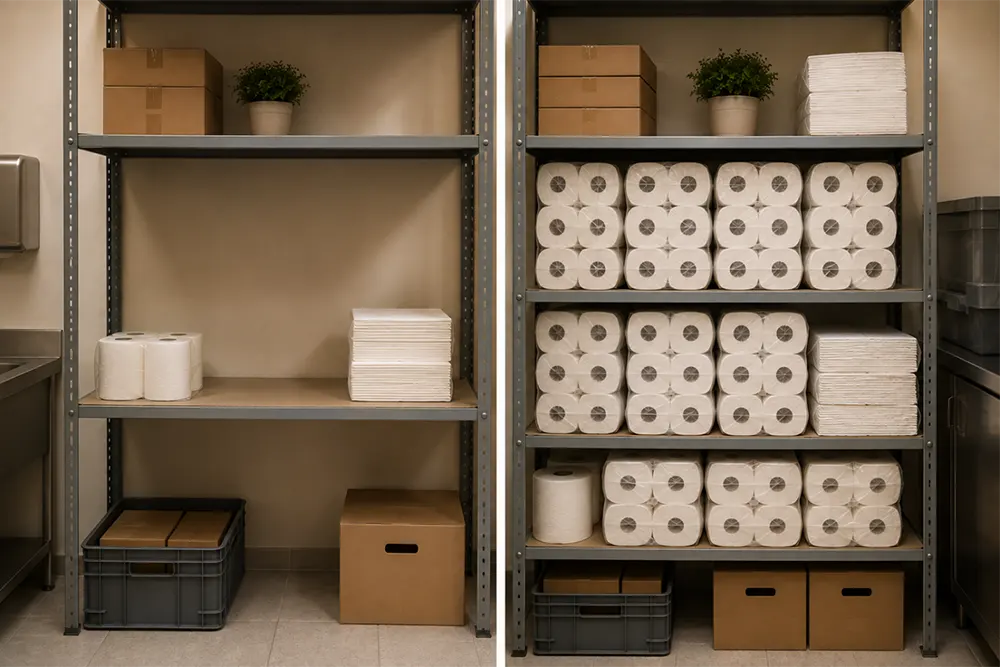
Both. The company should use one unified record-keeping system, but it should tailor the replenishment plan to each location. An office with 20 employees and a restaurant with a high daily volume of guests have completely different consumption patterns, so applying the same ordering rules to every facility usually creates excess stock at one location and shortages at another.
Example of how centralized records make procurement planning easier
The example shows three restaurants from the same chain with different monthly guest volumes. The figures are illustrative and demonstrate how procurement planning works.
| Location | Average number of guests per month | Opening stock (packs of toilet paper) | Delivery received | Consumed during the month | Closing stock | Conclusion |
| Belgrade Restaurant | around 6,000 | 18 | 20 | 31 | 7 | A higher number of guests corresponds with higher recorded consumption – consider a larger next delivery. |
| Novi Sad Restaurant | around 4,800 | 20 | 20 | 26 | 14 | Recorded consumption falls between the other two locations – keep the current plan and monitor the next period. |
| Niš Restaurant | around 3,600 | 22 | 20 | 20 | 22 | A lower number of guests corresponds with lower recorded consumption – consider a smaller next delivery. |
Consumption data provides the greatest value when a company turns it into a specific procurement plan for each location. For companies that want to coordinate supply quantities and schedules across multiple facilities, the next step can be a procurement proposal based on facility requirements.
How to track paper product consumption for companies with multiple business locations – FAQ
Do companies need specialized software to track consumption across multiple locations?
Not necessarily, especially for companies with a smaller number of facilities. A simple shared spreadsheet with a clear structure for each location and product category may be sufficient. Specialized tools become useful only when the number of locations and the volume of consumption make manual tracking difficult.
Should all locations order paper products at the same time?
Not necessarily. Consolidating the needs of multiple locations can allow a company to order larger total quantities and create a stronger basis for negotiations with the supplier.
Does a larger number of locations automatically mean higher paper product costs per employee?
Not necessarily. The number of locations alone does not determine the cost of paper products per employee. Consumption, product type, number of users, replenishment frequency and procurement terms all affect costs. Centralized records make it easier to identify and analyze differences between locations.
How does a company know when it is time to introduce centralized consumption tracking?
If the answer to how much the company spends on paper products each month depends on which employee you ask, or if urgent orders at individual locations keep recurring month after month, this may indicate that the existing record-keeping system no longer provides a sufficiently reliable overview of the company’s actual needs.
For companies with multiple business locations, the difference between efficient and inefficient procurement often depends not only on the quantity of paper products purchased but also on the quality of the data used to make decisions. When a company tracks consumption systematically, it can plan future procurement more accurately and manage inventory more easily.
About the author:
Milja Tonić – SEO Content Strategist & Copywriter
Milja Tonić is an SEO Content Strategist and Copywriter at LUU. In cooperation with the sales and technical teams, she creates content about professional paper products, dispensers and hygiene management in business facilities.
Subscribe to the LUU newsletter and stay up to date with the latest offers.