
Table of Contents
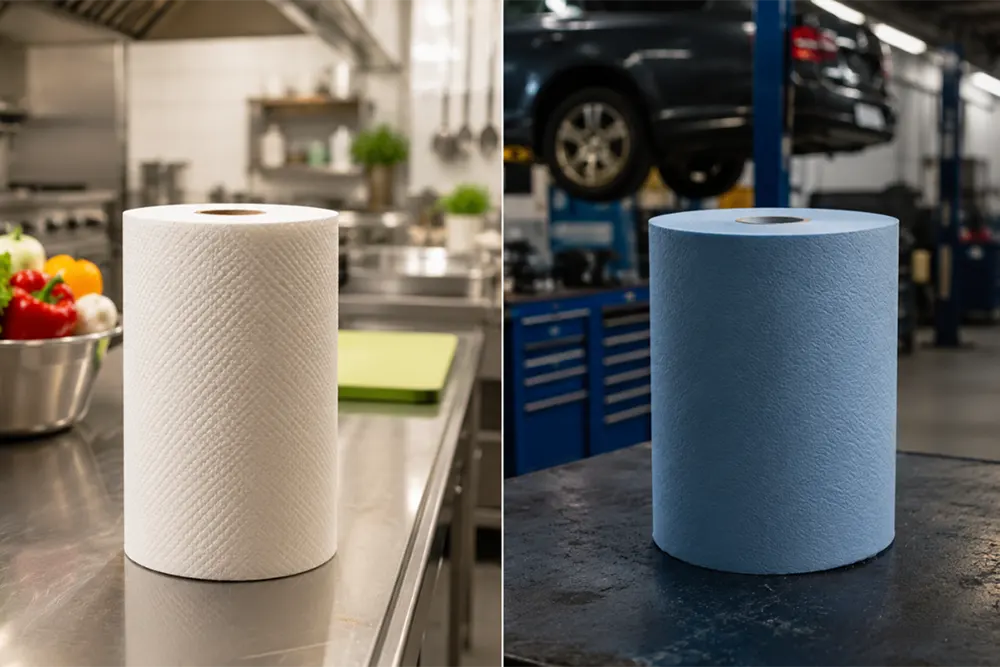
Kitchen paper towels vs industrial paper towels? The main difference between kitchen and industrial paper towels lies in their composition and format. Manufacturers make kitchen paper towels from 100% cellulose in smaller rolls for controlled use, while industrial paper towels use recycled fibres and come in much larger rolls designed for high consumption in production and service environments.
Tappi.org, the website of the international association for the pulp and paper industry, defines standardised test methods for measuring basis weight, absorbency and the strength of paper products, including paper towels. These parameters, rather than the stated intended use alone, determine the actual difference between kitchen and industrial paper towels.
If you are interested in the composition and intended use of other types of paper towels, read more on our blog: Paper towels in commercial facilities: Everything you need to know about types, savings and hygiene.
What are kitchen paper towels made from?
Manufacturers make kitchen paper towels from 100% cellulose – virgin fibres that have not previously been used or recycled. These fibres retain their full length and natural strength, which gives the product better absorbency and softness, while its composition makes it suitable for direct contact with food in kitchens and catering facilities.
What are industrial paper towels made from?
Manufacturers make industrial paper towels from recycled material – fibres that have already undergone one or more processing cycles, making them shorter and weaker than cellulose fibres. Despite this, they remain strong enough for general use in production and service areas, where cost efficiency and a large roll format take priority over the food-safe composition required in facilities that prepare or serve food.
Do industrial and kitchen paper towels use dispensers?
No. Both types are used independently, without dispensers. Industrial paper towels are intended for workshops, warehouses and production facilities where workers need to wipe larger surfaces quickly and directly. Kitchen paper towels are used in the same way, directly from the roll in kitchens and catering facilities, without the need for additional dispensing equipment.
Are industrial paper towels stronger than kitchen paper towels?
Not necessarily. Industrial paper towels are not automatically stronger simply because they are intended for more demanding working conditions. The recycled fibres in industrial paper towels are shorter and weaker than virgin cellulose fibres, but their slightly higher basis weight (22 compared with 20 grams per square metre per ply) partly compensates for this difference. This gives industrial paper towels sufficient strength to remove oil and heavier dirt, although they do not match the softness and precise absorbency of kitchen paper towels made from pure cellulose.
Why do industrial paper towels come in much larger rolls?
Industrial paper towels come in rolls weighing up to 4 kilograms, while kitchen paper towels usually come in rolls weighing around 300 grams. The larger format reduces how often workers need to replace rolls in high-consumption environments such as production facilities and workshops, where frequent replacement of smaller rolls is inefficient and slows down work.
Table: Comparison of kitchen and industrial paper towels
| Feature | Kitchen paper towel | Industrial paper towel |
| Composition | 100% cellulose | Recycled material |
| Basis weight per ply | 20 g/m² | 22 g/m² |
| Number of plies | 2 | 2 |
| Roll weight | 300 g | up to 4,000 g |
| Intended use | Food contact, catering | General cleaning, production facilities, workshops |
Table: Which paper towel should you choose for each situation?
| Situation | Kitchen paper towel | Industrial paper towel |
| Wiping up water and spilled drinks | ✓ | ✓ |
| Kitchen work | ✓ | |
| Food contact | ✓ | |
| Wiping oil and lubricants in a workshop | Suitable, but not economical | ✓ |
| Cleaning work surfaces in production areas | Suitable | ✓ |
| High daily consumption | Less practical format | ✓ |
| When softness matters | ✓ | Less important |
| When cost efficiency by quantity matters | ✓ |
How to choose the right type of paper towel for a commercial facility?
The choice depends on whether the paper towel comes into contact with food and how much the facility uses. Kitchens, food preparation areas and catering facilities require kitchen paper towels made from 100% cellulose, while production facilities, workshops and service areas with high general consumption benefit more from economical industrial paper towels in large rolls.
Not sure which format suits your needs? We will recommend a solution tailored to your facility.
Recommended products
Kitchen paper towel: 100% cellulose, 2 plies, 300 g roll
Industrial paper towel: recycled material, 2 plies, roll up to 4 kg
Kitchen paper towels vs industrial paper towels – FAQ
Can industrial paper towels replace kitchen paper towels in catering facilities?
No. Industrial paper towels are not certified as food-safe for surfaces and items that come into contact with food because manufacturers make them from recycled fibres without this certification. They can be used for general cleaning outside the kitchen area, such as floors or technical rooms, but not for food preparation or serving.
What should you consider if a facility has both a kitchen and a production area?
The safest option is to purchase both types separately and clearly define where staff should use each one – kitchen paper towels exclusively in areas that come into contact with food, and industrial paper towels in technical and production areas. Mixing their intended uses increases the risk of using an unsuitable product where food safety is a mandatory requirement.
Do kitchen and industrial paper towels differ in colour?
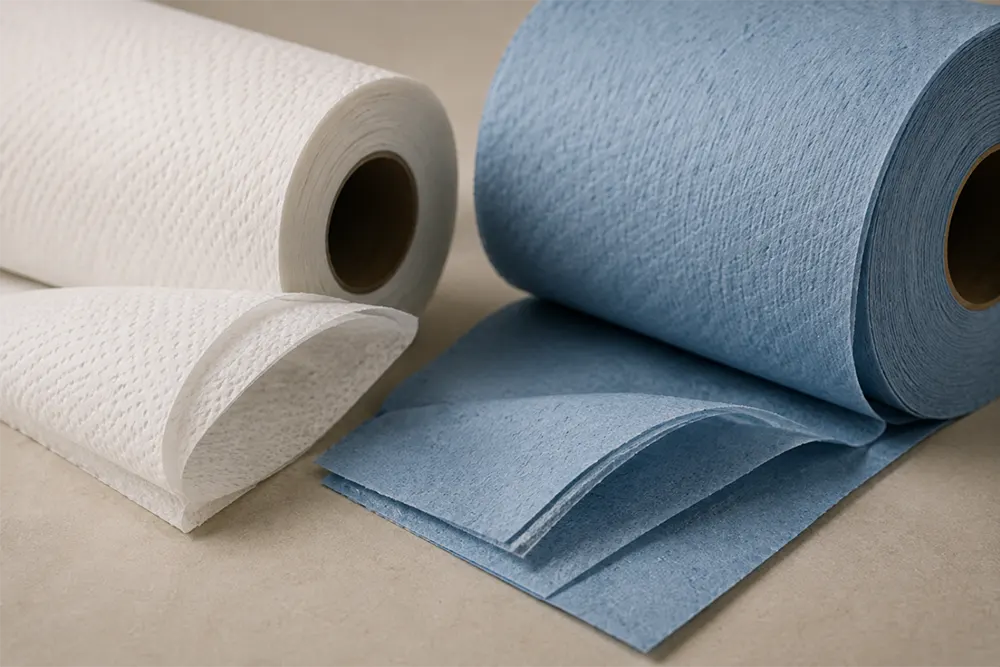
Yes. Kitchen paper towels are white, in line with their pure 100% cellulose composition and food-safe purpose. Industrial paper towels are blue – a convention commonly used in the cleaning industry, where the blue colour provides a clear visual distinction between products used for technical cleaning and those intended for food-related use, while also concealing traces of oil and grease more effectively during use.
Are industrial paper towels cheaper per kilogram than kitchen paper towels?
Generally, yes. Recycled fibres cost less than virgin cellulose, while the larger roll format further reduces packaging and transport costs per unit of weight. For this reason, industrial paper towels are generally the more economical choice for facilities with high daily consumption where a food-safe composition is not necessary.
Choosing the right paper towel is not only about price, but also about efficiency. When the format matches actual consumption, staff replace rolls less often, experience fewer interruptions and avoid unnecessary material waste.
The right paper towel works in the background – without creating extra work for you.
About the author:
Milja Tonić – SEO Content Strategist & Copywriter
Milja Tonić is an SEO Content Strategist and Copywriter at LUU. Working with the sales and technical teams, she creates content about professional paper hygiene products, dispensers and hygiene management in commercial facilities.
Subscribe to the LUU newsletter and stay up to date with the latest offers.