
Table of Contents
Number of paper plies affects thickness, softness, and the feel during use, but it is not the only indicator of quality. Absorbency and overall consumption are often influenced more by the basis weight, fiber density, and wet strength of toilet paper and paper towels. Choosing the right paper can reduce consumption and optimize costs in commercial facilities.
According to iso.org, standardized methods for testing the absorbency of tissue paper are based on measuring absorption capacity and absorption rate, rather than the number of plies in tissue paper products.
To make a successful purchase of tissue paper products, you need to understand the product characteristics and their key benefits for your type of commercial facility. We therefore recommend reading our detailed blog: Tissue paper products: A complete guide to types, systems, and applications.
What does the number of paper plies mean, and why does it matter in professional use?
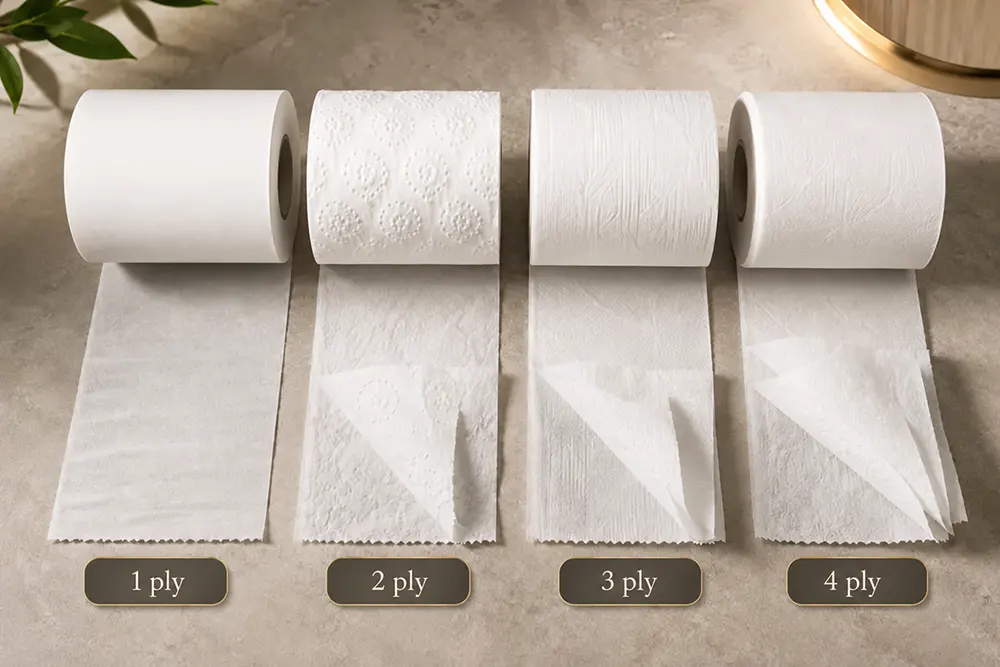
The number of paper plies indicates how many thin sheets are bonded together to create a single product. This characteristic affects thickness, softness, and the feel during use, but it does not determine quality on its own. In professional use, what matters more is how the paper performs in everyday operations and its actual consumption.
People responsible for purchasing professional toilet paper and paper towels often assume that more plies always mean a better choice. The reality is more complex. The paper basis weight, fiber density, and ply lamination technique determine actual performance just as much as, or even more than, the number of plies itself.
How does the number of paper plies affect absorbency?
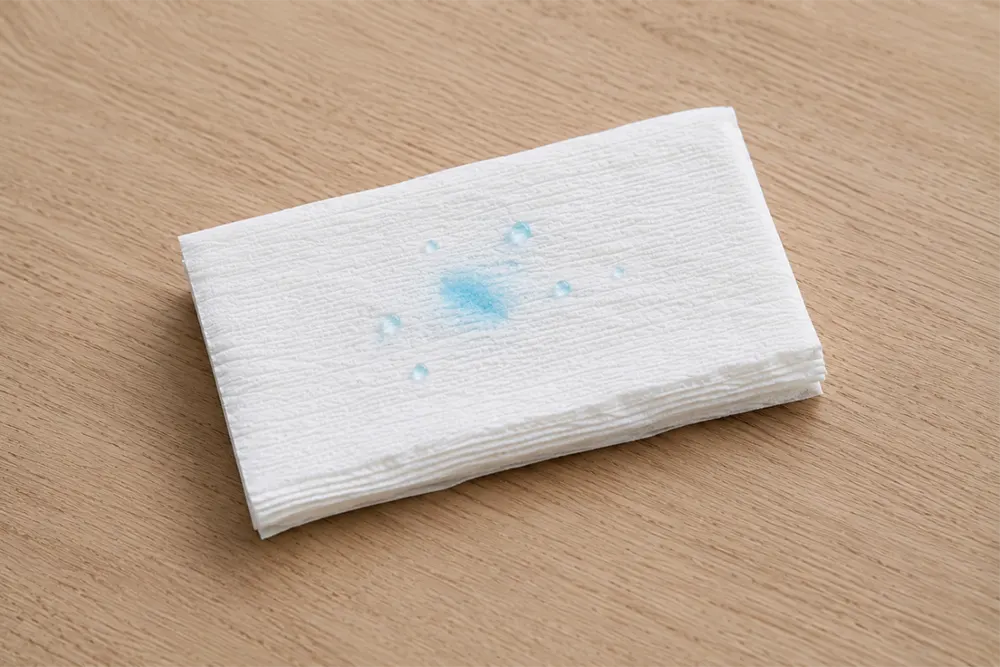
The number of paper plies can contribute to higher absorbency, but it is not the decisive factor. Fiber quality, basis weight, and the way the plies are bonded determine how quickly and efficiently the paper absorbs liquid. As a result, a high-quality single-ply paper can outperform a lower-quality two-ply or three-ply product.
A scientific analysis published in BioResources confirms that the wet strength of tissue paper has a strong correlation with absorbency and wiping performance, while paper softness has no significant relationship with user preference under professional conditions. This means that the fiber structure, rather than the number of plies itself, is the key performance factor.
How does the number of paper plies affect consumption in commercial facilities?
The number of paper plies affects consumption indirectly through user behavior. Thinner, single-ply toilet paper and paper towels with a weaker structure encourage users to pull more sheets per visit to compensate for the lack of strength. This habit can eliminate the savings expected from a lower ply count stated on the product label.
Consumption analyses show that users pull approximately twice as many sheets of single-ply paper as two-ply paper on average to achieve the same sense of security and hygiene. When single-ply paper is of lower quality, this behavioral difference significantly reduces the initial purchasing savings, as higher consumption also increases the frequency of dispenser refills and staff involvement.
Simply reducing the sheet size without improving fiber density rarely leads to lower actual consumption. Instead, users fold the paper multiple times or pull additional sheets to achieve the same tangible feel they are accustomed to.
Basis weight vs. number of paper plies: Which is more important for performance?
Basis weight is a more reliable indicator of paper performance than the number of paper plies alone. A higher basis weight usually provides greater strength, better absorbency, and lower consumption per user. For this reason, professional purchasing should consider both parameters, with particular emphasis on basis weight.
Suppliers that clearly specify the basis weight per ply make it easier to compare products from different manufacturers objectively. A facility that compares only the number of paper plies without considering basis weight is comparing incomplete data. This difference becomes especially evident in high-traffic dispenser systems, where every avoided refill directly reduces maintenance costs.
How do you choose the right number of paper plies for your facility?
The right number of paper plies depends on the type of facility, the intensity of use, and the expected user experience. Rather than basing the decision solely on the number of plies, compare the basis weight, the wet strength of paper towels and toilet paper, dispenser compatibility, and actual consumption during use.
Table: Number of paper plies: When is each option the better choice?
| Number of paper plies | Absorbency | Consumption | User comfort | Recommended application |
| 1 ply | Depends on basis weight and fiber quality | May be higher if the paper is of lower quality | Lower | Gas stations, industrial facilities, manufacturing plants, locations with very high traffic |
| 2 plies | Very good with the appropriate basis weight | The best balance between consumption and performance | Good | Offices, commercial buildings, schools, healthcare facilities, restaurants |
| 3 plies | High, but not always significantly better than a high-quality two-ply product | Usually the lowest number of sheets used per user | Very high | Higher-category hotels, premium restaurants, business lounges, VIP areas |
Case study: A bank branch in Požarevac
- Problem: A bank branch in Požarevac wanted to reduce purchasing costs by switching to lower-cost single-ply toilet paper and paper towels. However, due to the lower strength of the paper, users pulled more sheets, causing the dispensers to empty faster than expected.
- Solution: After monitoring consumption, the branch switched to higher-quality two-ply interfold toilet paper with an appropriate basis weight and introduced compatible interfold toilet paper dispensers, as well as an Autocut paper towel dispenser and Autocut paper towels, which are also two-ply.
- Result: Consumption per user decreased, the interval between refills became longer, and staff refilled dispensers less frequently. The results showed that actual savings depend not only on the number of paper plies but also on the combination of basis weight, fiber quality, and real consumption during everyday use.
FAQ
Is single-ply or two-ply toilet paper a better choice for commercial use?
It depends on the basis weight and fiber density, not only on the number of paper plies. High-quality single-ply paper with a higher basis weight can outperform a lower-quality two-ply product in absorbency and durability. High-traffic facilities often choose single-ply paper because it carries a lower risk of clogging, while facilities focused on guest experience prefer two-ply paper for its softness.
How many paper plies are the standard for professional paper towels?
Two-ply paper towels are the most common standard in commercial facilities because they provide a balanced combination of absorbency, strength, and cost. Single-ply paper towels are used in very high-traffic areas to control costs, while three-ply products are reserved for environments that require faster wiping of larger amounts of liquid, such as industrial kitchens.
Does a higher number of paper plies mean the paper lasts longer?
Not necessarily. Durability depends on fiber quality, basis weight, and the way the paper is used. A high-quality two-ply paper can last longer than a lower-quality three-ply product because users consume fewer sheets per use.
Does three-ply paper justify its higher price in professional environments?
It depends on the type of facility and user expectations. In hotels and restaurants, the higher price of three-ply paper is often justified by a better guest experience. In high-traffic facilities focused on operating costs, higher-basis-weight two-ply paper usually offers a better balance between price and performance than lower-density three-ply products.
Does the Number of paper plies affect dispenser compatibility?
No. Compatibility depends on the paper format (rolls, interfold toilet paper, folded paper towels, and similar products), product dimensions, and the type of dispenser. The number of paper plies alone does not determine whether toilet paper or paper towels will fit a specific dispenser.
Does the Number of paper plies affect the price of paper?
In most cases, yes, but it is not the only factor. The price is also influenced by the type of fiber, basis weight, manufacturing process, sheet dimensions, and the number of sheets per roll or package. As a result, a more expensive paper can often have a lower total cost of use because users consume less of it.
The number of paper plies matters less. What matters more is how the paper performs when you need it most. The quality you cannot see on the product label often becomes most visible in the day-to-day operation of a facility.
Subscribe to the LUU newsletter and stay up to date with our latest offers.