
Table of Contents
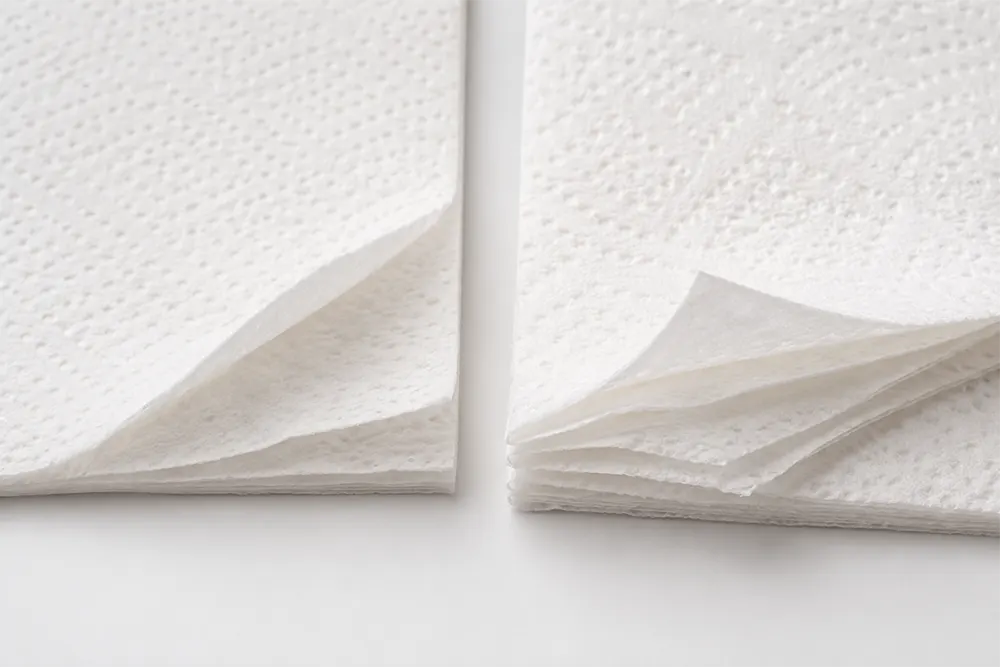
Two-ply vs. three-ply paper towels is not a fixed or automatic difference, because the number of plies alone does not determine strength. According to manufacturers’ technical documentation, the tensile strength ranges of both formats overlap significantly – actual strength depends on basis weight and processing, not on the number of plies stated on the label.
ISO 12625-4:2022 defines a standardized method for determining the tensile strength of tissue paper and tissue products. This shows why actual strength is assessed by measuring the force required to break the paper, rather than simply by counting the number of plies stated on the packaging.
Uspto.gov, the official United States patent database, contains manufacturers’ technical documentation for tissue paper with precise values measured using this method – three-ply paper towels typically achieve dry tensile strength of 300 to 420 centinewtons per 25 millimeters, while a high-quality two-ply product can reach up to 450, depending on basis weight and processing. The data show that the value ranges for two-ply and three-ply products overlap considerably, confirming that the number of plies is not the only factor that determines final strength.
If you are interested in what affects the quality of paper towels, read our blog: Paper towels in commercial facilities: Everything you need to know about types, savings and hygiene.
Why does a higher number of plies not guarantee greater strength?
Each ply adds thickness, but it does not automatically add proportional strength, because the final result depends on:
- the basis weight of each individual ply
- fiber quality
- the ply bonding technique
A well-made two-ply paper towel with denser plies can match or exceed the strength of a lower-quality three-ply product with thin, poorly bonded plies.
What is tensile strength and how is it measured?
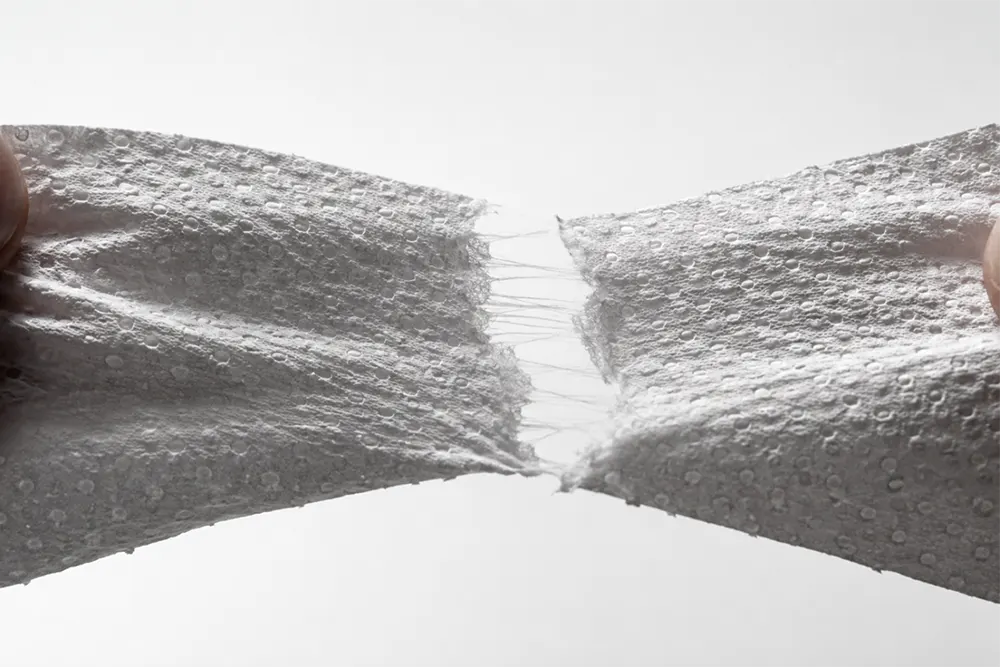
Tensile strength is the force required to break a strip of paper when stretched, expressed in centinewtons per 25 millimeters of sample width. Testing measures the machine and cross directions separately, because a paper towel usually shows different resistance depending on the direction in which it is rubbed or stretched.
Does basis weight per ply affect strength more than the number of plies?
Basis weight provides more information about the amount of material in the sheet than the number of plies alone, but it still does not determine strength by itself. Two paper towels with the same basis weight can have different tensile strength if they differ in fiber type, processing method and paper structure.
Does strength change when the paper towel is wet?
Yes, the strength of a paper towel changes when the paper gets wet, but the degree of change depends on its structure and chemical treatment. For tissue products, wet tensile strength is measured separately from dry tensile strength, because paper designed for contact with water may contain agents that help the fibers maintain some of their bonding even when wet.
Does improving strength affect other properties of paper towels?
Yes, often at the expense of softness or bulk. Manufacturers’ technical documentation for tissue paper confirms that increasing strength usually requires a compromise. A denser fiber structure that increases tear resistance also reduces softness and the full-bodied feel of the sheet, so manufacturers must balance these competing requirements.
How should you choose a paper towel based on the actual need for strength?
For tasks that require greater tear resistance, such as wiping wet surfaces or industrial use, basis weight per ply and the type of chemical treatment should take priority over the number of plies stated on the label. A product data sheet with tensile strength information provides a more precise basis for selection than the label “two-ply” or “three-ply” alone.
If you are unsure which balance of strength, basis weight and number of plies suits the way paper towels are used in your facility, we can help you choose the right paper towel.
Table: Comparison of two-ply and three-ply paper towels (according to available technical documentation)
| Characteristic | Two-ply paper towel | Three-ply paper towel |
| Dry tensile strength (machine direction) | 275-450 cN/25mm | 300-420 cN/25mm |
| Basis weight per ply | 16-25 g/m² | Not always available in the specification |
| Thickness | Not available in the specification | 176-230 μm (all three plies) |
| Key quality factor | Basis weight and processing | Basis weight and processing |
Example: When can a two-ply paper towel be a better choice than a three-ply paper towel?
Imagine purchasing paper towels for a commercial facility where tear resistance is the priority. Two products are available: a two-ply paper towel with a dry tensile strength of 450 cN/25 mm and a three-ply paper towel with a value of 300 cN/25 mm.
Although the second product has one additional ply, the two-ply paper towel in this comparison withstands 50% greater tensile force before breaking. The difference shows why the number of plies is not a sufficient criterion when strength is the priority.
This does not mean that a two-ply paper towel is generally better than a three-ply paper towel. A three-ply product may offer advantages in other characteristics, such as thickness, softness or a fuller feel. However, for tasks where tear resistance matters most, declared or measured tensile strength provides more relevant information than the number of plies alone.
Therefore, when comparing two paper towels, you should first define the intended use and then compare their technical characteristics.
This example uses the extreme values from the documented ranges to illustrate the principle. In practice, the difference between two specific products will usually be smaller, but the principle remains the same.
Recommended products
Industrial paper towel: recycled fiber, 2 plies, basis weight 2×22 g/m². The higher basis weight per ply provides the tear resistance required for more demanding tasks, regardless of the number of plies.
Center-pull paper towel: 100% cellulose, 2 plies, basis weight 2×20 g/m². The center-pull system further protects the paper structure from unnecessary handling, preserving strength until the moment of use.
Two-ply vs. three-ply paper towels- FAQ
Does a three-ply paper towel always have greater strength than a two-ply paper towel?
Not always. According to technical documentation, the tensile strength ranges of two-ply and three-ply products overlap significantly. A high-quality two-ply paper towel can reach a strength of 450 centinewtons per 25 millimeters, which exceeds the lower end of the range for some three-ply products. The number of plies is only one of several factors that determine final strength.
Does the number of plies affect the price more than the strength?
Partly true. An additional ply increases production costs and the amount of material used, but it does not guarantee proportionally greater strength if the basis weight per ply remains low. Buyers who pay more for a third ply without checking the basis weight may receive a more expensive product that is not necessarily more resistant than a good two-ply alternative.
Is paper thickness a reliable indicator of strength?
Not entirely. Thickness mainly determines the full-bodied feel and softness of the paper. Strength depends on fiber density and bonding, not only on the sheet’s total thickness. A paper towel may feel thick but still have relatively low tensile strength. Poor fiber bonding or low basis weight per ply can reduce its strength.
Does a paper towel with a higher declared basis weight always have greater tensile strength?
Not necessarily. Basis weight measures the mass of paper per unit area. Tensile strength also depends on fiber length, ply bonding quality and production technique. Two products with the same declared basis weight can have noticeably different tensile strength. Processing methods and raw material quality can affect the results.
When strength is the priority, how the paper towel performs in actual use matters more than how many plies are stated on the packaging.
About the author:
Milja Tonić – SEO Content Strategist & Copywriter
Milja Tonić is an SEO Content Strategist and Copywriter at LUU. In cooperation with the sales and technical teams, she prepares content about professional paper products, dispensers and hygiene management in commercial facilities.
Sign up for the LUU newsletter and stay up to date with the latest offers.