
Table of Contents
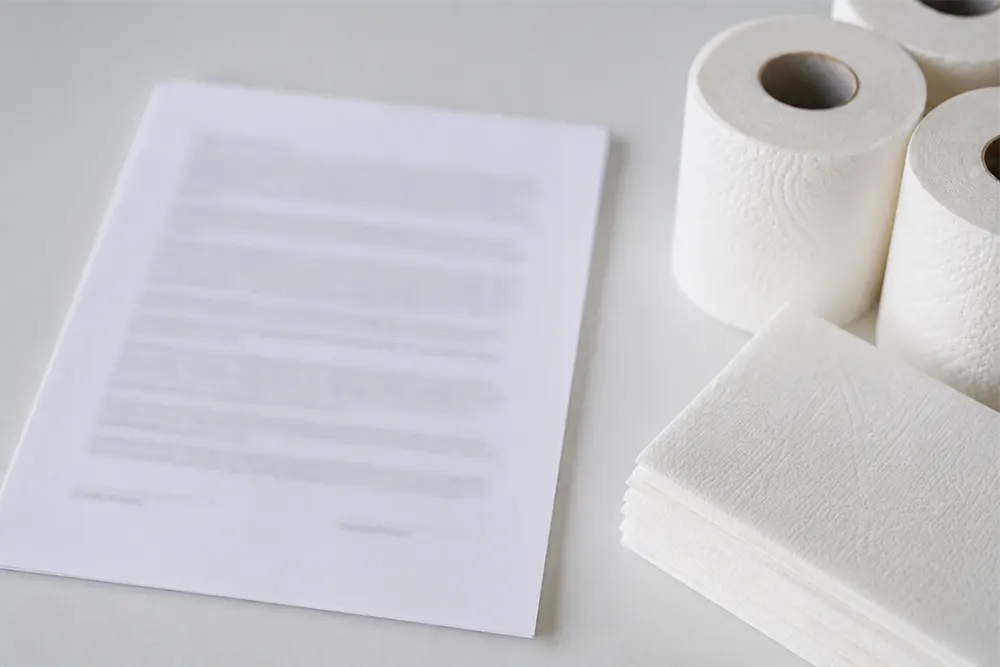
Paper products procurement contract in the public sector? It is a contract concluded in writing between the contracting authority and the selected bidder. In practice, the contract defines the subject of procurement, price, quantities, delivery deadline and method, payment terms, and other rights and obligations of the contracting parties, in accordance with the procurement documentation and the selected bid.
Propisi.net contains the consolidated text of the Public Procurement Law (“Official Gazette of the Republic of Serbia”, Nos. 91/2019 and 92/2023), which defines the legal framework for this type of contract, including mandatory elements, the procedure for conducting the procurement process, and rules governing contract performance.
To learn what professional paper products ordered for the needs of both the public and private sectors should look like, read our blog: Paper products: A complete guide to types, systems, and applications.
What is a public procurement contract and when does it apply?
A public procurement contract for goods is a contract whose subject is the purchase, rental, or leasing of goods, including paper products (toilet paper, paper towels, paper toilet seat covers). A public contracting authority – a state authority, local government unit, public institution, or public enterprise – concludes such a contract when it procures goods from an economic operator selected through the prescribed procedure.
Unlike contracts in the private sector, where the parties freely negotiate the terms, a public procurement contract must follow a precisely prescribed procedure: from publishing the invitation to submit bids, through evaluating bids according to predefined criteria, to signing the contract with the selected bidder.
What is the legal basis for procuring paper products in the public sector?
State authorities, institutions, and public enterprises procure paper products in accordance with the Public Procurement Law and accompanying bylaws governing:
- the method of procurement planning (annual procurement plan)
- value thresholds and procurements to which the Law does not apply in accordance with Article 27 of the Public Procurement Law
- the obligation to record and document every stage of the procedure
- deadlines for publishing contract award notices on the Public Procurement Portal
- rules for amending and terminating contracts

What does a paper products procurement contract typically contain?
| Contract element | What does it include? |
| Details of the contracting authority and supplier | Name, registered office, company registration number, and tax identification number of both contracting parties |
| Subject of the contract | Exact description of the goods (e.g. toilet paper, paper towels, paper toilet seat covers), with technical specifications from the tender documentation |
| Price and calculation method | Unit price per item, currency (dinars), and indication of whether VAT is included |
| Delivery deadline and location | Defined period from order placement to delivery and the exact delivery location or locations |
| Payment terms | Payment deadline and payment method (bank transfer is common in the public sector) |
| Quality and technical specifications | Compliance of the goods with the requirements specified in the tender documentation |
| Contract validity period | The period for which the contract is concluded (usually one calendar year, with the possibility of extension) |
| Termination terms and penalty provisions | The contracting authority’s right to terminate the contract in the event of improper performance, as well as contractual penalties for delays |
| Jurisdiction for disputes | The court or other body responsible for resolving any disputes |
The law requires the contracting authority to record and document in writing all activities during planning, implementation of the procedure, and contract performance, and to retain all documentation for at least five years from the date of contract conclusion. These elements represent standard contractual practice in accordance with statutory provisions governing essential contract terms and the general rules of contract law.
Must the contract always be concluded in writing?
Yes, with the option of using an electronic form, in accordance with regulations governing electronic documents and electronic signatures. An oral agreement or informal order is not legally valid for this type of procurement because the law requires a clearly documented and verifiable form that establishes the rights and obligations of both contracting parties.
Is a contract different from a purchase order?
Yes. A public procurement contract and a purchase order are not the same documents. For certain procurements to which the Public Procurement Law does not apply, contracts or purchase orders may be used, depending on the subject of procurement, value, and the contracting authority’s rules. Therefore, a purchase order does not serve as a universal substitute for a public procurement contract.
What does the process from the invitation to submit bids to signing the contract look like?
- Publishing the invitation: the contracting authority publishes an invitation to submit bids, together with tender documentation containing the subject of procurement, technical specifications, and conditions.
- Obtaining the documentation: interested bidders obtain the documentation, usually electronically
- Submitting bids: bidders submit their bids within the prescribed deadline, together with all required forms (e.g. price structure, list of references)
- Evaluating bids: the contracting authority reviews and evaluates the bids according to predefined contract award criteria and the requirements set out in the procurement documentation.
- Contract award decision: after the professional evaluation of bids, the contracting authority issues a contract award decision and, once the legal requirements have been met, concludes the contract with the selected bidder.
- Publishing the contract award notice: the contracting authority must submit the contract award notice for publication on the Public Procurement Portal within 30 days from the date on which it concludes the public procurement contract or framework agreement.
Can the contracting authority subsequently change the contract terms?
Not arbitrarily. The contracting authority may not make substantial amendments to a public procurement contract. The contracting authority considers an amendment substantial if it changes the nature of the original contract – for example, by significantly changing the price, subject matter, or delivery terms beyond what the tender documentation provided for.
Paper products procurement contract in the public sector – FAQ
Who can act as the contracting authority in a public procurement procedure for paper products?
The contracting authority may be a state authority, local government unit, public institution (e.g. in healthcare or education), or public enterprise that procures goods for its own needs.
Does the supplier bear the costs of preparing the bid?
Yes. As a rule, the bidder bears the costs of preparing and submitting the bid, unless the law or tender documentation provides otherwise.
How long does the contracting authority retain documentation relating to a concluded contract?
The contracting authority must retain all documentation relating to the public procurement for at least five years from the date of contract conclusion.
Can the agreed price change during the term of the contract?
The agreed price may change only when the procurement documentation, the contract, or the Public Procurement Law provides a basis for such a change. The contracting authority and the supplier may not arbitrarily change the price during contract performance.
Understanding paper products procurement contract in the public sector helps suppliers prepare bids in accordance with the contracting authority’s requirements and helps contracting authorities monitor contract performance in the manner prescribed by law.
About the author:
Milja Tonić – SEO Content Strategist & Copywriter
Milja Tonić is an SEO Content Strategist and Copywriter at LUU. In cooperation with the sales and technical teams, she prepares content about professional paper products, dispensers, and hygiene management in commercial facilities.
Subscribe to the LUU newsletter and stay up to date with the latest offers.