
Table of Contents
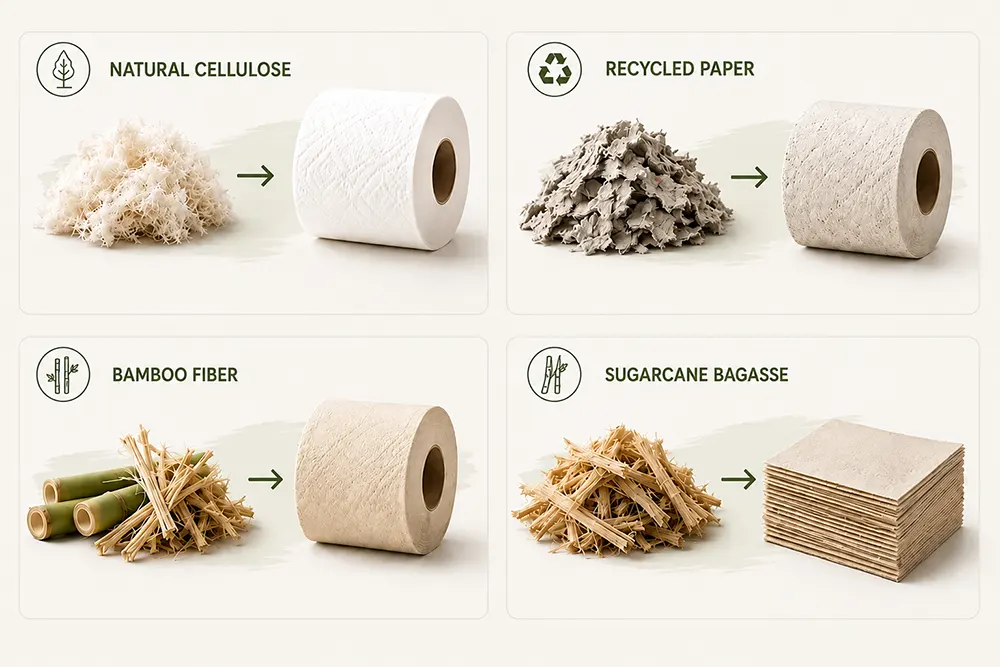
what is tissue paper made of? Tissue paper most commonly consists of virgin cellulose and recycled fiber obtained from recovered paper. To a lesser extent, manufacturers also use alternative fibers such as bamboo and bagasse to produce eco-friendly toilet paper and paper towels. The choice of raw material directly determines the softness, strength, and cost of the final product.
According to tappi.org, the professional association for the paper industry, the quality and performance of tissue paper depend on the precise balance of fiber length and fiber type in the raw material blend. This allows manufacturers to tailor products for specific applications, ranging from professional toilet paper to premium paper towels.
To learn why commercial facilities use tissue paper made from 100% virgin cellulose, read our blog: Tissue Paper: A Complete Guide to Types, Systems, and Applications.
What is tissue paper made of: virgin cellulose or recycled fiber?
What is tissue paper made of is generally divided into two main categories:
- virgin cellulose
- recycled fiber from recovered paper
Virgin cellulose produces stronger, brighter fibers that are ideal for premium products. Recycled fiber offers a more environmentally friendly alternative, although it is slightly less durable because the fibers become shorter during previous processing cycles.
Manufacturers obtain recycled fiber by processing previously used paper, including newspapers, office paper, and packaging materials. During a process known as deinking, they remove inks and impurities using chemical treatment. The resulting pulp (deinked pulp) is now widely used to manufacture toilet paper and paper towels, especially where sustainability is a higher priority than maximum softness.
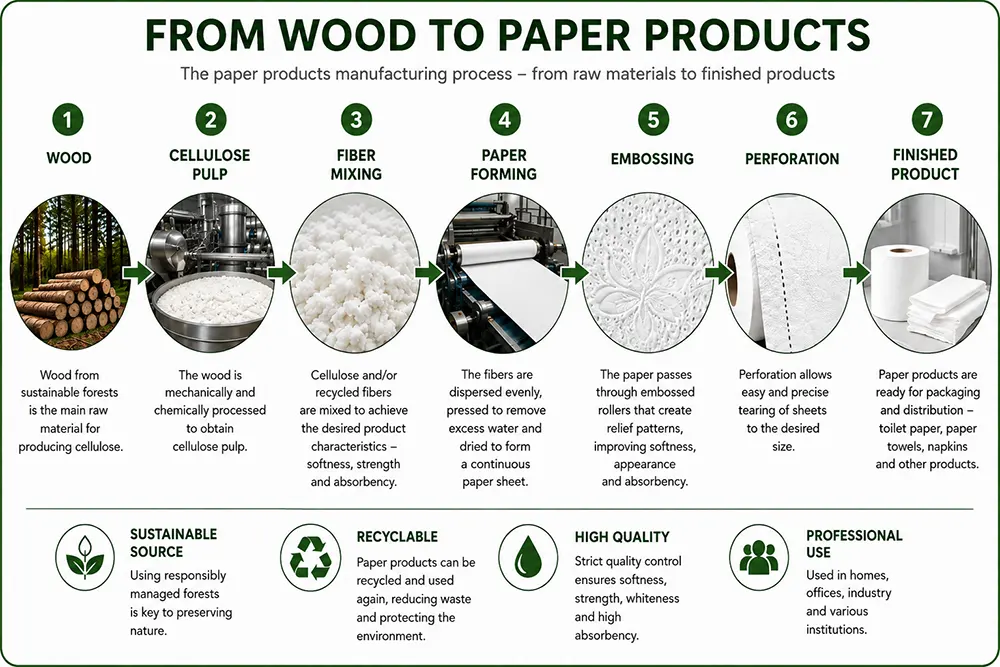
table: comparison of the most common raw materials used to manufacture tissue paper
| Raw material | Advantages | Disadvantages | Most common application |
| 100% virgin cellulose | Exceptional softness, high strength, excellent whiteness, superior absorbency | Higher cost | Premium toilet paper, paper towels, |
| Recycled fiber | Lower environmental impact, lower cost | Less softness and strength compared to cellulose | Toilet paper and paper towels for offices, industrial facilities, and high-traffic buildings |
| Bamboo fiber | Rapidly renewable resource, good strength, sustainable | Higher cost and lower availability | Eco-friendly toilet paper and paper towels |
| Bagasse (sugarcane) | Uses agricultural waste, renewable material | Limited production and availability | Eco-friendly tissue paper products |
Which fibers make tissue paper soft, and which make it strong?
Fibers that make tissue paper soft come from hardwood species such as eucalyptus (bleached hardwood kraft pulp, BHKP). Fibers that provide strength come from softwood species such as fir and pine (softwood kraft pulp, NBSK). The combination of these two fiber types determines the final balance of softness and durability.
Short eucalyptus fibers (0.7–1.2 mm) give paper a smooth texture and a pleasant feel. Longer softwood fibers (2.5–4.5 mm), which typically account for 15–30% of the fiber blend, prevent the paper from tearing during use. Premium products, such as facial tissues, often contain up to 80% eucalyptus fiber to achieve superior softness.
How is recycled fiber produced for tissue paper manufacturing?
Manufacturers produce recycled fiber for tissue paper by processing recovered paper. First, they break the material down in water inside a machine called a pulper. The material then goes through a deinking process that removes printing inks, adhesives, and other impurities. After purification and contaminant removal, the fibers become paper pulp once again, ready to manufacture new tissue paper products.
There are two main types of recycled fiber. The first is deinked pulp obtained from newspapers and magazines, while the second is mixed office waste collected from paper used in administrative processes. Recycled fiber is a more environmentally responsible option. However, it has a limited recycling lifespan because the fibers become shorter and weaker with each processing cycle.
Do manufacturers use alternative fibers such as bamboo to produce tissue paper?
Yes, manufacturers use alternative fibers such as bamboo and bagasse as a supplement to or replacement for wood pulp in tissue paper production. Bagasse is a by-product of sugarcane processing. These materials are especially common in tropical regions where they are readily available. Their use also reduces dependence on forest harvesting.
Manufacturers process bamboo and bagasse in a similar way to wood pulp. However, they require specialized equipment for fiber preparation because of their different fiber structure. Although these materials have not yet become dominant raw materials on the global market, they continue to gain importance in tissue paper manufacturing focused on sustainability and locally renewable resources.
How does the choice of raw material affect the quality and cost of tissue paper?
The choice of raw material directly affects the quality and cost of tissue paper. Products with a higher percentage of virgin cellulose cost more, but they offer greater softness and higher whiteness. Products with a higher percentage of recycled fiber are more affordable and have a lower environmental impact, although they generally provide slightly lower absorbency and durability.
Commercial facilities should select raw materials according to the intended use of the space. Premium hospitality venues often choose tissue paper with a higher percentage of virgin cellulose to create a more luxurious impression. Offices and facilities that prioritize sustainability more often choose products with a high percentage of recycled fiber.
Real-world experience
One business center switched to tissue paper made from recycled fibers throughout the entire building because of its lower purchase cost. After several weeks, employees and visitors began reporting that the toilet paper felt rougher and that the paper towels absorbed less effectively in representative restrooms.
The solution was to divide products according to their intended use. Restrooms intended for visitors were supplied with 100% virgin cellulose tissue products. Products made from recycled fibers remained in technical and utility areas. This approach created a better user experience while maintaining cost efficiency and selecting raw materials that matched the actual purpose of each area.
FAQ
Is tissue paper made from recycled fiber lower in quality than tissue paper made from virgin cellulose?
Not necessarily. It simply performs differently. Recycled fiber becomes shorter and weaker after multiple processing cycles, which can affect softness and absorbency. Virgin cellulose provides more consistent strength and softness.
How many times can paper fiber be recycled?
Paper fiber can usually be recycled a limited number of times, typically between five and seven cycles, because the fibers become shorter and lose part of their original strength with each recycling process.
Is tissue paper made from 100% virgin cellulose always the best choice?
Not always. Tissue paper made from 100% virgin cellulose provides greater softness, whiteness, and strength. However, for certain commercial facilities, products made from recycled fiber may offer better value while still delivering sufficient quality for everyday use.
How can you tell whether tissue paper is made from virgin cellulose or recycled fiber?
The easiest way is to check the manufacturer’s product declaration. Products made from virgin cellulose are usually whiter, softer, and have a more uniform structure. Products made from recycled fiber may have a more natural shade and a rougher texture.
Can tissue paper made from bamboo fibers be recycled?
Yes. Tissue paper made from bamboo fibers can be recycled in much the same way as products made from wood pulp, provided it has not been contaminated with chemicals or other waste after use.
What is deinked pulp?
Deinked pulp is recycled paper pulp from which printing inks, adhesives, and other impurities have been removed during processing. Manufacturers commonly use this type of fiber to produce recycled toilet paper and paper towels.
Does the type of raw material affect the absorbency of paper towels?
Yes. In addition to embossing and the number of plies, the type of fiber significantly affects absorbency. Paper made from high-quality cellulose generally absorbs liquid better and maintains its strength during use.
Which raw material is most commonly used for professional toilet paper?
Manufacturers produce professional toilet paper from virgin cellulose, recycled fiber, or a combination of both. The choice depends on the desired balance between softness, durability, cost, and the requirements of the commercial facility.
Can recycled tissue paper be safe for skin contact?
Yes. Tissue paper manufactured according to current standards undergoes purification and quality control processes. As a result, it is safe for everyday use and skin contact.
Quality tissue paper begins long before the product reaches your facility—it starts with the choice of raw material. When you understand the difference between virgin cellulose, recycled fibers, and alternative fibers, it becomes much easier to choose tissue paper that matches your facility’s standards, user expectations, and everyday requirements.
About the author:
Milja Tonić – SEO Content Strategist & Copywriter
Milja Tonić is an SEO Content Strategist and Copywriter at LUU.rs. She specializes in creating expert content about professional hygiene, tissue paper products, dispensers, and facility management.
The expert articles published on this blog are the result of thorough research, analytical thinking, and editorial review, while following the latest SEO standards and best practices for Google Search and AI Search (SGE/AI Overview).
Subscribe to the LUU newsletter and stay up to date with our latest offers.