
Table of Contents
Toilet paper gsm is the weight of paper expressed in grams per square meter. It indicates the thickness, strength, and absorbency of the product. A higher gsm means thicker and more durable paper, but also a higher price. A lower gsm, on the other hand, reduces the cost per unit, but also decreases user comfort.
According to the ISO 12625-6 standard, toilet paper gsm is measured using a standardized test method to ensure comparable results between manufacturers.
To learn about all types of toilet paper available for professional use and how to choose the right one, read our blog: Professional toilet paper for commercial facilities: The perfect balance of softness, superior cleanliness, and optimal savings
How does toilet paper gsm affect quality and price?
The toilet paper gsm affects both quality and price. A greater fiber weight per square meter creates thicker and stronger paper with better absorbency, but it also increases production costs. A lower gsm reduces the price, but it also decreases durability and user comfort. That is why choosing the right toilet paper always involves balancing quality and cost.
How is toilet paper gsm measured?
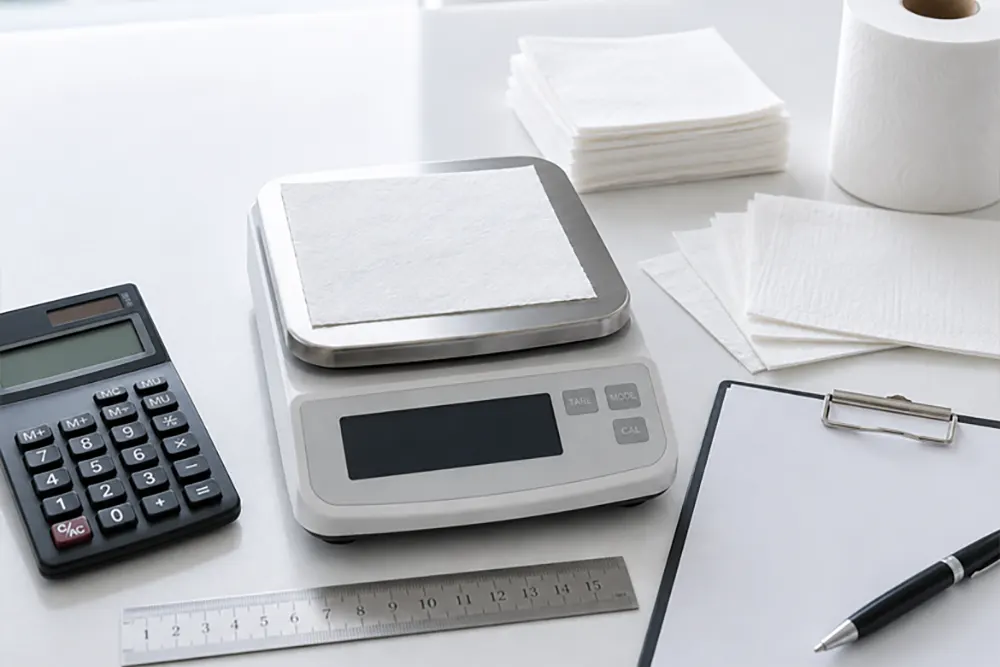
Toilet paper gsm is measured by determining the weight of a paper sample with a known surface area and expressing it in grams per square meter (g/m²).
The measurement follows the standardized laboratory method defined by ISO 12625-6. This method allows reliable comparisons of paper thickness and quality across different manufacturers.
What is the typical toilet paper gsm range?
The typical toilet paper gsm ranges from 13.5 to 20 grams per square meter. It depends on the number of plies and the intended use of the product. Single-ply toilet paper typically has a gsm of around 20 g/m². Three-ply paper usually ranges from 13.5 to 15 g/m² per ply, resulting in a greater total weight of the finished product.

How to choose the right toilet paper gsm for different commercial facilities?
The appropriate gsm depends on the type of facility, the number of users, and the expected level of comfort. High-traffic facilities typically choose paper that offers a good balance between strength and consumption. Hotels and premium facilities prioritize greater softness and multi-ply paper.
Table: Recommended gsm by facility type
| Facility type | Recommended gsm | Priority |
| Shopping malls | Three-ply Jumbo toilet paper roll 3×15 g/m² | Consumption control |
| Office buildings | Toilet paper roll 3×18 g/m² | Balance between quality and price |
| Schools | Three-ply Jumbo toilet paper roll 3×15 g/m² | Durability |
| Hospitals | Two-ply interfold toilet paper 2×18 g/m² | Hygiene and reliability |
| Hotels | Toilet paper roll 3×18 g/m² | User comfort |
| Restaurants | Toilet paper roll 3×18 g/m² | Appearance and quality |
What is the difference between toilet paper gsm and basis weight?
There is no difference between toilet paper gsm and basis weight in this context. Both terms refer to the same property: the weight of paper per square meter, expressed in g/m². The term toilet paper gsm is more commonly used in the Serbian market by local manufacturers and suppliers. Basis weight, on the other hand, appears more frequently in Croatian and Slovenian sources.
For commercial buyers, this terminology has no practical significance. Both terms describe the same technical specification. You can use them interchangeably when comparing offers from different suppliers without any risk of misinterpreting the data.
Why does single-ply toilet paper have a higher paper weight than two-ply toilet paper?
Single-ply toilet paper has a higher paper weight than two-ply toilet paper because it must achieve all of its strength and absorbency with a single layer. Manufacturers therefore compensate by using a denser fiber structure of around 20 g/m². Two-ply and three-ply paper distribute the weight across multiple layers (13.5–15 g/m² per ply), allowing each individual layer to remain thinner while maintaining the overall strength.
Table: Toilet paper gsm vs quality
| Parameter | What does it indicate? |
| GSM | Paper weight per m² |
| Number of plies | Thickness and comfort |
| Fiber type | Softness and strength |
| Absorbency | How much liquid the paper can absorb |
| Number of sheets per roll | How long the roll lasts |
| Dispenser compatibility | Efficiency in commercial facilities |
Is toilet paper gsm more important than the number of plies?
No, toilet paper gsm is not more important than the number of plies. The quality of toilet paper depends on the combination of gsm, the number of plies, the type of fibers, and the manufacturing process. Paper with a slightly lower gsm per ply can be softer, stronger, and more comfortable to use than paper with a higher gsm made from lower-quality raw materials.
How does professional toilet paper differ from retail toilet paper?
Professional toilet paper can have the same gsm as retail toilet paper. However, it differs in its dispenser-compatible design, roll length, and resistance to intensive use. Retail toilet paper is intended for individual use and shorter rolls. Professional toilet paper, on the other hand, reduces the frequency of refilling and lowers maintenance costs in commercial facilities.
Case study: Hotel Vrnjačka Banja
Problem
The hotel used toilet paper with a higher gsm because it believed this would provide better quality for guests. However, the greater material consumption and shorter roll lifespan required the staff to refill dispensers more frequently. As a result, maintenance costs increased.
Solution
After testing several samples, the hotel selected three-ply toilet paper rolls made from 100% cellulose with a gsm of 3 × 18 g/m², along with matching mini Jumbo toilet paper dispensers in white (Blanc). This combination provided a better balance between softness, strength, and durability in everyday use.
Result
- approximately 17% lower toilet paper consumption
- less frequent dispenser refilling during the day
- higher guest satisfaction thanks to a more comfortable user experience
- a better balance between quality, comfort, and overall operating costs
This example shows that when selecting professional toilet paper, toilet paper gsm should not be the only criterion. The best approach is to evaluate gsm together with the number of plies, fiber quality, and the intended use in a specific commercial facility.
FAQ
Does a higher gsm always mean better toilet paper?
Not necessarily. Toilet paper gsm indicates the thickness and weight of the paper. However, quality also depends on the raw material composition, the number of plies, and the manufacturing process. That is why you should compare products based on all of these parameters together.
Are toilet paper gsm and the number of plies the same?
No. Toilet paper gsm measures the weight of paper per square meter, while the number of plies indicates how many paper layers are combined into the final product. Together, these two parameters determine the final thickness and absorbency of the product.
What gsm is best for high-traffic commercial facilities?
For facilities with a high number of users, a gsm between 15 and 17 g/m² is recommended for Jumbo rolls. This type of paper withstands frequent use and the tension of industrial dispensers more effectively.
Does a lower gsm always mean lower overall operating costs?
No. A lower gsm reduces the purchase price per unit, but it can increase overall consumption and the frequency of dispenser refilling. That is why you should calculate the total cost of use rather than considering only the price per roll.
Is gsm measured per ply or for the entire roll?
Manufacturers most commonly specify toilet paper gsm per individual paper ply and express it in grams per square meter (g/m²). For multi-ply toilet paper, manufacturers often state the gsm of each individual ply, for example 3 × 18 g/m². This means that each of the three plies has a gsm of 18 g/m².
How can you check toilet paper gsm if it is not listed on the packaging?
If the gsm is not listed on the packaging or in the product’s technical specification, you cannot determine it reliably by visual inspection or touch alone. The most reliable solution is to request the product’s technical data sheet from the manufacturer or supplier. It contains the gsm, the number of plies, and other important technical specifications.
The best solutions do not rely on a single parameter. They result from giving every detail a purpose. That is why, when choosing professional toilet paper, you should view toilet paper gsm as part of the bigger picture, because it is that complete picture that creates a lasting difference.
Subscribe to the LUU newsletter and stay up to date with our latest offers.