
Table of Contents
When was toilet paper invented? The first recorded mention dates back to China in 589 AD.
Chinese scholar Yan Zhitui wrote around 589 AD that people should not use paper containing quotations from classical works for toilet purposes, implying that they already used other types of paper for personal hygiene.
Commercial production began in 1857 in the United States, when Joseph Gayetty introduced the first commercially available toilet paper in the U.S., called “Medicated Paper for the Water-Closet.” The modern perforated roll, in the form we know today, emerged in the late 19th century when Seth Wheeler patented perforated rolled paper in 1871.
For a detailed historical timeline, including archaeological and textual sources, visit history.com.
If you want to learn what high-quality toilet paper looks like today and explore the different types available, read our detailed blog: Professional toilet paper for commercial facilities: The perfect balance of softness, superior hygiene, and optimal cost efficiency
When was toilet paper first mentioned in written records?
The first written mention of toilet paper comes from China in 589 AD. At that time, the court scholar Yan Zhitui recorded that he refused to use paper containing quotations from sages for toilet purposes.
This is the oldest known evidence that paper was already being used for personal hygiene, although it was not yet an industrial product.
When did toilet paper become commercially available?
The first commercially available toilet paper appeared in the United States in 1857. That year, Joseph Gayetty began selling packages of flat sheets infused with aloe oil.
The product sold poorly at first because households commonly used free newspapers and catalogs. Toilet paper achieved true commercial success only several decades later.
Who invented the toilet paper we know today?
Modern toilet paper is not the work of a single inventor. Joseph Gayetty introduced the first commercial product in 1857. Seth Wheeler patented the perforated roll in 1883, while Scott Paper made rolled toilet paper widely available in the late 19th century.
When was perforated toilet paper invented?
Rolled toilet paper was developed between 1877 and 1891. Seth Wheeler patented perforation in 1883, making it easy to separate individual sheets. By the end of the 19th century, perforated rolls had become the standard in homes and commercial facilities.
How did toilet paper become softer and safer to use?
In 1935, Northern Tissue produced splinter-free toilet paper that was safer for everyday use. This innovation solved the long-standing problem of rough, coarse paper. Manufacturers introduced two-ply toilet paper in England in 1942, marking the beginning of a stronger focus on softness and comfort as key product features.
Table: The most important milestones in the history of toilet paper
| Year / period | Event | Why is it important? |
| 589 AD | First written record of paper being used for hygiene in China | The oldest known historical evidence of paper being used for toilet purposes. |
| 14th century | The imperial court of the Ming dynasty produces large quantities of specialized hygiene paper | The first recorded organized production of paper intended for personal hygiene. |
| 1857 | Joseph Gayetty sells the first commercial toilet paper in the United States | The beginning of toilet paper as a standalone commercial product. |
| 1877–1883 | Development of rolled paper and the first perforation patents | The format that later became the worldwide standard was created. |
| 1890 | Scott Paper popularizes rolled toilet paper | Rolls become widely available to households. |
| 1935 | Northern Tissue produces splinter-free paper | Significantly improves safety and product quality. |
| 1942 | The first two-ply toilet paper is introduced | Marks the beginning of modern, softer, and more comfortable toilet paper. |
| 1960s | Regional production in Yugoslavia (Paloma) | Toilet paper becomes more accessible to households across the region. |
| Today | Multi-ply, recycled, 100% cellulose, and professional toilet papers | Focus on hygiene, comfort, sustainability, and consumption control. |
When did toilet paper reach the Yugoslav market?
Manufacturers began producing hygiene paper on a larger scale in the former Yugoslavia during the second half of the 20th century. In 1961, the Slovenian factory Paloma installed a new machine for producing wrapping paper and hygiene paper. The Paloma brand first appeared on the market with its products in 1967, becoming one of the first regional manufacturers of hygiene paper. The Paloma factory produced hygiene paper for the entire former Yugoslavia. The exact moment when toilet paper became widely used in households across the region is difficult to determine precisely due to the limited availability of historical sources.
What were the strangest alternatives to toilet paper throughout history?
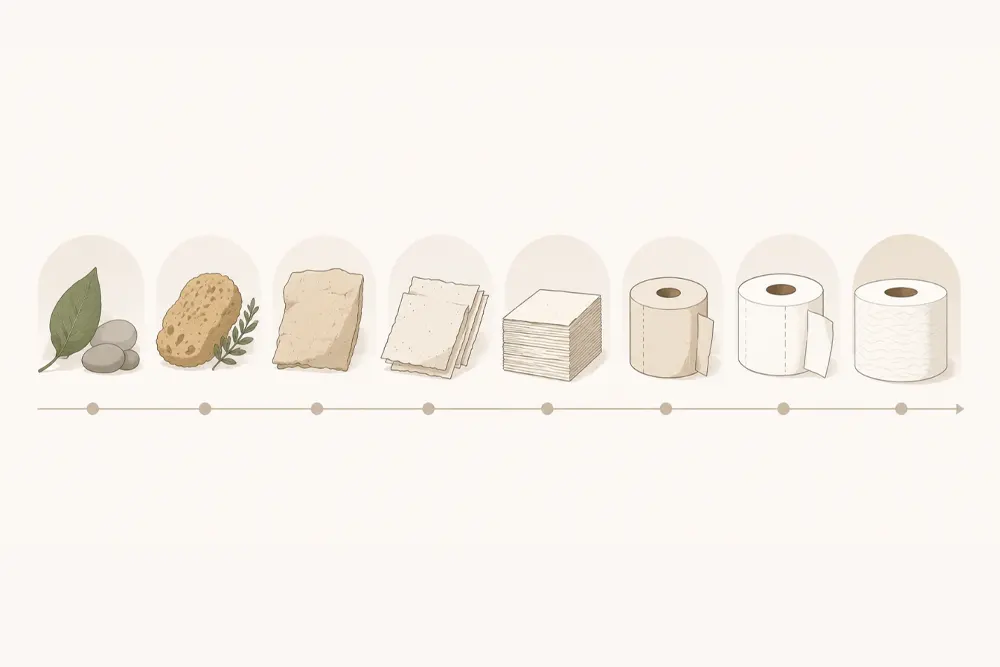
Throughout history, people used leaves, silk, moss, corn cobs, clay, seashells, and salt water with a sponge as alternatives to toilet paper.
The choice of material depended on the region and the available natural resources, and people still use some of these methods today in less developed parts of the world.
| Material | Where it was used | Why |
| Leaves | Europe, America | Readily available |
| Moss | Northern Europe | Soft |
| Corn husks | United States | Available on farms |
| Seashells | Greece | Coastal regions |
| Sponge | Rome | Could be washed and reused |
Table: How has toilet paper evolved throughout history?
The history of toilet paper spans more than 1,400 years of development. It begins with the first written mention in China in 589 AD. The story continues with the first commercial product introduced by Joseph Gayetty in 1857. It then leads to the perforated roll at the end of the 19th century and the modern multi-ply products we use today.
The table below shows an overview of the most important milestones.
| Period | Product form | Main characteristic |
| Ancient times | Leaves, moss, seashells, sponge | Natural materials readily available in the environment. |
| Middle Ages | Hand-cut paper | Used mainly in China and among wealthier social classes. |
| 19th century | Flat sheets | The first commercial product intended for personal hygiene. |
| Late 19th century | Perforated roll | Easier separation of individual sheets and more practical use. |
| 20th century | Two-ply and softer paper | Greater comfort and improved quality. |
| Today | Professional and multi-ply toilet paper | Various solutions for households and commercial facilities. |
Real-world experience: Why is the history of toilet paper still important today?
When working with commercial facilities, we often notice that people evaluate the quality of toilet paper solely by the number of plies or its price. The development of this product throughout history shows that the greatest improvements resulted from advances in manufacturing. These include the introduction of perforation and rolls, followed by multi-ply construction and modern technologies that improve strength, absorbency, and comfort.
For this reason, when choosing professional toilet paper today, you should consider not only the number of plies but also the fiber composition, basis weight, wet strength, and compatibility with the dispenser. These characteristics have the greatest impact on the user experience and overall consumption in commercial facilities.
FAQ
When exactly was toilet paper invented?
The first written mention dates back to China in 589 AD. The United States introduced the first commercial product in the Western world in 1857.
Who is considered the inventor of modern toilet paper?
People consider Joseph Gayetty the creator of the first commercial product. Seth Wheeler patented perforated rolled paper in the late 19th century.
Were the Chinese the first to use paper for hygiene?
Yes. Available historical records show that the Chinese used paper for hygiene purposes as early as the 6th century, long before it became a commercial product in the Western world.
Why was toilet paper first produced in rolls?
Manufacturers introduced rolled toilet paper to make storage, use, and the separation of individual sheets more practical. The introduction of perforation made it even easier to use and reduced unnecessary tearing.
When was two-ply toilet paper introduced?
Manufacturers introduced the first two-ply toilet paper in England in 1942. Its introduction marked the beginning of the development of products that offer greater softness, comfort, and absorbency.
Why was the first commercial toilet paper sold as sheets instead of rolls?
Manufacturers sold the first commercial toilet paper as individual sheets because engineers had not yet developed the technology for producing rolls and perforation. Rolls became the standard only in the late 19th century thanks to perforation patents.
Is modern toilet paper still made from wood?
Yes. Most modern toilet paper is made from cellulose fibers obtained from wood or from recycled paper. Product quality depends on the type of fibers, the number of plies, and the manufacturing process.
The desire to make everyday hygiene simpler, more comfortable, and more efficient has driven the greatest innovations in the history of toilet paper. That development continues today through professional solutions designed for modern commercial facilities.
About the author:
Milja Tonić – SEO Content Strategist & Copywriter
Milja Tonić is an SEO Content Strategist and Copywriter at LUU.rs, specializing in creating expert content in the fields of professional hygiene, tissue paper products, dispensers, and facility management.
The expert articles published on this blog are the result of thorough research, an analytical approach, and editorial expertise, while following the latest SEO standards and best practices for Google Search and AI Search (SGE/AI Overview).
Subscribe to the LUU newsletter and stay up to date with our latest offers.