
Table of Contents
Who is the contract model for paper products not suitable for depends primarily on the volume of paper product consumption, the number of people using the restrooms each day, and the length of the commercial lease.
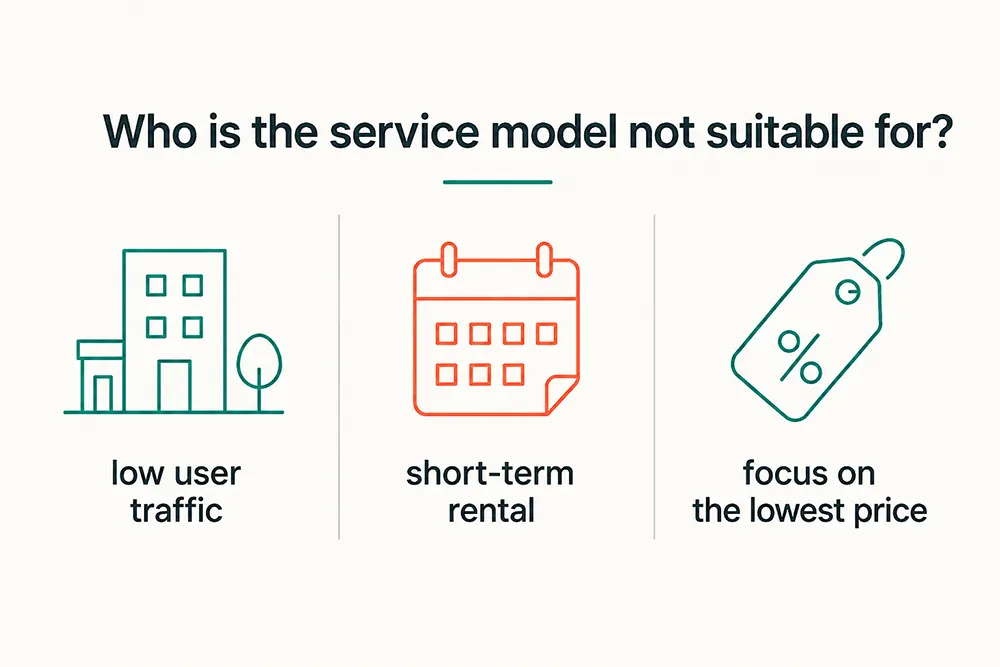
The contract model is not suitable for smaller facilities with low monthly paper product consumption, short-term leases, and businesses that prioritize only the lowest paper product prices. In these cases, the contractual obligation for regular supply exceeds the actual needs of the facility. A one-time purchase of dispensers and paper products is a more practical choice in these situations.
General principles for deciding between purchasing and leasing business equipment are explained by nolo.com.
Read our detailed blog to learn which professional paper products you can choose: Paper products: A complete guide to types, systems, and applications.
How does the contract model for paper product procurement work?
The contract model works by allowing the client to receive dispensers without an upfront investment, in exchange for a commitment to regularly purchase compatible paper products throughout the agreed contract period. The supplier provides the appropriate consumables, maintenance, and equipment replacement according to the contract terms, while the dispensers remain the supplier’s property.
When does low consumption make the paper product contract model unprofitable?
Low monthly consumption of paper towels and toilet paper makes the contract model less cost-effective for facilities with a small number of restroom users, regardless of whether they are employees, guests, clients, or visitors. In such facilities, it is more practical to purchase dispensers as a one-time investment and buy paper products based on actual consumption, without a long-term contractual commitment.
Why is the contract model not suitable for short-term commercial leases?
The paper product contract model is not suitable for commercial spaces leased for a period shorter than the minimum contract duration because the contractual commitment may last longer than the use of the premises itself. In this situation, it is more practical to purchase your own dispensers and buy paper products according to actual needs, with the option of moving the equipment to a new location.
Why is the paper product contract model not suitable for those looking only for the lowest price?
The paper product contract model is not suitable for those looking only for the lowest price because it includes certified and controlled quality of paper, towels, and soap. By definition, this level of quality cannot be the cheapest option on the market. Clients whose only criterion is price will benefit more from purchasing lower-cost alternatives independently, without a contractual commitment.
Table: Application of the paper product contract model by facility type
| Facility type or situation | Contract model | Reason |
| Office with more than 20 employees | ✅ Recommended | Regular consumption justifies the contract model |
| Hotel, restaurant, or shopping mall | ✅ Recommended | Large number of users and stable consumption |
| Healthcare facility | ✅ Recommended | Continuous consumption and the need for a reliable supply |
| Small café with low consumption | ❌ Not recommended | Consumption is too low to justify the contract |
| Commercial space leased for less than 12 months | ❌ Not recommended | The lease period is shorter than the contractual commitment |
| Facility where the lowest price is the top priority | ❌ Not recommended | The contract model is based on quality and long-term cooperation |
Who is the contract model for paper products not suitable for? – Practical experience
Problem: The owner of a small café in Belgrade contacted us with a request for a quotation for:
- two stainless steel towel dispensers (250 sheets)
- two stainless steel maxi jumbo toilet paper dispensers
- one electronic stainless steel foam soap dispenser
The estimated monthly consumption would be only six jumbo toilet paper rolls and six paper towel rolls.
Solution: After analyzing the consumption, we recommended that the owner make a one-time purchase of dispensers and paper products instead of choosing the contract model because the monthly consumption did not justify the contractual obligation for regular supply.
Result: The café purchased the equipment without entering into a long-term commitment and achieved savings of 22% compared to the projected cost of the contract model during the first six months.
Who is the contract model for paper products not suitable for? – FAQ
Can the contract model be adapted to lower consumption?
It depends on the terms of the specific contract and the supplier. If consumption differs significantly from the standard packages, a one-time purchase usually remains the simpler and more cost-effective solution.
What happens if consumption increases after a one-time equipment purchase?
In that case, the facility can decide to switch to the contract model once the number of users and monthly consumption justify it. A one-time purchase does not prevent a later change in approach.
How can I determine whether my consumption is sufficient for the contract model?
Sufficient consumption is not determined solely by the number of employees but also by the number of restroom users, monthly toilet paper and paper towel consumption, the number of dispensers, and the frequency of refilling. By comparing this data with the cost of purchasing equipment and handling maintenance independently, you can determine whether the long-term contract model provides financial and operational benefits.
Which is more cost-effective in the long run: a one-time purchase or the contract model?
It depends on the facility’s consumption volume. For smaller facilities with low consumption, a one-time purchase is more cost-effective because it avoids an unnecessary contractual commitment. For facilities with a large number of restroom users, the contract model becomes more cost-effective over time through free dispensers, guaranteed maintenance, and lower material costs per unit due to higher purchasing volumes.
The best systems do not attract attention because they are complex but because they operate without interruptions. When the supply model matches the actual needs of the facility, paper products become a reliable part of everyday operations rather than something that requires constant attention.
About the author:
Milja Tonić – SEO Content Strategist & Copywriter
Milja Tonić is an SEO Content Strategist and Copywriter at LUU, specializing in creating expert content on professional hygiene, paper products, dispensers, and facility management.
The expert articles on this blog are the result of thorough research, an analytical approach, and editorial expertise, while applying the latest SEO standards and best practices for Google Search and AI Search (SGE/AI Overview).
Subscribe to the LUU newsletter and stay up to date with our latest offers.