
Table of Contents
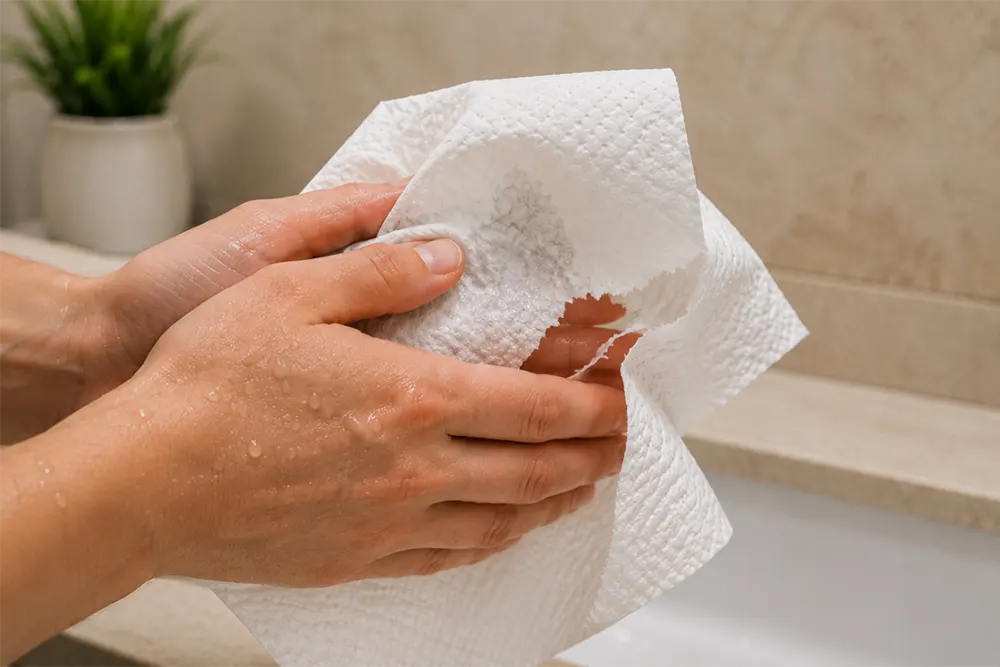
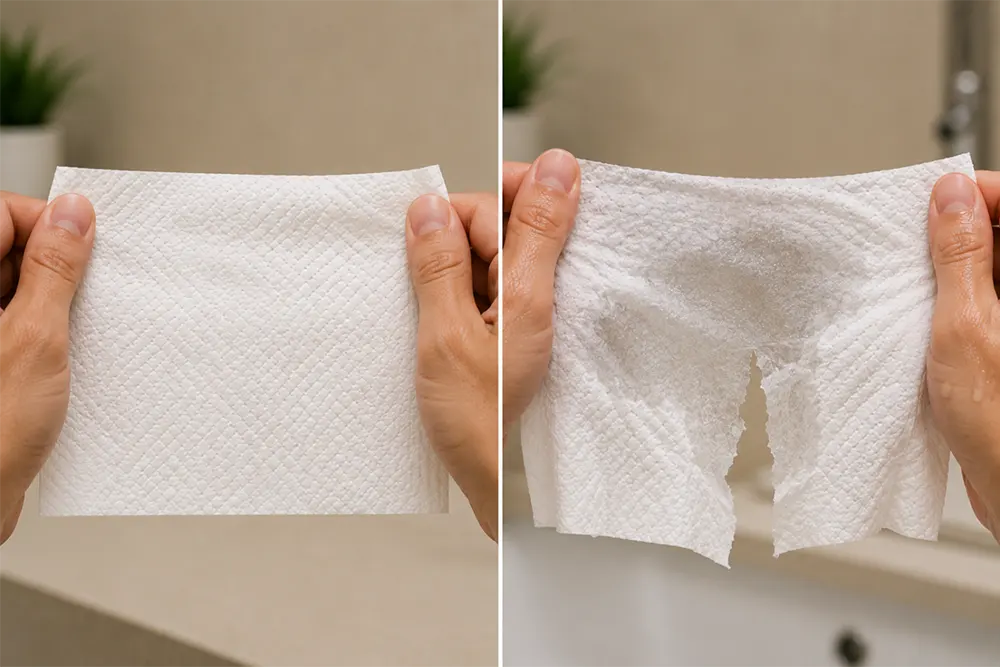
Why do paper towels tear when your hands are still wet? Water weakens the hydrogen bonds between the cellulose fibers that keep the paper strong, causing the fibers to swell and slide apart. Without special treatment, paper retains less than ten percent of its dry strength when wet, which is why ordinary paper gives way almost immediately.
Bioresources.cnr.ncsu.edu explains that manufacturers can assess the wet strength of paper by measuring its tensile strength after wetting, while TAPPI T456 is one of the methods used to determine this property.
To find out what type of paper towel will not fall apart as soon as you touch it with wet hands, read our blog: Paper towels in commercial facilities: Everything you need to know about types, savings, and hygiene.
Why do paper towels retain their strength better than ordinary paper?
Manufacturers can use special wet-strength agents, such as PAE resins, which help keep the fiber structure more stable after wetting. How much strength a paper towel retains depends on the type of fibers, the product formulation, the amount of added agents, and the construction of the paper towel itself.
Do all paper towels perform equally well when wet?
No. Resistance depends on the number of plies, fiber quality, and the embossing technique the manufacturer uses. A two- or three-ply paper towel with a well-embossed pattern usually withstands wiping for longer without tearing, while a thinner, single-ply paper towel with weaker fibers gives way much faster, even with the same type of chemical treatment.
What is the difference between paper towels and toilet paper in this respect?
Manufacturers design toilet paper to lose strength relatively quickly after contact with water and begin separating into fibers, which makes it easier to flush through the sewage system. Paper towels serve a different purpose: they must absorb water from the hands while retaining enough strength to avoid tearing during wiping.
What has the greatest effect on how long a paper towel lasts when wet?
The length and quality of cellulose fibers are the main factors – longer, undamaged fibers create a stronger structure that handles moisture better. Recycled paper, whose fibers are already shorter and weaker from previous processing, therefore usually performs worse in this respect than paper towels made from virgin cellulose, regardless of the added resin.
Table: What affects the strength of a paper towel when wet?
| Factor | How does it affect wet strength? | What does the user notice? |
| Fiber quality | Longer and better-preserved fibers can form a stronger paper structure | The paper towel breaks down less during wiping |
| Number of plies | More plies can increase overall resistance, but they are not the only factor | A thicker paper towel often retains its shape for longer |
| Wet-strength agents | They help the fibers remain bonded even after wetting | The paper towel does not tear immediately after absorbing water |
| Embossing | It bonds the plies and affects structure and absorbency | The paper towel feels more compact during use |
| Fiber type | Virgin and recycled fibers can have different mechanical properties | Users may notice differences in resistance and texture |
| Amount of water | Greater wetting places additional strain on the paper structure | An overly saturated paper towel tears more easily |
How can you assess paper towel strength before ordering larger quantities?
Wetting a single paper towel and checking whether it tears during rubbing is not a reliable test, because quality varies even within the same product category. The safest approach is to ask the supplier for a product technical data sheet containing information about the number of plies, fiber type, and absorbency level – these details reveal more about the actual durability of the paper towel than its thickness or price.
Why do paper towels tear when your hands are still wet? – FAQ
Does a higher number of paper towel plies always mean greater wet strength?
No. The number of plies affects thickness and how sturdy the paper towel feels in the hand, but it does not change the chemical composition of the fibers. A three-ply paper towel made from weaker fibers may give way faster than a two-ply paper towel made from high-quality cellulose, because added resin primarily determines wet strength, not the number of plies.
Does a thicker paper towel mean it tears less when wet?
Not directly. Thickness affects how much water a paper towel can absorb before it becomes fully saturated, but not how long it retains its structure while wet. A thinner paper towel with a stronger anti-tear treatment can withstand rubbing for longer than a thicker paper towel without that treatment.
Does embossing affect how long a paper towel lasts when wet?
Partly. Embossing bonds the plies and changes the texture, which affects how the paper towel absorbs water, but the embossed pattern itself does not add tear resistance. The fibers and chemical treatment determine this property, while embossing primarily shapes how the paper towel behaves during use.
Why does a paper towel tear specifically while rubbing your hands?
When a paper towel absorbs water, its structure becomes weaker, while rubbing simultaneously creates mechanical stress. If the paper does not retain enough strength while saturated with water to withstand that stress, the structure gives way and the paper towel starts to tear.
Does greater absorbency also mean greater tear resistance?
No. Absorbency and tear resistance are different paper properties. A paper towel can absorb a large amount of water quickly without having a structure strong enough for continued wiping. That is why you should consider both properties when assessing quality.
When choosing paper towels for a commercial facility, the number of plies is not the only factor you should compare. If you want to match your choice to the number of users, consumption intensity, and usage pattern, you can request a paper towel recommendation based on your facility’s needs.
About the author:
Milja Tonić – SEO Content Strategist & Copywriter
Milja Tonić is an SEO Content Strategist and Copywriter at LUU. In cooperation with the sales and technical teams, she prepares content about professional paper products, dispensers, and hygiene management in commercial facilities.
Subscribe to the LUU newsletter and stay up to date with the latest offers.