
Table of Contents
Dispensers are mechanical or sensor-operated devices used to dispense soap, paper towels, and toilet paper in controlled quantities. Their selection depends on the type of mechanism, refill system, and intensity of facility use, as they affect hygiene protocols, maintenance organization, and material consumption.
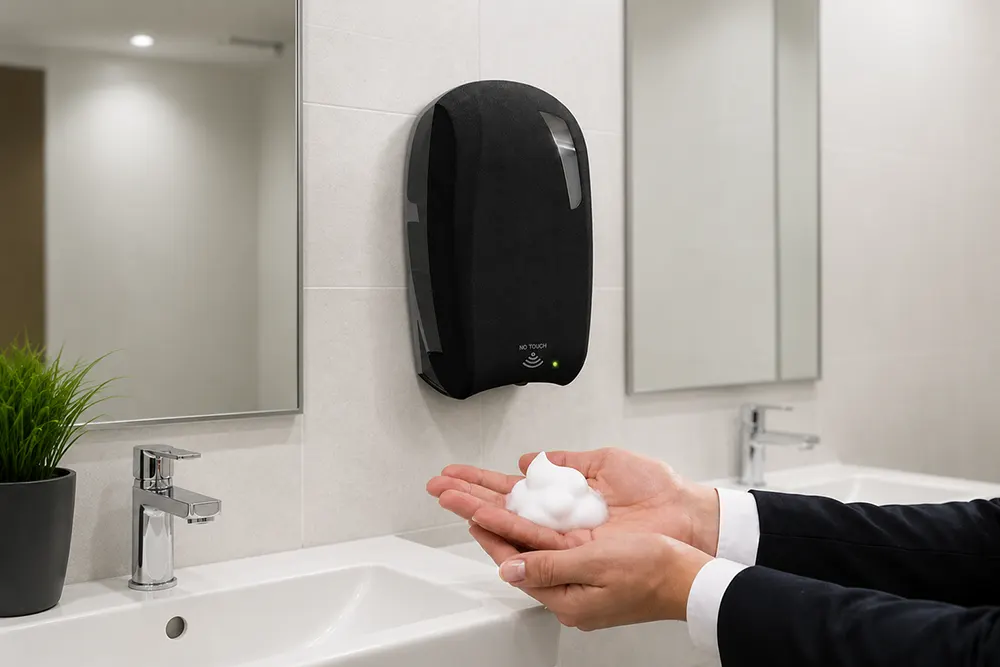
- Automatic (sensor-operated) dispensers provide touch-free use and a higher hygiene standard, making them suitable for hotels, restaurants, and healthcare facilities
- Mechanical dispensers are simpler, more economical, and are often used in offices and spaces with a smaller number of users
Dispensing systems can be adapted to different materials:
- liquid soap, foam soap, or gel
- paper towels
- toilet paper
Professional dispensers have three key roles:
- Functional: organized and consistent dispensing of materials
- Operational: fewer interventions and easier facility maintenance
- User-related: a consistent user experience and a professional appearance of sanitary areas
Learn how the right dispensers can improve aesthetics and hygiene protocols while reducing costs in your business facility in our comprehensive Master Guide.
Table: When to choose an automatic dispenser and when a mechanical one?
| Dispenser type | When it is used | Examples of facilities |
| Automatic (sensor-operated) dispensers | When a high level of hygiene and reduced physical contact are the priority | · hotels
· restaurants · clinics · business centers · premium offices |
| Mechanical dispensers | When simplicity and lower maintenance costs are important | · smaller offices
· administrative facilities · warehouses · industrial facilities |
Technical note: How are automatic (sensor-operated) dispensers powered?
Most professional sensor-operated models are powered by standard alkaline batteries (most commonly AA or C type), allowing installation on any wall without the need for electrical wiring.
Thanks to optimized energy-saving algorithms, one set of quality batteries provides high autonomy:
- Up to 20,000 activations on a single charge.
- Up to two years of continuous operation in moderately frequented facilities.
Soap dispensing dispensers: Liquid, foam, or gel?
Soap dispensing dispensers are used for different types of soap: liquid soap, foam soap, and gel. The model you choose depends on the level of hygiene you want to achieve, the number of employees and clients using the restroom, and the desired level of consumption efficiency.
There are several types according to the type of soap they use:
- Liquid soap dispensers are the most common and versatile, suitable for most business facilities.
- Foam soap dispensers use a mechanism that mixes soap with air, reducing consumption and enabling more economical use, making them common in facilities with a high frequency of users.
- Gel soap dispensers are most commonly used in healthcare facilities and spaces where a higher level of disinfection and controlled hygiene is required.
Paper towel dispensing mechanisms: Autocut vs folded paper towels
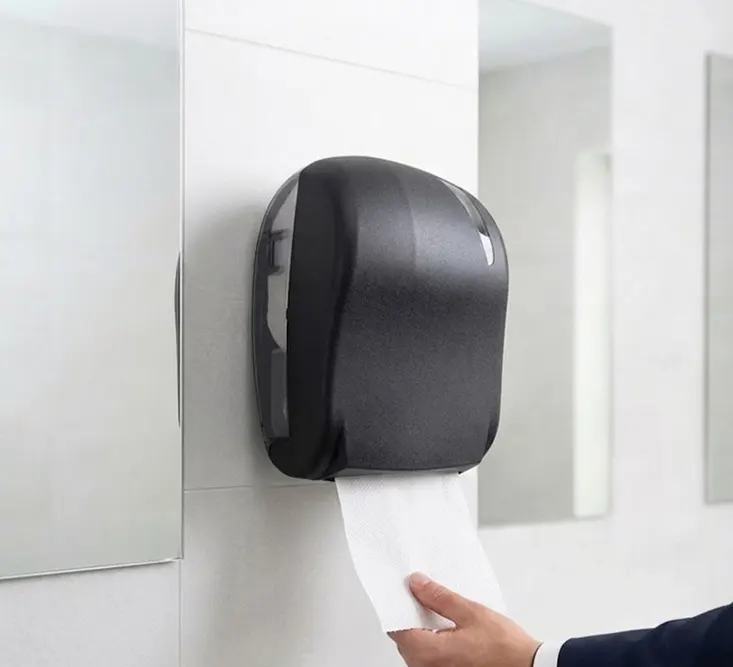
Paper towel dispensing mechanisms determine how users take paper, directly affecting hygiene, consumption, costs, and maintenance efficiency.
In practice, two systems are most commonly used:
Autocut dispensers (Automatic cutting systems):
- These devices operate without electrical power and mechanically control the paper dispensing length, cutting each sheet to a predefined length of 27 cm.
- Since the user touches only the paper they pull, this system provides a high level of hygiene through completely touch-free use.
- By controlling dispensing, autocut dispensers reduce paper towel consumption by 25–35% (approximately one-third), generate significantly less waste, and ensure a tidier restroom appearance.
- They are an ideal choice for facilities with a high frequency of users, such as restaurants, shopping centers, and public institutions, where cost optimization is the primary goal.
Dispensers for folded paper towels:
- They operate on the principle of dispensing individually pre-folded sheets (most commonly in V-fold or Z-fold format)
- They are characterized by compact dimensions, a transparent base for quick visual inspection, and a large capacity (often up to 450 or 600 sheets within the housing)
- The main advantages of this system are a lower initial investment in the devices themselves, exceptional ease of use, and quick, simple refilling without complicated mechanisms
- Offices, administrative facilities, and smaller business premises most commonly use these dispensers because their level of traffic does not justify investing in autocut systems
While folded paper towels offer cost-effectiveness when purchasing equipment, facilities with a high volume of visitors gradually switch to autocut dispensers in order to achieve significant savings on consumables through controlled consumption and reduced waste.
What does the mathematics of dispensers look like in practice? (ROI)
If your facility has 100 employees who use the restroom on average 3 times per day, switching from standard folded paper towels to an Autocut system reduces consumption by approximately 33%. On an annual basis, instead of 120,000 sheets, you will use approximately 80,000 sheets.
This means that the investment in the dispensers themselves pays for itself within 3 to 6 months, after which the system directly generates profit through reduced material procurement.
Toilet paper dispensing: Jumbo rolls or sheet dispensers?
Toilet paper dispensing in business facilities is most commonly based on the choice between jumbo rolls and sheet dispensers.
The differences between the systems are:
- toilet paper dispensing method: With jumbo rolls, the user takes as much paper as needed, while sheet dispensers provide controlled consumption: one sheet per pull
- hygiene aspects: The jumbo roll inside the dispenser is protected from external influences such as dust, moisture, and contamination. The user touches only the portion being used, while the remainder stays inside the housing. Sheets provide an additional level of hygiene, as each sheet is individually separated and there is no contact with the remaining material
Jumbo dispensers can reduce refill frequency by up to 50% compared to standard rolls.
Sheet dispensers reduce overall toilet paper consumption by up to 38%, while refill frequency is reduced by approximately 30–50% depending on facility traffic.
Security aspect: Locking system against theft and vandalism
In addition to consumption control, a key role of professional restroom dispensers is the protection of consumable materials.
All professional models (whether made of ABS plastic or stainless steel) are equipped with a security lock and a universal key.
This locking system prevents unauthorized opening of the devices, eliminating the risk of theft of entire jumbo rolls or packs of paper towels, while protecting the material inside from intentional contamination and vandalism.
A universal key allows maintenance staff to quickly open and refill all dispensers within the facility using a single tool.
Table: Toilet paper dispenser by business facility type: jumbo rolls vs sheet dispensers
| Toilet paper dispensing system | Description | Where it is used | Key advantages | Limitations |
| Jumbo rolls | Designed for facilities with a high frequency of users, enabling long-term use without frequent replacement | · public restrooms
· shopping centers · hospitality facilities · facilities with high foot traffic |
· less frequent refilling
· reduced maintenance · greater capacity |
require a larger holder and initial installation |
| Sheet dispensers | Dispense a predefined number of sheets per use for better consumption control | · offices
· administrative facilities · smaller business premises |
· consumption control
· tidier appearance · cost efficiency |
more frequent refilling in high-traffic areas |
Open refill dispensers vs closed cartridge dispensers
Open refill dispensers and closed cartridge dispensers differ in their refill method and level of hygiene standards.
This difference directly affects:
- usage safety
- maintenance costs
- cleanliness standards in business facilities
- Open refill dispensers are refilled by directly pouring or inserting consumable material. They offer greater flexibility and lower procurement costs but require more careful maintenance to avoid contamination
- Closed cartridge dispensers use pre-packaged, sealed units that are replaced without direct contact with the contents. As a result, they provide a higher level of hygiene and standardized consumption, making them a common choice in healthcare facilities and premium establishments
The choice between these two dispenser types depends on priorities between cost efficiency and maximum hygiene safety.
Advantages of open refill dispensers
- lower refill costs
- flexibility in soap selection
- simple logistics
Advantages of closed cartridge dispensers
- lower risk of contamination
- standardized consumption
- tidier restroom maintenance
- faster material replacement
In healthcare facilities and premium establishments, closed dispensers are more common due to hygiene standard control.
Housing materials: Reinforced ABS plastic or stainless steel?
The level of usage and the frequency of facility traffic determine whether ABS plastic or stainless steel is the better choice.
- Reinforced ABS plastic for offices and lower-traffic facilities. It enables easy installation and maintenance
- Stainless steel is used in facilities with high hygiene requirements and heavy usage, such as hospitals, public institutions, and industrial facilities. Its main advantage is high resistance to wear, moisture, and vandalism.
Table: Reinforced ABS plastic vs stainless steel
| Housing material | Where it is used | When to choose it |
| Reinforced ABS plastic | Offices, hotels, facilities where a balance between aesthetics and costs is important | When a lower investment is important, for smaller facilities and spaces without a high risk of damage |
| Stainless steel | Hospitals, industrial facilities, airports, public institutions, high-traffic restrooms | For intensive use, public spaces, facilities with high hygiene requirements, and a risk of vandalism |
Practical experience: RGZ, Prokuplje
Republic Geodetic Authority introduced professional dispensers for the controlled dispensing of paper towels, soap, and toilet paper during the modernization of its sanitary facilities in order to improve hygiene standards and reduce operational maintenance costs.
The following equipment was installed in the facility:
- Large dispensers for folded paper towels with a capacity of 600 sheets enabled less frequent refilling and better maintenance organization during working hours. The transparent window simplified visual consumption monitoring without opening the device, while the robust construction ensured stability in a high-traffic environment
- sheet toilet paper dispensers contributed to consumption control thanks to the individual sheet dispensing system, reducing unnecessary paper waste and improving restroom tidiness
- 0.5L electronic liquid soap dispensers in nero black with an infrared sensor enabled completely touch-free use. Precise dispensing of 0.8 ml per activation reduced soap waste, while the anti-drip system eliminated dripping and moisture retention around the sink. The nero black finish further contributed to a more modern and professional appearance of the space
Implementation results:
- paper and soap consumption reduced by 25–35%
- refill frequency reduced by approximately 30%
- less physical contact with surfaces (80%+)
FAQ
How to choose the right dispenser for a business facility?
Facility usage frequency, hygiene requirements, and the maintenance budget determine the right dispenser. Facilities with high foot traffic most commonly use automatic and stainless-steel models, while mechanical systems are common in offices and smaller business premises.
When selecting dispensers, compliance with applicable technical regulations and standards available on the National Regulations and Standards – Institute for Standardization of Serbia page is recommended.
When are mechanical dispensers a better choice?
Mechanical dispensers are a better choice when lower maintenance costs, ease of use, and a long service life without electronics are important.
Is foam soap more economical than liquid soap?
Yes. Foam soap dispensers use a smaller amount of soap per use because they mix soap with air during dispensing. This enables lower consumption and a cleaner sink area.
What is an autocut paper towel dispenser?
An autocut paper towel dispenser is a mechanical or electronic device that automatically cuts paper to a precise, standardized length with every pull.
What is the difference between jumbo rolls and sheet dispensers?
Facilities with high foot traffic use jumbo rolls because they reduce refilling frequency, while sheet dispensers provide better consumption control and create a tidier restroom appearance.
Are closed cartridge dispensers more hygienic?
Yes. Closed systems use factory-sealed cartridges that are replaced without direct contact with the contents, reducing the possibility of contamination and ensuring a more consistent hygiene standard.
The selection of appropriate dispensers and accompanying systems directly shapes your operating costs and the impression you leave on clients and employees. Do not rely on guesswork—allow us to help you optimize material consumption and raise hygiene standards to the highest level.
Visit our contact page and secure the highest-quality equipment with a reliable supply of premium consumable materials tailored precisely to your facility’s needs.
Subscribe to the LUU newsletter and stay up to date with the latest offers.