
Table of Contents
The right professional soap dispenser is selected according to user frequency, facility hygiene requirements, and budget.
For premium facilities, hotels, and restaurants, touch-free automatic (sensor-operated) models are the best choice because they provide maximum hygiene. For offices and lower-traffic areas, mechanical foam soap dispensers offer the greatest cost efficiency, reliability, and consumption control without the cost of electronics.
| Dispenser type | Best for | Main advantage |
| Mechanical | offices | low cost |
| Sensor-operated | hotels and clinics | hygiene |
| Stainless steel | public restrooms | durability |
The cleanliness and hygiene level of sanitary areas directly affect brand perception, employee satisfaction, and the impression you leave on clients.
Before planning the procurement of a soap dispenser, be sure to read our comprehensive dispenser guide: Dispensers: How to choose the right operating mechanism and dispensing system?
What is a professional soap dispenser and how does it work?
Unlike household variants, a professional soap dispenser for business facilities is a technically optimized device designed to withstand hundreds of thousands of activations or dispense precise soap doses without mechanism failure.
Its primary function is to deliver a precisely measured amount of liquid, foam, or gel with each activation (most commonly between 0.4 ml and 0.8 ml), which is entirely sufficient for proper hand washing.
The operating mechanism is divided into two basic principles:
Mechanical soap dispensers: The operation is based on a push valve (pump) activated by physical hand pressure or, in specific medical environments, by pressing an extended lever with the elbow.
The standard soap dose depends on the force of the pressure and most commonly amounts to approximately 0.5–1 ml for foam soap and around 1–1.5 ml for liquid soap.
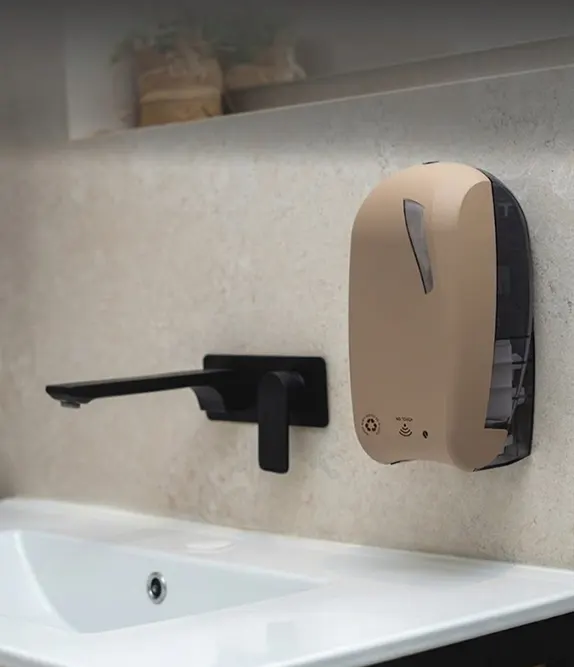
Automatic (sensor-operated) soap dispensers: They use a high-precision infrared (IR) sensor that reacts to heat and movement.
When a user places their hand 5–10 cm below the dispenser, the electronics activate a mini motor that dispenses an exact dose of 1.1 ml for liquid soap and 0.7 ml for foam soap within a second, without any physical contact with the device.
Why is a traditional soap dispenser a risk for business facilities?
Traditional household soap bottles and dispensers present a serious risk for business facilities because they spread bacteria and viruses through cross-contamination caused by frequent physical contact.
In addition, they lack a soap waste control mechanism, which leads to excessive consumption, dripping onto floors, and unnecessary increases in maintenance costs.
Among procurement managers, terminology is often confused, causing professional wall-mounted devices to be equated with ordinary dispensers.
The key difference is that the term soap dispenser generally refers to simple freestanding plastic bottles purchased through retail channels.
Using ordinary dispensers in a business environment carries three major risks:
- Hygiene risk: When dozens of people touch the same pump throughout the day, it becomes a primary hotspot for bacteria and viruses
- Financial loss: Standard pumps have no dispensing control. Users often press the valve 3–4 times, consuming up to 5 ml of soap per wash, resulting in uncontrolled spending
- Aesthetic and safety issue: Bottles easily fall and break, while soap leaks onto sinks and floors, creating slippery and hazardous surfaces that negatively affect the appearance of the restroom
Detailed classification: Types of soap dispensers by mechanism
Professional soap dispensers are classified by mechanism into automatic (touch-free) models, which use an infrared sensor for maximum hygiene, and mechanical models, which operate through physical hand or elbow pressure (medical models).
In addition, stainless steel (anti-vandal) dispensers with locking systems are designed for public and high-traffic areas prone to damage.
Table: Classification of soap dispensers by mechanism:
| Dispenser category | Key advantages | Main disadvantages | Best suited for (Facility type) |
| Automatic (Touch-free) | • Maximum hygiene standard (zero touch)
• Premium user experience
• Long-lasting alkaline batteries (up to 20,000 activations) |
• Higher initial investment
• Periodic battery replacement required |
• Clinics and laboratories
• High-category hotels
• Premium restaurants
• Modern business centers |
| Mechanical push models | • Most economical initial investment
• Zero battery costs
• Mechanism without electronics (minimal risk of failure) |
• Requires physical hand or elbow contact for activation | • Standard offices
• Warehouses and operational centers
• Industrial facilities |
| Stainless steel (Anti-vandal models) | • Extremely robust stainless-steel housing
• Security lock with key against theft and unauthorized opening
• Resistance to strong impacts and vandalism |
• More robust and heavier design requiring stable installation | • Public restrooms
• Shopping centers and airports
• Heavy industry facilities |
Mechanical dispensers provide the most cost-effective solution for most office and administrative environments, while sensor-operated models are the best choice for premium and healthcare facilities.
Soap types: Liquid, foam, or gel – which is more economical?
Foam soap is the most economical choice because a special pump mixes liquid with air, providing up to 12,000 doses of exactly 0.7 ml per dose (approximately 40% lower consumption compared to conventional liquid soap).
Liquid soap is universal and more affordable per liter, while gel is thicker and represents the standard for medical antiseptics.
The dispenser mechanism directly determines the type of soap you will use, which ultimately shapes your monthly operating costs.
- Foam soap (Maximum cost efficiency): A special pump inside the dispenser mixes soap with air at a ratio of 1:10, creating rich foam from a very small amount of liquid.
- Liquid soap (Universal application): A standard, reliable solution with higher viscosity. It is suitable for environments where users prefer the traditional feel of soap lather on their hands.
- Gel soap (Medical standard): Most commonly used in healthcare facilities for dispensing highly effective antiseptics and surgical disinfectants that require a stable formulation without mixing with air.
Open refill systems vs closed cartridges
When purchasing equipment, you must make a strategic decision regarding the refill method:
Open refill dispensers (bulk refill systems)
They are refilled by directly pouring soap from large 5-liter canisters into the dispenser reservoir.
- Advantages: Extremely low refill cost per liter and complete freedom in choosing the soap manufacturer
- Disadvantages: During opening and refilling, the soap is exposed to external influences, dust, and airborne bacteria. Periodic reservoir cleaning is required to prevent soap buildup
Closed cartridge dispensers (Cartridge systems)
They use factory-sealed, disposable soap bags or cartridges that are simply inserted into the housing together with the integrated pump.
- Advantages: Absolute sterility and maximum hygiene because the soap never comes into contact with the external environment until it reaches the user’s hands. Replacement is quick (only a few seconds) and spill-free.
- Disadvantages: Higher consumable costs and dependence on the dispenser brand.
How to choose a soap dispenser according to facility type?
A soap dispenser is selected according to the number of users who use the restroom daily and the hygiene requirements of the facility.
Premium locations (hotels and restaurants) choose aesthetically appealing, touch-free sensor-operated models; healthcare facilities require medical elbow-operated or sensor-operated dispensers, while offices and industrial facilities use economical, long-lasting mechanical or robust stainless-steel dispensers.
Table of recommended dispensing systems
| Type of business facility | Recommended equipment category | Operating system | Optimal capacity | Key practical benefits |
| Offices and smaller administrative spaces | Mechanical foam soap dispenser | Push-operated | 0.5l or 1l | · maximum material savings
· low investment · long service life |
| Medium-sized companies and IT hubs | Electronic liquid and foam soap dispenser | Touch-free (IR) | 0.5l | · touch-free use
· modern appearance · higher hygiene standard |
| Hotels, restaurants, and hospitality facilities | Premium electronic sensor-operated foam soap dispenser | Touch-free (IR) | 0.5l | · luxurious design
· zero dripping around the sink · premium user experience |
| Healthcare facilities and clinics | Medical elbow-operated dispenser | Mechanical elbow / Sensor | 1.1l | · elimination of cross-contamination
· support for disinfectant gel |
| Industrial and public restrooms | Mechanical stainless-steel or Electronic stainless-steel dispenser | Robust stainless-steel mechanism | 1l or 1.2l | · vandal-resistant
· less frequent refilling during high-traffic shifts |
The requirements for dispensers in healthcare facilities, including mandatory touch-free activation, are described in detail in the professional recommendation published on PMC/NIH.
Soap dispenser – Most common mistakes when choosing
The most common mistakes when choosing a soap dispenser include purchasing insufficient capacity, using household models in high-traffic facilities, and selecting the wrong refill system.
Such mistakes increase maintenance costs, soap consumption, and the risk of malfunctions, leakage, and poor hygiene standards.
The most common mistakes are:
- Choosing insufficient capacity for high-traffic restrooms
- Purchasing household dispensers instead of professional dispensers
- Choosing the wrong option between foam, liquid soap, and gel
- Lack of a security lock in public spaces
- Selecting models without an anti-drip system
- Ignoring the facility’s hygiene requirements
- Purchasing sensor-operated models without available service and spare parts
- Choosing dispensers that do not match user type and usage frequency
- Focusing solely on the lowest price instead of long-term cost-effectiveness
- Using insufficiently robust materials for industrial and public facilities
Practical experience: How did NES Požarevac Branch achieve outstanding results?
National Employment Service – Požarevac Branch as a busy public institution with a high daily number of users, faced frequent challenges in its sanitary areas:
- broken plastic dispensers
- soap leakage
- frequent refilling
- increased maintenance costs
- untidy restroom appearance throughout the day
As part of the sanitary facility modernization project, professional LUU stainless-steel mechanical liquid soap dispensers with a 1.2-liter capacity were installed.
After replacing standard plastic models, the facility achieved measurable operational benefits:
Less frequent refilling and reduced staff involvement
The large 1200 ml capacity significantly reduced refill frequency during the workweek, while the transparent inspection window enabled faster soap level monitoring without opening the dispenser.
Complete elimination of malfunctions and damage
The robust stainless-steel housing with a security lock and key eliminated issues related to breakage, vandalism, and unauthorized opening of dispensers.
No additional electronics-related costs
The battery-free mechanical operating system enables continuous operation without service costs, battery replacement, or electronic failures.
More consistent hygiene standards and a tidier restroom appearance
The anti-drip mechanism prevented soap leakage and the formation of slippery surfaces around sinks, while the anti-fingerprint finish maintained a clean and professional appearance despite heavy daily use.
With a special anti-fingerprint coating, these dispensers maintain a flawless, clean, and professional appearance despite hundreds of daily user interactions.
Soap dispenser – FAQ
Are automatic or mechanical soap dispensers better for business facilities?
For facilities where maximum hygiene and the prevention of bacteria transmission without contact are the primary goals, automatic sensor-operated models are unmatched. For environments with a stable number of employees (offices, warehouses), robust mechanical models are the optimal choice.
How does a soap dispenser reduce costs by up to 37%?
It reduces costs through precise factory-calibrated dosing, integrated anti-drip valves, and security locks that prevent theft or intentional liquid waste.
What is the difference between liquid soap and foam soap when choosing a dispenser?
The difference lies in the pump design. A foam soap dispenser includes an integrated aerator that creates foam, while a liquid soap dispenser dispenses pure liquid in its original form and is used with standard or specialized antibacterial soaps.
What dispenser capacity should you choose?
Smaller office restrooms with up to 15 employees most commonly use compact 0.5-liter models to save space. For high-traffic locations, restaurants, and public institutions, only dispensers with capacities of 1l or 1.2l are recommended.
If you are not sure which soap dispenser is optimal for your facility, a professional team can help you choose the appropriate capacity, mechanism, and refill system according to actual facility usage frequency.
Send a quick inquiry for a wholesale offer. Our professional team will analyze your facility traffic in the shortest possible time and create a free, optimal equipment specification tailored precisely to your requirements and budget.
Subscribe to the LUU newsletter and stay up to date with the latest offers.