
Table of Contents
Why does toilet paper change texture when exposed to moisture in the room? Toilet paper changes texture in a humid room because paper fibers are naturally hygroscopic, absorbing moisture from the air until they reach equilibrium with the surrounding humidity.
Thinner, lower-grammage paper may show more pronounced changes, while high-quality two-ply paper often retains its functionality longer due to its greater overall mass, sheet structure, and the way the layers are bonded. However, the number of plies is not the only factor that determines how paper behaves under high-humidity conditions.
Research by the USDA Forest Products Laboratory also confirms the effect of moisture on the strength of cellulose fibers, showing that paper’s resistance to tearing decreases as humidity rises because the bonds between cellulose fibers weaken.
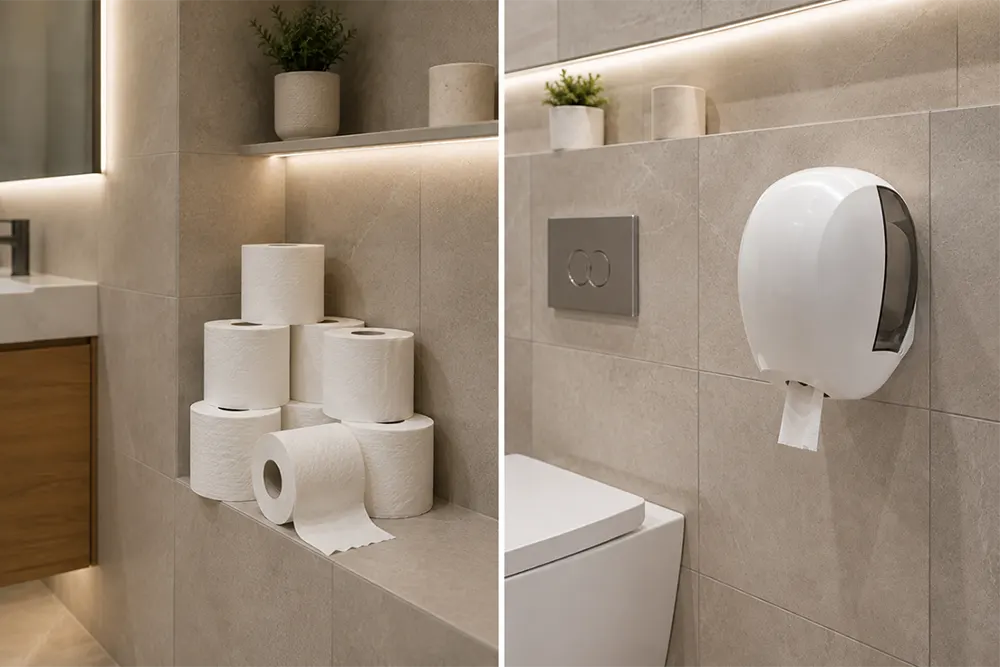
Professional toilet paper should be kept in suitable dispensers that protect it from moisture and dirt. To learn why it is superior to lower-quality toilet paper, read our blog post: Professional toilet paper for commercial facilities: The perfect balance of a gentle touch, superior cleanliness, and optimal savings.
What does it mean when toilet paper is hygroscopic?
A hygroscopic material absorbs moisture from the air and releases it again when conditions change, and toilet paper behaves in exactly this way. In a humid restroom, cellulose fibers naturally draw water vapor from the air until the moisture content of the paper reaches equilibrium with the humidity in the room, regardless of whether anyone has physically touched the roll.
Why does moisture weaken toilet paper fibers?
When the moisture content of paper increases, the bonds between cellulose fibers and the paper’s mechanical properties change. As a result, the paper may feel different to the touch, deform more easily, or behave differently when pulled or torn.
Which toilet paper changes the most in a humid room?
Paper with a lower grammage and lower initial strength may show more pronounced changes in its mechanical properties when it absorbs moisture. The type and quality of fibers, their length, sheet structure, number of plies, and manufacturing process all affect its behavior, so the quality cannot be assessed solely by whether the paper is made from virgin or recycled raw material.
Does two-ply toilet paper withstand moisture better than single-ply toilet paper?
Two-ply toilet paper may retain better functionality than thin single-ply paper, but the number of plies is not the only factor that determines its behavior under high-humidity conditions. Grammage, fiber quality and length, sheet structure, the way the layers are bonded, and manufacturing technology also affect strength.
How does professional two-ply toilet paper perform in a humid restroom?
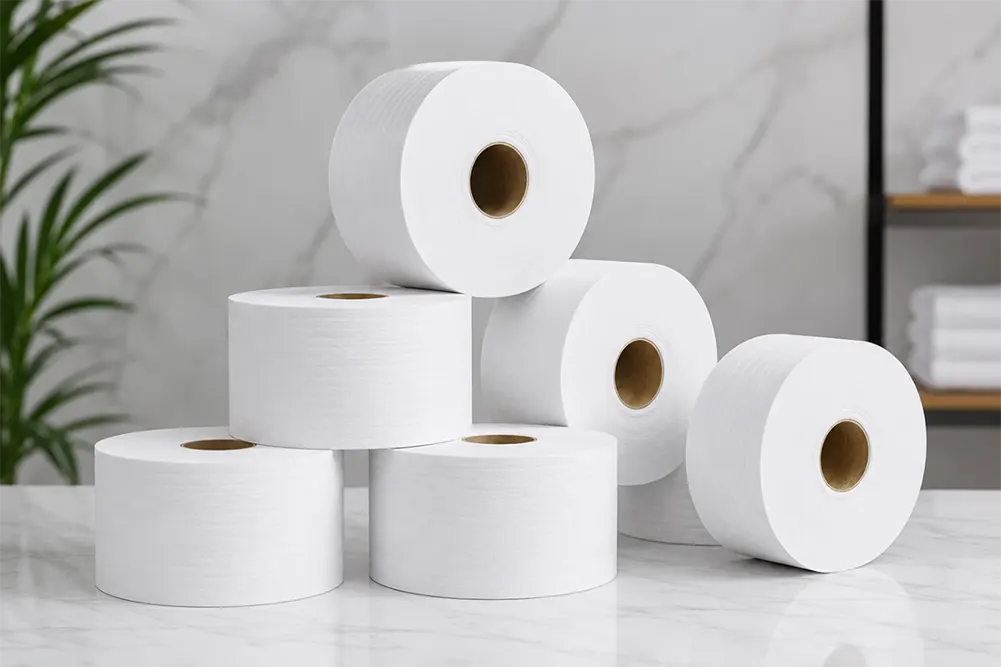
Professional two-ply toilet paper, made from higher-quality cellulose and featuring a denser fiber structure, changes texture significantly more slowly than single-ply paper. This is particularly important in restrooms with poor ventilation, where humidity remains consistently high.
Why is a dispenser important for protecting toilet paper from moisture?
A dispenser protects the roll from direct contact with humid air in the room because its enclosed housing slows the exchange of moisture between the paper and its surroundings compared with an open, unprotected roll. Professional toilet paper stored in a dispenser therefore retains its strength and texture for longer, even in restrooms where poor ventilation keeps humidity consistently high.
Where should you store spare toilet paper?
You should store spare toilet paper in a warehouse or a separate, dry room, not in the restroom itself where humidity remains consistently high. Open rolls left directly in the restroom, outside a dispenser, remain exposed to airborne moisture even when they are not in use, which accelerates the loss of strength before anyone even starts using them.
Does the roll core also react to moisture?
Yes, the cardboard core of the roll also absorbs moisture and may lose its shape or deform under prolonged humid conditions. A deformed core makes it harder for the roll to rotate properly in the dispenser, even when the paper itself appears intact.
Table: The effect of moisture on toilet paper
| Condition | What happens to the paper | Recommended solution |
| High air humidity | The fibers absorb moisture and the paper loses strength | Use an enclosed dispenser and provide adequate ventilation |
| Roll left outside the dispenser | The paper has greater direct exposure to humid air | Keep the roll in an enclosed dispenser |
| Spare rolls in a humid storage area | The fibers may absorb moisture before use | Store supplies in a dry warehouse |
| Prolonged exposure to moisture | The roll may lose its shape, and the layers may become harder to separate | Replace the roll and check the conditions in the room |
| Moisture in the cardboard core | The core may soften or deform | Keep rolls away from moisture and condensation |
Why does toilet paper change texture when exposed to moisture – Practical experience
- Problem: In a commercial facility, staff noticed that toilet paper occasionally tore when pulled from dispensers in restrooms with poorer ventilation. They stored spare rolls on an open shelf inside the restroom, exposing them to high humidity for extended periods. The paper became softer, and some rolls also showed slight deformation of the cardboard core.
- Solution: Staff moved the spare packages to a dry storage room and placed the toilet paper rolls in enclosed professional dispensers in the restrooms. They also introduced ventilation checks and stopped leaving spare rolls on open shelves in the restroom area.
- Result: The rolls retained their original texture and shape for longer, while problems with paper tearing and core deformation no longer occurred regularly. The procurement team also established a clearer rule: choosing the right product alone does not preserve paper quality; proper storage and protection from moisture until use are equally important.
Why does toilet paper change texture when exposed to moisture? – FAQ
If toilet paper is damp, does that mean it has gone bad?
Not necessarily, a slight change in texture is a normal consequence of the paper’s hygroscopic nature and does not mean that the product is defective, unless mold or an unpleasant odor appears, which indicates prolonged exposure to moisture.
Does the paper return to its original texture after it dries?
Partially, some paper properties may change to some extent after drying, but the paper may not fully return to its original condition. Fibers that have already broken or separated remain damaged. Lower-quality paper left exposed in the restroom itself usually experiences this change in texture. Professional paper protected inside a dispenser, with spare stock stored in a dry room, rarely encounters this situation.
Do heating and air conditioning in storage rooms reduce the effect of moisture on toilet paper?
Yes, heating and air conditioning reduce the relative humidity in the storage room, slowing the absorption of moisture by toilet paper supplies. This is particularly useful in warehouses without natural ventilation, where humidity would otherwise remain high and gradually weaken the paper fibers even before use.
Does packaging protect spare toilet paper rolls from moisture?
Sealed packaging can reduce the paper’s direct exposure to moisture from the surrounding environment, but it cannot replace proper storage. You should store packages in a dry area, away from the floor, damp walls, water sources, and areas where condensation occurs.
Can improper storage affect the quality of toilet paper before the package is opened?
Yes. Prolonged storage in a humid warehouse, especially when the packaging is damaged or insufficiently sealed, may allow moisture to gradually penetrate the paper. Therefore, the quality of the roll depends not only on production but also on transportation and storage conditions.
How can you tell if toilet paper has absorbed too much moisture?
Signs may include unusual softness, easier tearing, layers sticking together, a change in the roll’s shape, or a deformed cardboard core. If an unpleasant odor, visible discoloration, or mold appears, you should not use the paper.
The right choice is not simply toilet paper that looks good on a specification sheet, but paper that retains its properties under the actual conditions in your facility. With the right dispenser and properly planned consumption, quality remains where it matters most, in everyday use. See which solution best suits your facility.
About the author:
Milja Tonić – SEO Content Strategist & Copywriter
Milja Tonić is an SEO Content Strategist and Copywriter at LUU, specializing in creating expert content on professional hygiene, paper products, dispensers, and facility management.
The expert articles on this blog result from detailed research, an analytical approach, and editorial work by the author.
Subscribe to the LUU newsletter and stay up to date with the latest offers.