
Table of Contents
What do dispensers and paper hygiene products in education include?
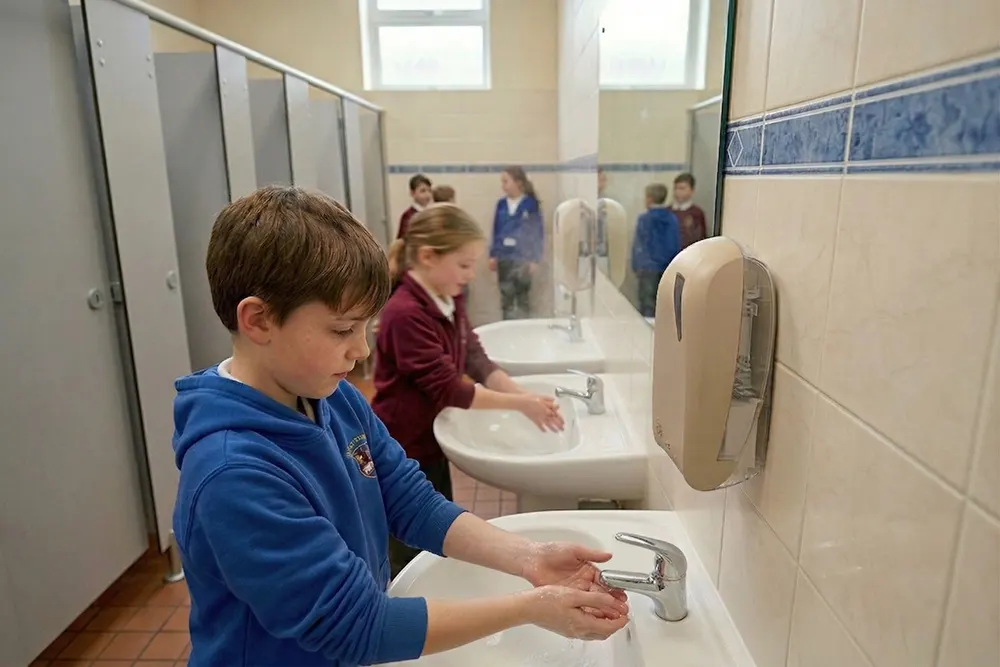
Dispensers and paper hygiene products in education include a complete range of products that enable both teaching staff and children and students attending educational institutions to use soap, paper towels, toilet paper, and disinfectants in a controlled and economical way.
If you are responsible for procuring paper hygiene products and dispensers for your school, faculty, or kindergarten, you need an adequate equipment package. This blog is a continuation of a series aimed at familiarizing end users with dispensers and paper hygiene products, consumption, savings, design, and dispenser aesthetics. You can read more about this in our Master guide.
When it comes to education, wall-mounted or freestanding dispensers, as well as consumables that are easy to refill, are at the top of the list.
Their role is both practical and preventive. They reduce direct contact with surfaces and thus lower the risk of spreading bacteria.
Hygiene standards in schools in Serbia are defined by the Ministry of Health, the Ministry of Education, and the Institute of Public Health of Serbia through laws, regulations, and professional recommendations that govern sanitary conditions and the prevention of infectious diseases.
Dispensers and paper hygiene products in education – Why are they essential for hygiene?
Dispensers and paper hygiene products in education are essential for hygiene because they enable controlled use of consumables, reduce direct contact with contaminated surfaces through touch-free dispensing of soap and paper towels, and significantly reduce the risk of transmitting bacteria and viruses in high-traffic environments such as schools and kindergartens. All of this additionally contributes to the prevention of seasonal flu.
In educational institutions, children and teaching staff often share objects, toys, and spaces, which increases the risk of spreading bacteria and viruses and makes hygiene especially important.
Considering the very high risk of transmitting bacteria and viruses, dispensers and paper hygiene products in education emerge as the most effective solution.
The most important advantages of soap dispensers are:
- reduction of contamination on contact surfaces
- precise dosing of soap and paper towels
- easier maintenance of sanitary facilities
- long-term financial savings
- better space organization without clutter
By partnering with Luu when procuring equipment and paper hygiene products, you will also gain a number of additional benefits such as:
- 0 RSD initial investment
- controlled dosing and reduced excessive paper consumption
- less waste, less frequent refilling, and lower monthly costs
- reduced risk of theft and misuse of materials (lock-in system)
- more efficient distribution across the facility without “empty” or overfilled points
- long-term reduction in operational, logistics, and storage costs
- precise consumption control, resulting in savings and better budgeting
When the system is properly established, hygiene becomes predictable and measurable, and you can save up to 39% on consumables.
How to choose the right dispensers and paper hygiene products for educational institutions?
The proper selection of dispensers and paper hygiene products for educational institutions depends on several criteria. These include capacity and durability, activation type, and compatibility with consumables.
To make it easier for you to choose the appropriate dispensers and paper hygiene products for educational institutions, we suggest considering three key criteria:
- capacity and durability of dispensers (due to high student traffic)
- type of activation
- compatibility with consumables for reduced usage.
Frequency of use, level of automation, and the number of users who visit your school, kindergarten, or any other educational institution daily are extremely important parameters for selecting an adequate dispenser.
The quantity and type of paper hygiene products are also equally important criteria.
Which soap dispenser should you choose for educational institutions?
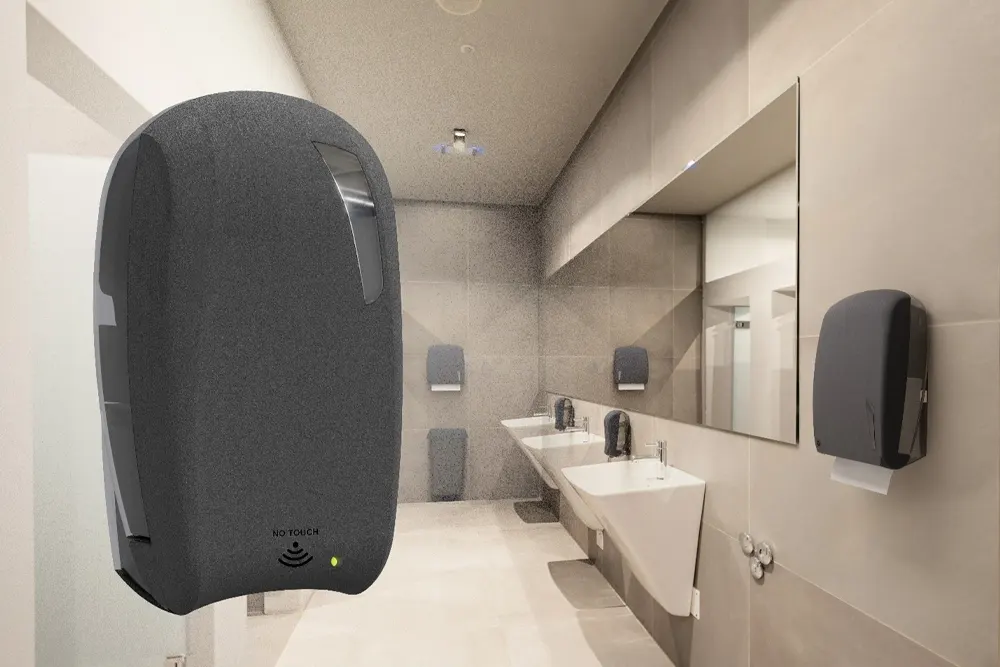
When it comes to soap dispensers for schools and other educational institutions, you should choose a robust and durable model designed for frequent use and a large number of daily users.
In practice, the Luu electronic foam soap dispenser with a 1L capacity has proven to be an excellent choice.
The Luu electronic dispenser can be mounted on a wall or a stand.
Thanks to touch-free soap dispensing and an IR sensor, there is no physical contact, and the level of hygiene increases significantly.
It is made from durable materials, with a cover made of ABS plastic and a base and window made of MABS material.
The lock is made of POM (polyoxymethylene), while the pump and collector are made of PP (polypropylene).
Paper towel dispensers
Toilet equipment in schools cannot be imagined without paper towel dispensers.
It is useful to know that there are two types of paper towel dispenser activation:
- manual
- sensor-based (touch-free)
Manual paper towel dispensers
Manual paper towel dispensers are devices that allow the user to take a paper towel mechanically (by pulling or pressing), providing basic consumption control and easy maintenance.
Sensor-based paper towel dispensers
Sensor-based paper towel dispensers enable precise touch-free dispensing, achieving maximum hygiene in the space.
The mechanical Luu Large paper towel dispenser is ideal for educational institutions known for high daily foot traffic.
This device is durable and practical, with a large capacity that reduces the need for frequent refilling.
It is wall-mounted, uses 750 Z-folded sheets, and features a key locking system, which prevents theft and uncontrolled use of paper towels.
Dispensers and paper hygiene products in education – What types are there?
Dispensers and paper hygiene products in education include various types of products tailored to the specific needs of an institution. For schools, faculties, kindergartens, and other educational institutions, dispensers for liquid soap, disinfectants, and paper towels are equally important.
The most common categories are:
- dispensers
- liquid soap dispensers
- disinfectant dispensers
- paper towel dispensers
- high-capacity toilet paper dispensers
- paper hygiene products
- folded paper towels
- hand paper rolls
- industrial toilet paper
- disposable tissues
Dispensers and paper hygiene products in education – How to properly use and maintain equipment?
Maintaining hygiene in education also means proper use of dispensers and paper hygiene products, as well as regular refilling, disinfection, and consumption control to ensure the system remains efficient and hygienically safe.
These are the most important steps:
- regular monitoring of consumable levels
- disinfection of dispenser surfaces
- use of compatible refills
- education of staff and students on proper use
Our experience has shown that user education is just as important as equipment quality. Without proper use, there are no good results.
Comparison table: traditional vs electronic dispensers
| Feature | Traditional soap dispenser | Electronic soap dispenser |
| Dispensing | Uncontrolled | Precise dispensing |
| Consumption | Higher | Reduced by up to 37% |
| Contact | Direct contact | Touch-free |
| Hygiene | Lower level | Higher level |
| Maintenance | Simple | Planned and controlled |
The table clearly shows the difference in approach. One system reacts. The other anticipates.
Practical experience
Collaboration with primary schools, kindergartens, educational centers, and other educational institutions has shown us an increase in hygiene maintenance efficiency when transitioning from traditional to controlled systems.
We tested implementation in a private educational institution in Zemun, Belgrade. After three months, the number of cleaning staff interventions in restrooms decreased. Consumption of soap, paper towels, and toilet paper stabilized. Staff reported easier hygiene maintenance, and management observed more predictable logistics and costs.
The result was a reduction in the consumption of paper hygiene products and soap between 25% and 39%, depending on the device.
Dispensers and paper hygiene products in education – FAQ
What are paper hygiene products in education?
Paper hygiene products in education include all consumable paper products such as paper towels, toilet paper, and tissues used to maintain hygiene in educational institutions. It is very important to optimize their consumption to prevent unnecessary use and increase savings.
How do dispensers reduce costs?
Soap dispensers, as well as other types of dispensers, reduce costs through controlled dosing. Pre-programmed doses reduce material waste and optimize consumption over the long term. In addition, they facilitate device use and prevent mess in restrooms and other areas where they are used.
Are sensor dispensers necessary?
Sensor dispensers are not mandatory but significantly increase hygiene levels as they eliminate the need for contact. Since there is no direct contact between the user and the device, the risk of bacterial transmission is minimized.
How often should dispensers be maintained?
Dispenser maintenance can be carried out weekly, monthly, quarterly, or as needed. Daily visual inspection and regular cleaning in accordance with the institution’s hygiene protocols are recommended.
Dispensers and paper hygiene products in education are not an expense but an investment. After a few weeks, you will notice a reduced number of absences among teaching staff, fewer absences among children and students, as well as a subjective feeling of better health and increased efficiency among all users.
If you are considering improving hygiene standards in your institution, explore how Luu solutions can optimize consumption and increase control.
Discover how to improve the hygiene standard of your space or learn more about solutions tailored to your institution. Schedule free consultations for equipping your educational institution.
Subscribe to the LUU newsletter and stay up to date with the latest offers.