
Table of Contents
Automatic or manual dispensers are one of the crucial questions when it comes to hygiene in education. The right choice directly affects consumption and hygiene levels as well as daily habits among children. To find out how to do this in the most efficient way, read our blog: Dispensers and paper products in education – how to raise hygiene standards in schools and kindergartens?
What are automatic and manual dispensers?
Automatic and manual dispensers are devices for dispensing soap, paper towels, or disinfectants. Touchless dispensers operate without contact using sensors, while manual ones require physical contact by the user. The difference in activation directly affects hygiene, consumption, and behavior.
These systems use sensors and a predefined dose.
Manual models operate by pressing or pulling.
Both have their use. The difference lies in the type of educational institution and the specific needs of children and staff.
How do automatic (sensor) dispensers affect hygiene?
Sensor dispensers improve hygiene by eliminating the need for physical contact, thereby reducing the transfer of bacteria between users. The system works on a sensor principle and dispenses a precisely defined amount of soap or paper, which further prevents contamination and waste.
Analysis: Automatic (sensor) dispensers
| Feature | Advantages | Disadvantages |
| Hygiene | No contact with contaminated surfaces | Periodic cleaning of the sensor is required |
| Health | Reduced spread of bacteria and viruses | / |
| Consumption | Efficient and precise dosing | / |
| Neatness | Cleaner space without dripping and mess | / |
| Costs | Long-term material savings +
0 RSD CAPEX (you only pay for what is used) |
Higher initial device cost if purchased compared to traditional ones |
| Power supply | 2 AA batteries | Battery replacement required |
| Maintenance | Less frequent refilling | / |
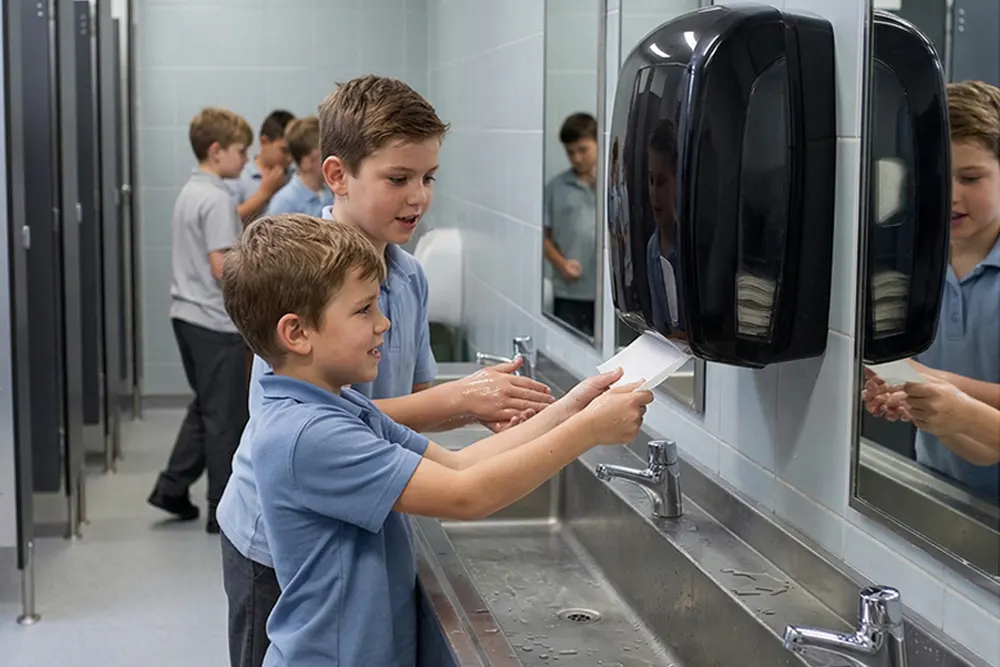
How do manual dispensers affect students’ habits?
Manual dispensers positively influence habits. Children learn proper hygiene and handwashing habits. Active use of dispensers can contribute to the development of responsibility.
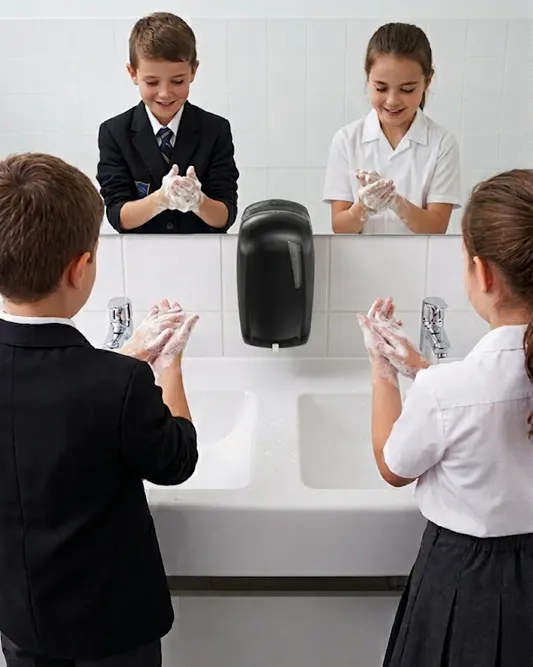
Advantages and disadvantages of manual dispensers
| Feature | Advantages | Disadvantages |
| Investment | Lower initial purchase cost or
0 RSD initial investment with a supply contract. |
Higher costs if purchased individually. |
| Maintenance | Easy and simple system maintenance. | / |
| Consumption | Slightly higher compared to automatic. | Higher and uncontrolled material consumption. Usage depends entirely on the user’s judgment. |
| Use | Simple refilling of supplies and soap. | Physical contact with the device is required. |
| Power supply | Do not require batteries or electricity | / |
| Hygiene | / | Higher risk of surface contamination. |
What is more cost-effective in the long run: Automatic or manual dispensers?
Automatic technology turns cost into investment. Sensor precision eliminates waste. Although the initial investment is higher, total costs balance out through controlled dosing and reduced material loss. If used for large consumers such as schools or educational institutions, CAPEX is 0 RSD and you only pay OPEX.
Most common effects:
- lower consumption of soap and paper towels
- less frequent refilling
- less waste
- better budget control
Which solution to choose for a school or kindergarten?
The choice between automatic and manual dispensers depends on the number of users, budget, and hygiene priorities. In high-traffic facilities, automatic systems deliver better results, while manual ones can be adequate in smaller and controlled spaces.
It is recommended to provide sufficient soap and hand-cleaning products in educational facilities, as proper hand hygiene significantly reduces the spread of infectious diseases among children and staff. Guidelines can be found on the official website of the Centers for Disease Control and Prevention.
Recommendation for kindergartens are LUU automatic dispensers
The recommendation for kindergartens is Luu automatic dispensers that operate contactlessly using infrared sensors. When a child or staff member places their hand near the sensor, the mechanism activates automatically and dispenses a precise amount of product.
Overview of LUU automatic dispensers
| Feature | Details and models |
| Advantages | • Fully touchless use (sensor-based operation)
• Controlled dosing (prevents waste) • Higher level of hygiene in the space • Significant reduction in the transmission of bacteria and viruses |
| Recommended models | • LUU Electronic liquid soap dispenser (0.5l) |
| Design and colors | • Blanc (white)
• Nero (matte black) • Ramel (sand) • Rock (stone) |
LUU manual dispensers for primary schools and staff rooms
Manual dispensers operate mechanically: the user presses a lever or button or pulls paper to dispense soap or towels. Some models have an Autocut system that automatically cuts paper to a specific length.
Advantages of manual dispensers:
- do not require batteries or electricity
- easy maintenance
- reliable in operation
- more economical to purchase
If it is more practical for you to use manual models, we recommend:
Overview of LUU manual models
| Category | Model name |
| For soap | LUU foam soap dispenser 1l mechanical |
| For paper towels | LUU autocut dispenser |
| For toilet paper | LUU toilet paper dispenser sheets |
| Combined models (DUO) | LUU DUO dispenser for liquid soap and paper towels |
Professional dispensers of this type are made from durable materials and are adapted to high-traffic spaces such as schools and kindergartens.
Comparison table automatic or manual dispensers
| Feature | Manual dispensers | Automatic dispensers |
| Activation | Touch (pressing) | Touchless (sensor) |
| Hygiene | Lower level | Higher level |
| Consumption | Higher and uncontrolled | Precise dosing |
| Maintenance | Simple | Planned |
| Costs | Lower initially | Lower long-term |
Costs are lower initially with manual models, while automatic dispensers are more cost-effective in the long run.
Practical experience
We recently visited a high school in New Belgrade whose staff expressed the need to switch from manual dispensers of another manufacturer to Luu automatic dispensers due to easier use and savings in paper products and soap.
The decision proved justified based on measured results.
- paper towel consumption reduced by 33%
- no repairs, only refills over a 12-month period
- significantly cleaner restrooms without material waste
The system became predictable and cost-effective in the long term for the school, maintenance staff, general affairs coordinator, and the school’s financial officer.
FAQ
What is better for children – automatic or manual dispensers?
Automatic dispensers are better for children because they reduce contact with unhygienic surfaces and ensure controlled material usage.
Are automatic dispensers complicated to use?
They are activated by a sensor and are easy to use.
Do manual dispensers have advantages?
Yes. They have a lower initial cost and simpler installation but require more control in use.
What is the difference in consumption?
In practice, automatic systems can reduce consumption by 27 to 37% compared to manual ones.
Discover how to improve the hygiene standard of your space and find out which solution best suits your institution. Schedule free consultations so we can analyze consumption and savings together in your educational institution.
Subscribe to the LUU newsletter and stay up to date with the latest offers.