
Table of Contents
School hygiene standards – quality education begins in an environment that inspires safety Although a hygiene standard is often viewed as a technical detail in facility maintenance it is actually the foundation of health protection for every student and the most important requirement of domestic regulatory bodies. How to raise school hygiene standards read on our blog: Dispensers and paper products in education – how to raise school hygiene standards in schools and kindergartens?
What do school hygiene standards include?
School hygiene standards include a set of rules and procedures that enable a safe and healthy environment for students through regular maintenance availability of hygiene materials and control of contamination in sanitary areas.
In practice this implies that there is:
- constant availability of soap and paper towels
- functional dispensers
- controlled consumption of materials
- a clearly defined maintenance system
Without these elements the standard exists only on paper.
What does the legal regulation prescribe for school hygiene standards in Serbia?
Legal regulation in Serbia prescribes strict sanitary conditions that regulate a safe environment for staying and working in educational institutions. These standards require mandatory equipping of toilets and kitchens with functional dispensers along with continuous availability of liquid soap and paper towels for hygienic hand drying. The goal of these regulations is the prevention of infection spread through the elimination of cross-contamination which directly affects the health stability of the collective.
All facilities under sanitary supervision including primary and secondary schools must align their operations with the following key regulations:
- Compliance with the law is not a matter of spontaneous execution but strict adherence to regulations defined by the Ministry of Health of the Republic of Serbia. A very important document regulating this area is the Rulebook on general sanitary conditions which in its provisions specifies the necessity of having means for hygienic hand drying in all facilities of public importance
- In addition to basic school premises educational institutions that include kitchens or cafeterias are also subject to specific standards defined by the Rulebook on sanitary-hygienic conditions
These regulations require that every segment of the institution from toilets to food preparation areas meets the highest health protection standards thereby directly preventing contamination and enabling a stable working environment.
What must a school necessarily have?
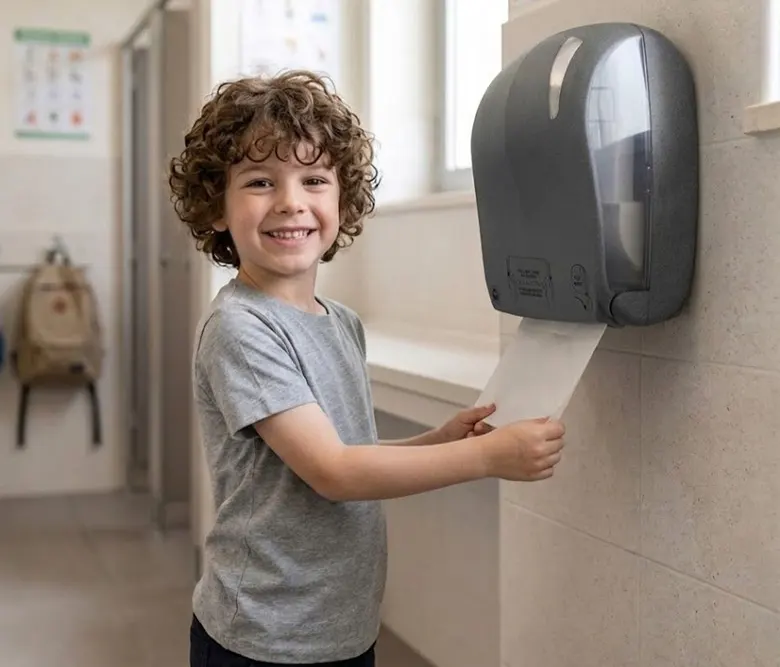
According to current standards the hygiene minimum in school toilets and common areas includes the following elements:
1. Hand washing products (Liquid soap)
The school is obliged to ensure constant availability of liquid soap. The use of solid soaps in schools is not recommended (and often prohibited) because they become a breeding ground for bacteria as soon as they are used by multiple people.
- Ideal solution: Sensor Luu dispensers for foam soap that prevent contact and reduce consumption.
2. Hand drying products (Paper towels)
Wet hands transmit bacteria much faster than dry ones. The law requires the existence of means for single-use hand drying.
- Note: Textile towels are strictly prohibited in public school toilets due to a high risk of cross-contamination. Paper towels in dispensers are the standard required by inspection.
3. Toilet paper in every cabin
Availability of toilet paper is a basic hygiene requirement. In schools emphasis is placed on dispensers that protect the roll from external influences and moisture and prevent contamination as well as unnecessary unwinding of more toilet paper than needed as well as throwing entire rolls into the toilet bowl.
4. Hot and cold running water
All sinks must be connected to the water supply network with safe drinking water and as a rule hot water should also be provided for more efficient hand washing.
5. Waste disposal equipment (Bins)
Next to every sink and in every cabin there must be a waste bin ideally with a lid that opens with a pedal in order to avoid direct hand contact.
Table: Minimum equipment standards
| Mandatory item | Why is it necessary? | Luu recommendation for stability |
| Liquid soap | Removal of 99% of pathogens | LUU – Electronic liquid soap dispenser – 0.5l |
| Paper towels | Prevention of bacteria spread from wet hands | LUU – Autocut dispenser (less waste) |
| Toilet paper | Basic sanitary necessity | Luu locked dispensers (vandalism prevention) |
| Disinfection | Additional protection during virus seasons | LUU – Dispenser for disinfectant |
Why is proper restroom equipment necessary for compliance with laws?
Proper restroom equipment enables schools to meet legal standards because it ensures continuity of hygiene reduces the risk of infection and eliminates manual unreliable processes of material replenishment.
This system includes:
- equipment that prevents waste and disorder in school toilets
- controlled soap dosing
- reduced contact with surfaces
- continuous availability of supplies
How do dispensers directly affect hygiene and costs?
Dispensers directly affect school hygiene standards because they control the amount of consumption reduce contact and ensure constant availability of materials without waste.
The difference between a system and improvisation is clearly visible.
Comparison of solutions
| Feature | Traditional dispenser | Luu electronic dispenser |
| Dosing | Uncontrolled (multiple presses) | One precise dose |
| Consumption | High | Savings up to 37% |
| Contact | Manual use | Contactless |
| Hygiene | Varies | Stable |
| Maintenance | Frequent | Rare |
Less waste means fewer refills and fewer empty dispensers.
This achieves a stable hygiene standard.
School hygiene standards – what does practice say and what does the optimal solution look like?
The optimal solution for school hygiene standards includes a combination of equipment control and a refill system that eliminates human error and introduces predictability into maintenance.
In real school conditions the problems are always the same:
- soap runs out too early
- paper towels are consumed uncontrollably
- staff react too late
The solution is a smarter system that reduces consumption of paper products and soap by 29% on an annual level.
Most importantly this approach reduces the possibility of spreading bacteria and viruses among children and staff by 49% especially during winter months.
The system solution includes:
- locked dispensers
- sensor dosing
- standardized refills
- a refill plan based on consumption
Experience from practice: transformation of the hygiene standard in an educational environment
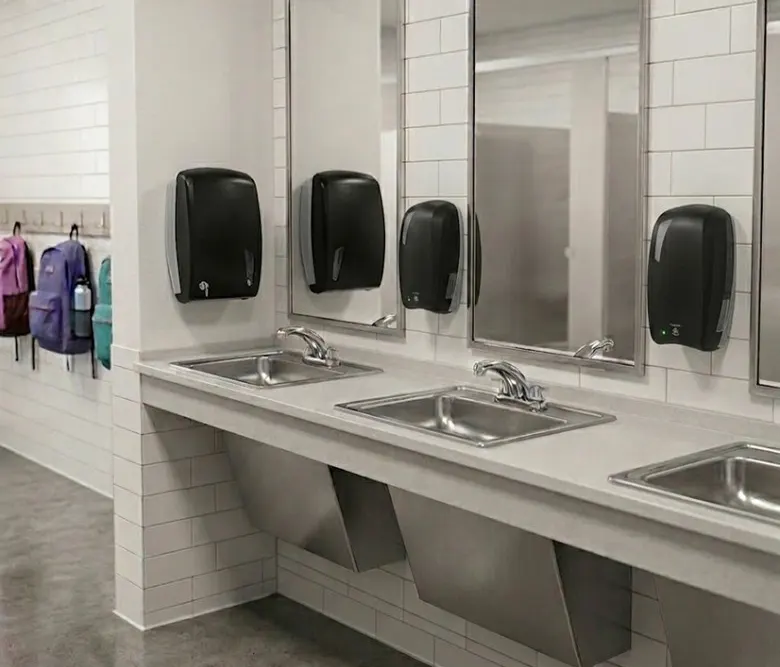
In cooperation with several leading educational institutions in Belgrade we identified a common challenge: traditional equipment systems could not keep up with the intensity of use during breaks which led to a chronic shortage of materials and disruption of the hygiene protocol. By implementing the LUU system with controlled dosing we shifted the focus from constant procurement to smart consumption.
The results we achieved are:
- paper towel consumption reduced by 37%
- clean toilets at all times
- satisfied parents students and management
- reduced number of school absences by 23% annually
If you want a detailed explanation of how such a system works in practice visit us in our showroom at Jablanička 184 in Belgrade. Find out why LUU dispensers are necessary for your school. You can also call us and schedule free consultations and we will answer all your questions.
School hygiene standards – FAQ
- Are school hygiene standards legally mandatory? Yes they are defined through health and sanitary regulations and are mandatory for all educational institutions.
- How often should dispensers be refilled? It depends on the frequency of use but with controlled dosing the intervals are significantly extended.
- Do sensor dispensers really reduce consumption? Yes because they eliminate multiple pressing and precisely dose the quantity.
- What is the biggest problem in school toilets? Lack of a system not equipment.
Sign up for the LUU newsletter and stay up to date with the latest offers.