
Table of Contents
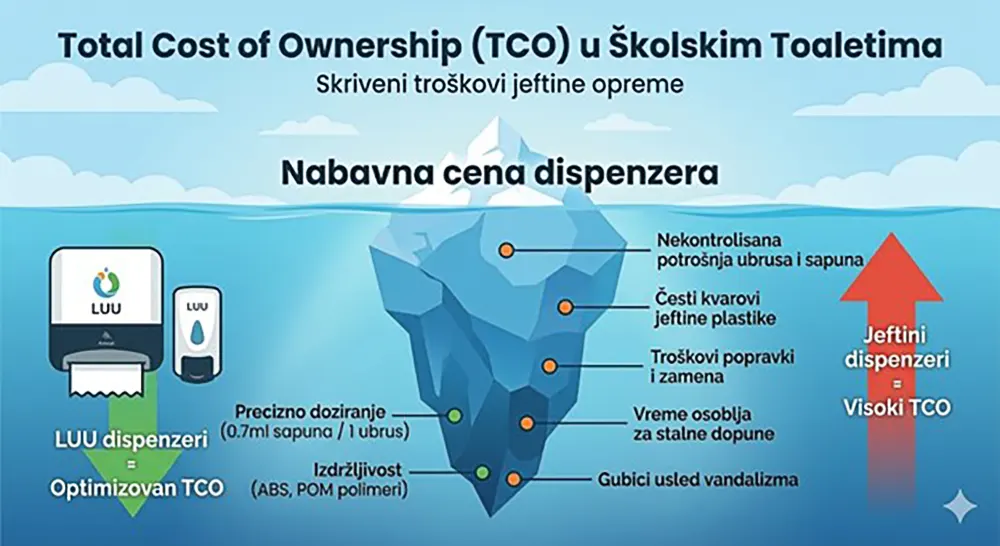
In budgeting educational institutions, the lowest price on the invoice often becomes the most expensive item in practice. While the initial school dispenser prices are easily noticeable, the real costs are hidden beneath the surface in uncontrolled paper waste, frequent malfunctions, and constant staff engagement for refilling.
How to equip school restrooms wisely, save money, and raise the hygiene standard in your school, read in our blog: Dispensers and paper products in education – how to raise hygiene standards in schools and kindergartens?
Why school dispenser prices are not a realistic indicator of cost?
School dispenser prices are not a realistic indicator of cost because they do not include material consumption, refill frequency, and operational maintenance costs, which in practice make up the largest part of the total budget.
The initial price is visible.
The real cost is not.
When only the purchase price is considered:
- consumption is overlooked
- maintenance is ignored
- control is lost
It is important to know that the total cost arises during usage. Not at the time of purchase.
How do cheap dispensers increase maintenance costs?
Cheap dispensers increase maintenance costs because they allow uncontrolled dosing, break down more often, and require constant refilling, which directly increases material consumption and staff workload.
The most common effects are:
- multiple pressing of soap dispensers
- excessive paper pulling
- leakage and malfunctions
How do long-term cost-effective LUU dispensers reduce total costs?
LUU dispensers reduce total maintenance costs (TCO) through strict consumption control and the elimination of hidden costs of cheap equipment. The application of the Autocut system and precise sensor dispensers of 0.7 ml reduces material waste by up to 37%, while the use of high-quality Italian polymers (ABS, POM) drastically extends the device lifespan in high-consumption conditions.
The most important advantages of efficient LUU systems are:
Material consumption control:
- The Autocut system prevents waste one towel per pull instead of 3-4
- Electronic soap dispensers deliver exactly 0.7 ml per cycle
- Folded paper dispensers dose individually
- This control results in significant savings in consumables
Equipment durability:
- Italian material quality (ABS, MABS, POM) ensures longevity
- Resistance to frequent use in school environments
- Less need for replacement or repairs over years of use
Reduced maintenance costs:
- Large capacities (450-750 sheets) mean less frequent refilling
- Transparent windows enable efficient refill planning
- Simple servicing and cleaning
Hygiene and health:
- Touchless use reduces the spread of bacteria and viruses
- Fewer student and staff sick days mean lower costs for replacements and medical services
Protected investment:
- Locking mechanism prevents vandalism
- High-quality materials resistant to damage
- Long-term functionality warranty
Contract model:
- Elimination of initial equipment costs
- Predictable monthly costs only for consumables
- Service and replacement included in case of malfunction
How to achieve optimization of the TCO factor through LUU systems?
When we talk about professional facility maintenance, TCO (Total Cost of Ownership) represents the only measure of real cost-effectiveness, and LUU dispensers are designed to directly optimize every component of this equation.
Instead of focusing on the initial price, LUU systems drastically reduce total costs through precise resource control:
Foam soap with a dosage of 0.7 ml and Autocut mechanisms reduce material waste by over 29%.
- Long-term TCO is further reduced thanks to the extreme durability of Italian polymers that eliminate the costs of frequent replacements
- Touchless technology acts preventively on collective health and reduces indirect costs of sick leave and absence
- By choosing LUU dispensers, management shifts from a reactive consumption model to a predictive investment model, where top-quality equipment is obtained through contractual cooperation without hidden maintenance and service costs
School dispenser prices – Comparison of solutions
Comparison: Cheap vs long-term cost-effective solution
| Factor | Cheap dispensers | Long-term cost-effective Luu dispensers |
| Initial price | High (purchase) | 0 RSD initial investment for dispensers for a 2-year contractual supply model of paper products |
| Dosing | Uncontrolled (multiple presses or towel pulls) | Controlled (one dose per use) |
| Material consumption | High | Reduced by up to 27–37% |
| Refill frequency | Frequent | Optimized |
| Malfunctions | Frequent | Rare |
| Durability | Short lifespan | Long lifespan |
| Hygiene standard | Varies | Stable |
| Total cost (TCO) | High | Lower over time |
| Operational burden | High (constant interventions) | Minimal |
| Cost predictability | Low | High |
How to make the right decision when choosing equipment?
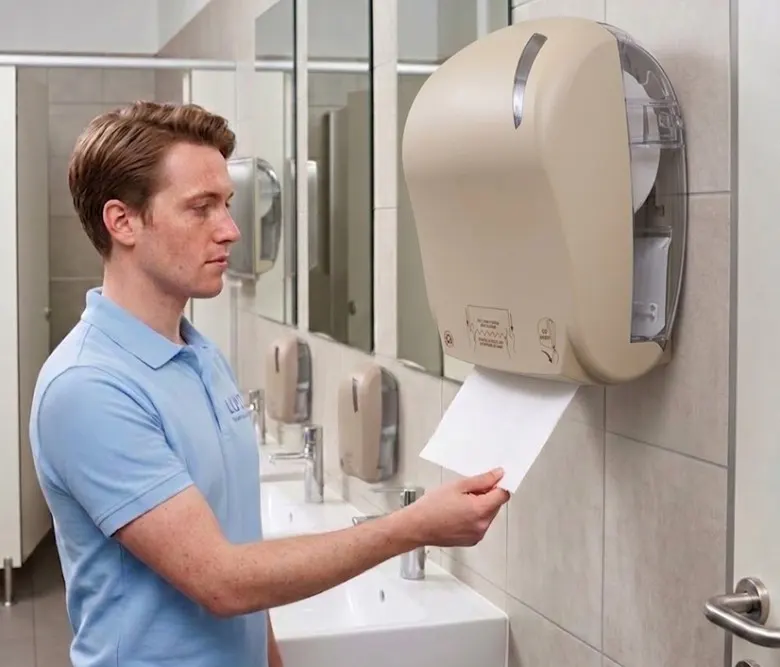
The right decision when choosing equipment is made by analyzing the total cost of use, not the initial price, with a focus on consumption control, durability, and compliance with hygiene standards.
When choosing, pay attention to:
- dosing method
- equipment durability
- compatibility with consumables
- ease of maintenance
When equipping restrooms, schools are not left to free assessment but must strictly follow the Rulebook on sanitary-hygienic conditions for facilities where educational activities are carried out.
According to the provisions of this Rulebook, it is mandatory to provide functional handwashing stations equipped with liquid soap and hygienic hand-drying solutions.
The use of shared textile towels is unacceptable due to the risk of cross-contamination, which highlights paper towels in controlled dispensers as the only proper hygiene standard.
Experience from practice: How schools in Novi Sad optimized their budget
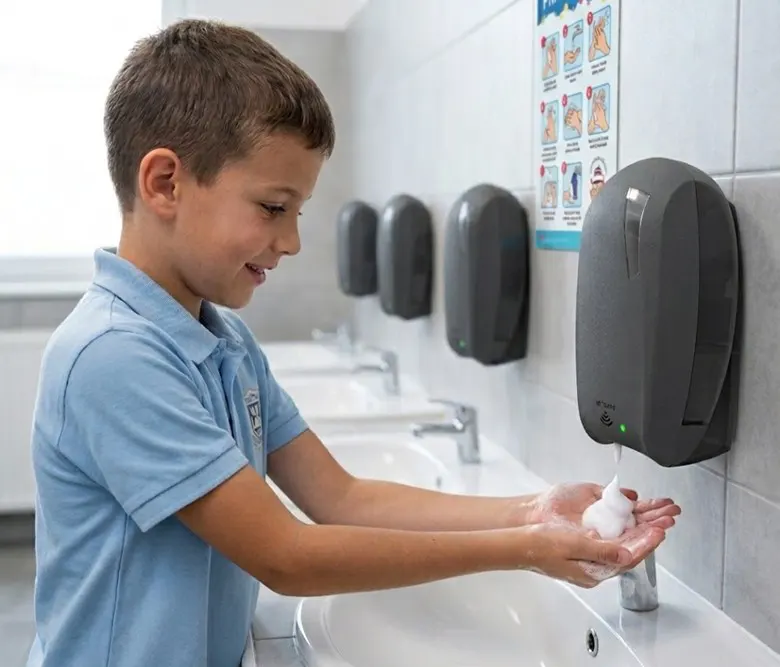
In cooperation with several leading primary and secondary schools in Novi Sad, we identified that the greatest losses occurred due to:
- uncontrolled paper consumption during breaks
- frequent malfunctions of cheap plastic dispensers
By installing LUU systems with Autocut mechanisms and soap sensors, these institutions achieved:
-
- a reduction in total paper product consumption by 34% already in the first quarter
- a contractual model with 0% initial investment that enabled school administrations predictable monthly costs without hidden repair expenses
Today, these facilities not only meet the highest sanitary standards but also serve as an example of smart resource management, where saved funds can be used for other educational priorities.
School dispenser prices – FAQ
- Are cheap school dispensers really more expensive in the long run? Yes, because they increase consumption and require more frequent maintenance.
- How to assess the real cost of dispensers? Through analysis of consumption, maintenance, and durability, not only through the purchase price.
- Does dosing control make a difference? Yes, because it directly affects the amount of consumed material.
- What are the real savings? In practice, systems with control can reduce consumption by up to 27–37%.
Discover how to reduce maintenance costs without compromising hygiene and contact the LUU team for free consultations.
Subscribe to the LUU newsletter and stay up to date with the latest offers.