
Table of Contents
Paper towels in schools represent a standard that directly impacts hygiene, safety, and space organization. Their use is an important issue of a systematic and responsible approach to controlling contamination, consumption, and the maintenance of sanitary conditions. Learn more about paper towels and paper products that improve hygiene standards in your school in our blog: Dispensers and paper products in education – how to raise hygiene standards in schools and kindergartens?
Why are paper towels a more hygienically safe choice?
Paper towels are a more hygienically safe and superior solution because they enable single use, thereby eliminating the transfer of bacteria between students and reducing the risk of infection spread in the school environment.
These are the main reasons:
Hygienic superiority (Reduction of cross-contamination):
- Electric dryers, especially those with a powerful jet of air (jet dryers), act as dispersers of bacteria
- Dryers pull in air from the toilet (which is full of aerosols after flushing) and spread it at high speed throughout the room, onto the child and their clothing
- Paper towels do what air cannot – through friction they physically remove residual bacteria that washing with water has not eliminated
Flow speed:
- In schools, hundreds of children gather in the restroom within a 5 to 15 minute interval
- Proper hand drying with an electric dryer takes 30–40 seconds. A child’s attention (and patience) lasts about 5 seconds
- Children often give up at the dryer and leave with damp hands, which is a perfect breeding ground for new germs and viruses. With the Luu paper towel dispenser – Large, a child takes a towel on the move and dries their hands while returning to the classroom
Acoustic comfort (Noise that disrupts teaching):
- School restrooms are often located right next to classrooms or in hallways where every sound is heard
- Modern hand dryers reach noise levels of up to 90–100 decibels, equivalent to a chainsaw. This sound can be stressful for children with sensory issues and has been proven to disrupt student concentration in nearby classrooms.
Multi-purpose use:
- A school is a dynamic place where incidents happen constantly
- With a paper towel, a child can wipe their mouth after a snack, clean spilled juice from a desk, or wipe their glasses. An electric dryer is limited strictly to the restroom wall
Reliability and TCO (Total cost of ownership):
- Although electricity may seem cheaper than paper, the reality in schools is different: electric dryers are prone to breakdowns and vandalism. When a dryer breaks, the restroom is left without any drying solution until a technician arrives
- Luu paper towel dispenser has no electronics that can fail, and with a contractual model (from 0 RSD initial investment), the school never runs out of materials
How do paper towels reduce the risk of contamination?
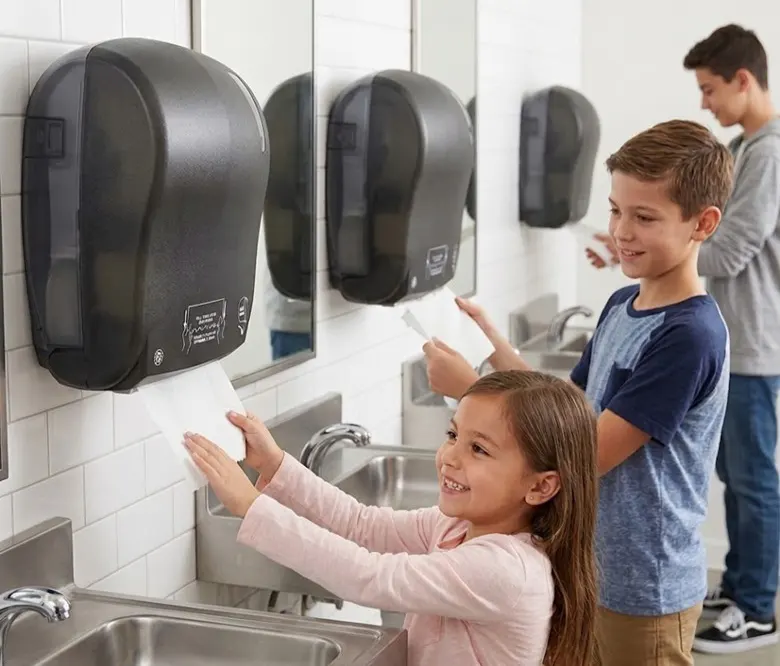
Paper towels reduce contamination by physically removing moisture and bacteria from the hands while simultaneously preventing contact with shared surfaces such as faucets and door handles.
The world’s leading authority for disease control, the American CDC (Centers for Disease Control and Prevention), in its official guidelines for schools emphasizes that proper hand drying is just as important as washing itself. According to their research, wet hands transfer germs up to 1,000 times faster than dry ones, which is why ensuring the constant availability of paper towels in school restrooms is an important strategy for reducing student absenteeism and the spread of seasonal infections in group settings.
Why are LUU paper towel dispensers the best solution for your school?
LUU dispensers represent the gold standard in equipping educational institutions because they directly address three critical challenges: hygiene, budget, and durability. Thanks to the advanced Autocut system, these dispensers prevent waste by dispensing one towel at a time, which reduces consumption by up to 37%. Touchless use eliminates cross-contamination, while the robust Italian construction with a locking system guarantees resistance to vandalism in high-frequency school restrooms.
Comparative overview: LUU Autocut systems vs alternative solutions
| Comparison factor | Electric air dryers | Classic dispensers (v-fold) | LUU Autocut dispensers |
| Hygiene and health | Poor. They disperse bacteria from the air directly onto hands and clothing. | Moderate. The device itself is often touched to pull out paper. | Superior. Touchless use: paper physically removes remaining microbes. |
| Speed and flow | Slow. 30–40 seconds per child is required. Queues form. | Moderate. Children often pull out a pile of paper at once. | Fast. A towel is ready in a second. Ideal for school breaks. |
| Consumption control | None (electricity is consumed as long as the device runs). | None. Children pull 5–10 sheets, which end up in the bin or toilet. | Strict. The Autocut mechanism dispenses exactly one towel. Reduces waste by up to 37%. |
| Noise level | High (90+ dB). Disrupts classes and frightens younger children. | Low. Quiet dispensing. | Low. Almost silent operation without disrupting lessons. |
| Vandalism and failures | Frequent. Heaters and sensors break, and repairs are expensive. | Moderate. Often break due to cheap plastic. | Rare. Italian ABS plastic and locking system protect the device. |
| Economic factor | High electricity and maintenance costs. | Cheap initially but very expensive due to excessive paper waste. | Most cost-effective (TCO). Through a contractual model and paper savings, costs are minimal. |
| Multi-purpose use | Hands only. | Hands, face, spilled liquids. | Hands, face + hygienic surface cleaning. |
Paper towels – Practical experience:
In cooperation with a school of 900 students in Zvezdara, Belgrade, we resolved chronic hygiene maintenance issues under high-intensity usage conditions.
Challenges we solved:
- Intentional clogging of toilets with bundles of paper
- Dispensers being emptied already after the first break
- Old dryers that disrupt classes in nearby classrooms
Solution we implemented:
- Luu Autocut mechanism: “Sheet-by-sheet” dispensing prevented dumping large amounts of paper into drains
- Locked dispensers prevented theft and spillage of rolls
- Precise dosing (0.7 ml) eliminated slippery floors and excess waste
Results achieved:
- Paper consumption reduced by 31%.
- Zero floods and breakdowns since installation
- Less frequent refilling freed staff for other tasks
- Introduction of recycled towels within the “Eco-school” program
Paper towels – FAQ
Are paper towels more expensive than other solutions? At first glance, they may seem more expensive, but with controlled consumption they often result in lower total costs.
How often should dispensers be refilled?
It depends on usage frequency, but on average once a day or according to the maintenance plan.
Are they better than electric hand dryers?
In the context of hygiene and bacterial control, paper towels provide greater safety.
Do not allow poor hygiene to increase absenteeism in your school.
Sign up for a free session of hygiene budget optimization.
Subscribe to the LUU newsletter and stay up to date with the latest offers.