
Table of Contents
Dispenser cost analysis for commercial buildings represents a comprehensive calculation that compares the initial equipment costs with long-term savings in consumable materials and labor.
Instead of focusing solely on the price of the device itself, this analysis examines the total cost of ownership TCO (Total Cost of Ownership).
To find out which dispensers you need depending on the type of your commercial building, read our blog: Dispensers in commercial buildings: What should you know before procurement?
What are the factors of dispenser cost analysis for commercial buildings?
The factors of dispenser cost analysis for commercial buildings are:
- material savings calculation
- operational cost optimization
- CAPEX vs OPEX model
- depreciation control
- return on investment
Here is an overview of the most important factors of the cost analysis of dispensers organized in a table for easier comparison and understanding:
| Analysis factor | Focus and methodology | Key benefit |
| Material savings calculation | Measures the difference between uncontrolled dispensing in low-cost models and precise sheet-by-sheet or drop-by-drop dispensers | Reduction in material consumption by up to 40%. |
| Operational cost optimization | Focuses on reducing labor hours: larger-capacity dispensers require less frequent refilling | Increase in staff efficiency by approximately 30%. |
| CAPEX vs OPEX model | Examines CAPEX 0% contractual models where equipment is provided for use instead of being purchased | Transforms a large investment into a fixed, predictable monthly expense while preserving liquidity |
| Depreciation control | Evaluates equipment lifespan and resistance to wear | Reduction in the costs of frequent replacements and breakages typical of low-cost solutions |
| Return on investment through brand image | Analyzes the intangible value of impeccable hygiene and touchless dispensers | Higher employee satisfaction and improved client retention |
The essence of this analysis lies in recognizing that the cheapest dispenser often becomes the most expensive over time due to resource waste and frequent malfunctions.
In the world of premium business operations, the details that go unnoticed create the greatest difference.
Hygiene is no longer just a background operational element but the silent identity of a company that communicates its standards before a single word is spoken.
Why is a cost analysis of restroom equipment in commercial buildings necessary?
A cost analysis of restroom equipment in commercial buildings helps companies evaluate the total costs of a hygiene system, including material consumption, maintenance, and the long-term reliability of the equipment.
High-quality professional dispensers can significantly reduce paper and soap consumption, improve maintenance efficiency, and enhance the hygiene standards of the facility.
Based on the analysis, it becomes easier to choose a solution that provides the best balance between the initial investment, operational costs, and user experience.
Making equipment decisions based solely on the lowest price on paper may seem rational, but in practice it often creates budget leakage through uncontrolled consumption and constant complaints.
A true dispenser cost analysis for commercial buildings shows that the initial price of the device is only a small part of the bigger picture.
Far more important factors are:
- Resource control: Professional dispensers function like precisely calibrated valves that do not dispense more than necessary
- Operational stability: A high-quality device reduces the number of staff interventions and ensures long-term predictable costs
- Psychology of trust: An impeccable restroom creates an impression of organization and professionalism for every visitor
Dispenser cost analysis for commercial buildings – What makes the difference between an expense and a smart investment?
The difference is reflected in long-term value and resource control. An expense focuses exclusively on the outflow of money at the moment of purchase, while a smart investment evaluates how that same device impacts the budget throughout its entire operational lifespan.
The biggest mistake in restroom equipment procurement is viewing dispensers as an ordinary expense.
Low-cost models often appear to be a good purchase because they have a lower initial price. However, over time they create problems:
- uncontrolled paper and soap consumption
- more frequent refilling
- breakages and replacements
- greater staff involvement
- poorer visual impression of the space
- increased risk of unhygienic use
On the other hand, professional dispensers are designed to reduce consumption and standardize usage. They do not dispense more than necessary to the user. This is precisely where the greatest difference in long-term profitability is created.
Professional dispensers are designed to remain unnoticed. They bring order to the environment:
- Drop-by-drop and sheet-by-sheet dispensing: Controlled mechanisms protect the budget through thousands of small optimizations every day
- Touchless hygiene: Sensor-based solutions reduce physical contact, which is now a priority in the modern workplace
- Aesthetic standard: Modern dispensers contribute to a sense of safety and attention to detail
The mathematics of savings: how does drop-by-drop dispensing protect the budget?
Drop-by-drop dispensing protects the budget because it enables precise and controlled consumption of soap, disinfectants, or other liquids without unnecessary waste.
Professional dispensers always dispense the same quantity of product per use, which reduces overall consumption and extends refill intervals. In this way, companies achieve lower operational costs, less waste, and more efficient hygiene maintenance in facilities with
The greatest savings occur where consumption is not immediately visible.
In commercial buildings with high foot traffic, the difference between controlled and uncontrolled dispensing can become enormous on a monthly basis.
For example:
- reduced pulling of paper towels lowers total consumption according to research by European Tissue Symposium
- precise soap dispensing prevents waste
- closed dispensers reduce theft and disappearance of consumable materials
- less frequent refilling reduces employee workload
- higher-quality mechanisms reduce malfunctions and replacements
When everything is calculated together, companies often realize that the greatest expense is not equipment procurement but uncontrolled daily consumption that continues for years.
Dispenser cost analysis for commercial buildings – How to reduce operational maintenance costs?
Operational costs are reduced by transitioning from reactive to preventive maintenance, which prevents costly breakdowns and extends equipment lifespan.
The key lies in the standardization of devices, which simplifies servicing and reduces spare part inventory. By introducing sensor dispensers, material consumption is directly controlled and staff time is saved.
In many facilities, maintenance staff spend a significant portion of their time on activities that seem minor:
- constant refilling of toilet paper and paper towels
- cleaning spilled soap
- replacing damaged holders
- resolving blockages and malfunctions
- checking consumable materials multiple times per day
When high-quality dispensers with larger capacity and controlled dispensing are introduced, the number of interventions decreases. This frees employees to focus on more important activities.
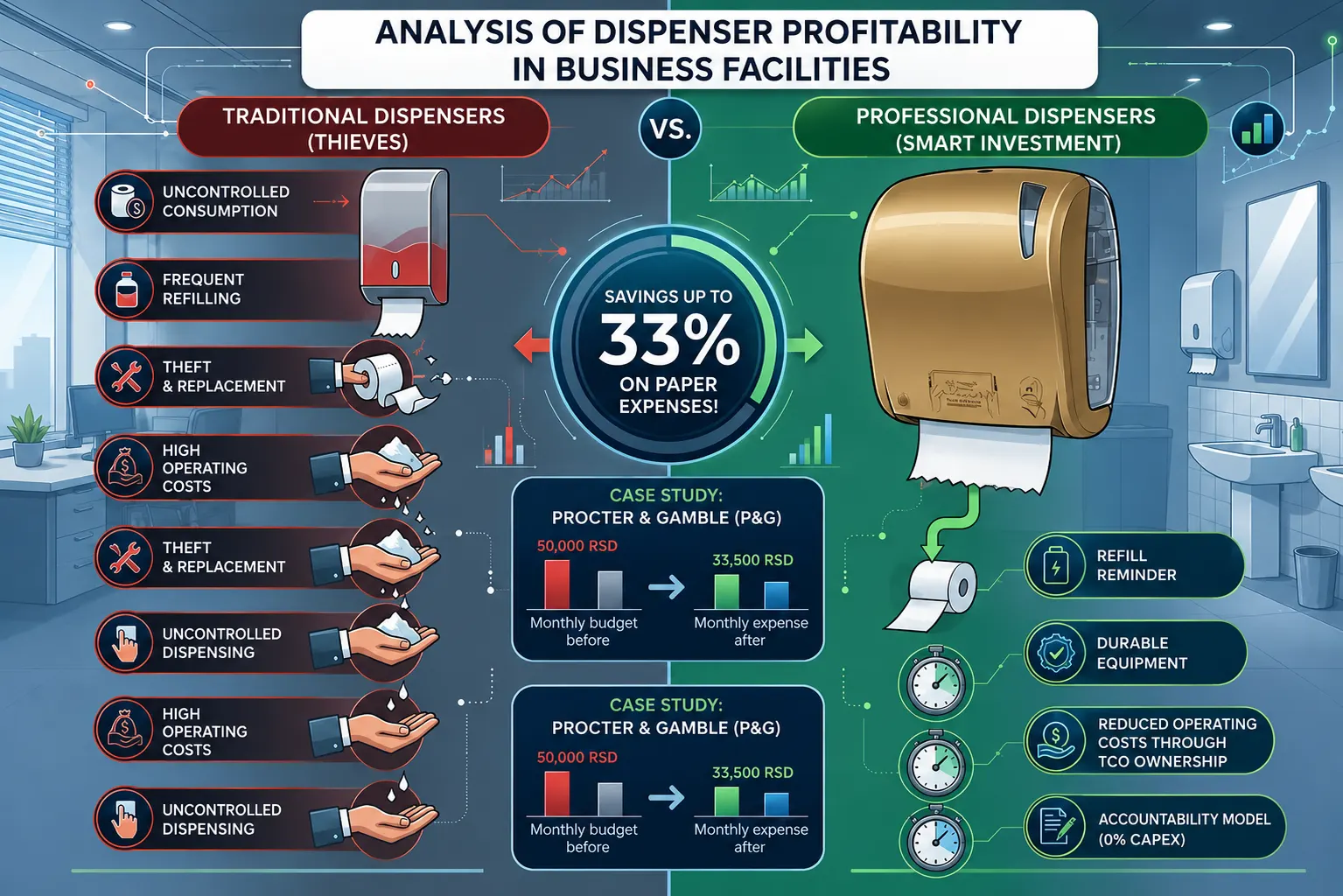
Real-world experience: System optimization at Procter & Gamble, New Belgrade
The best proof of profitability is the real figures from our long-term clients.
The company we have been working with for five years, Procter & Gamble (P&G) in New Belgrade, had been using traditional dispensers in its facilities for years.
Although they initially appeared to be an economical solution, the analysis revealed enormous material waste due to unrestricted paper dispensing.
Solution through a contractual cooperation model:
Instead of the traditional equipment purchase approach, a model was implemented that transforms costs.
By introducing modern Autocut dispensers with a sheet-by-sheet dispensing mechanism through a contractual model (0% CAPEX investment), a radical reduction in operational costs was achieved:
- Previous situation:
The budget for paper consumables averaged 50,000 RSD per month per facility measurement unit
- Optimization through the contractual model:
The company received premium equipment for use, thereby avoiding a large initial investment while shifting the focus to controlled consumption.
- Result:
By implementing precise dispensing, consumption immediately decreased by 33% (one-third). The monthly cost was reduced to approximately 33,500 RSD, which represents annual savings of more than 198,000 RSD for just one facility measurement unit
This example clearly demonstrates that switching to professional dispensers does not have to be a financial burden. Through the contractual model, the investment pays for itself from day one exclusively through dramatically lower paper consumption.
Dispenser cost analysis for commercial buildings – FAQ:
Why should the cheapest solutions be avoided?
Because a low device price usually means high and uncontrolled material consumption in the future.
What do I gain from touchless dispensers?
A higher level of hygiene, a more modern appearance of the space, and a better impression among employees and clients.
How does a dispenser impact the budget?
Through thousands of small savings with every use, preserving resources that low-cost dispensers waste.
Although the general standards are clear, a real assessment (which we can provide for you free of charge) often reveals where hidden costs exist, how to avoid them, and where there is room for optimization.
Subscribe to the LUU newsletter and stay informed about the latest offers.