
Table of Contents
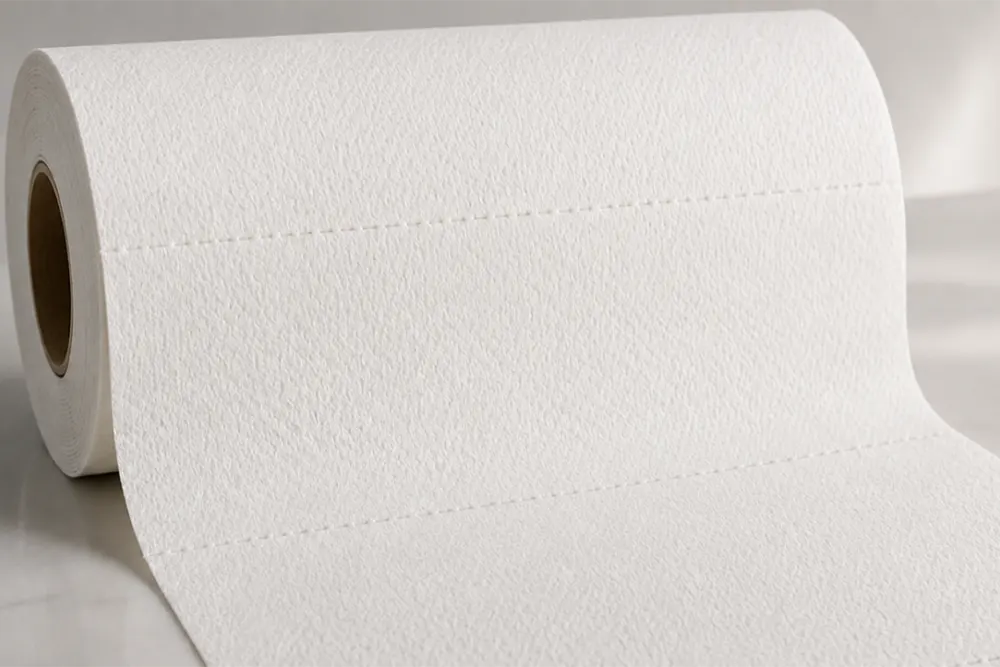
How are paper towels perforated? Paper towels are perforated by passing through a wheel with fine teeth and an opposing roller. The teeth create a series of small cuts, while tiny uncut sections of paper remain between them to hold each sheet together until it is pulled apart. This process explains why paper towels tear cleanly, one sheet at a time, instead of ripping randomly. It is important to note that perforation does not completely cut through the paper. Some of the fibers remain connected so that the sheets stay attached until they are used.
According to worldpapermill.com, the perforation spacing on paper towels is typically 114 mm, and the entire process takes place during the converting stage, after the paper has already been produced and wound into a large roll.
To learn about other types of professional paper towels, read our comprehensive blog: Paper towels in commercial facilities: Everything you need to know about types, savings, and hygiene.
How are paper towels perforated in practice?
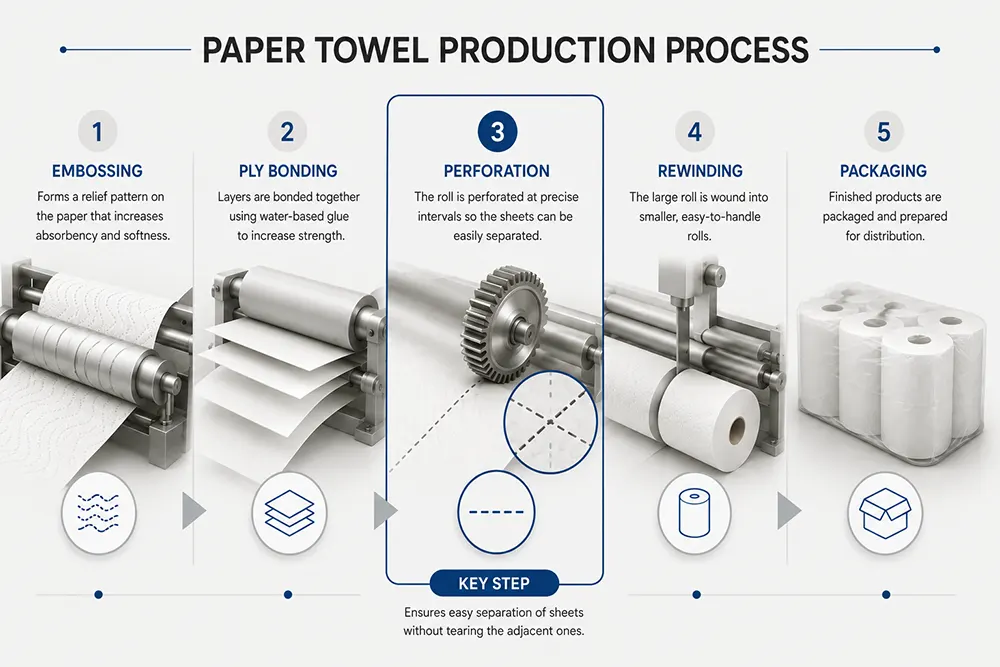
In practice, the process begins only after the paper towel has gone through the embossing stage and, in the case of two-ply towels, the ply bonding stage. Only then does the towel enter the section where the toothed wheel creates the tear line. Perforation is performed in two directions: longitudinally, along the movement of the paper web through the machine, and transversely, dividing the web into individual sheets.
Perforation is carried out by a dedicated paper converting machine, in which a perforating roller with teeth creates a series of evenly spaced cuts.
The key is achieving the right balance. The bridges between the cuts must be strong enough to withstand unwinding the roll, yet weak enough to separate with a gentle pull. If they are too strong, the paper tears outside the perforation line. If they are too weak, the roll falls apart before it even reaches the end user.
According to iso.org, perforation efficiency is measured as the difference in tensile strength between perforated and non-perforated paper from the same sample.
Table: The perforation stage in the paper towel manufacturing process
| Production stage | What happens |
| Embossing | The paper texture is formed |
| Ply bonding | The layers are bonded together in two-ply paper towels |
| Perforation | A tear line is created for precise sheet separation |
| Cutting | The large roll is cut into smaller rolls |
| Packaging | The finished products are packed for delivery |
What are perforated paper towels?
Perforated paper towels are paper products with a series of small cuts that allow one sheet to be torn off precisely without damaging the adjacent sheets. The difference compared to a standard paper towel is not the material but the processing: the cuts predetermine where the sheet will separate.
Without perforation, users would have to tear the paper randomly. This results in uneven edges and greater waste, as people often take more than they need when they cannot easily separate a single sheet.
Why are paper towels perforated?
Perforation allows users to control exactly how much paper they use, one sheet at a time. This reduces unnecessary waste and makes paper towels easier to use in everyday situations, from kitchens to public restrooms.
In commercial facilities, this small difference has a significant impact on operating costs. When perforation is poorly executed, employees and visitors often take two or three sheets instead of one because the paper does not tear cleanly. Good perforation reduces paper consumption and waste without changing the quality of the paper itself.
Table: Well-perforated paper towels vs. poorly perforated paper towels
| Characteristic | Well-perforated paper towels | Poorly perforated paper towels |
| Sheet separation | One sheet separates easily and precisely | The paper tears outside the perforation line |
| Consumption | Users take only as much as they need | Multiple sheets are often taken at once |
| Area cleanliness | Less paper waste around the dispenser | More torn pieces of paper |
| User experience | Simple and quick to use | Frustrating sheet separation |
| Facility costs | Less paper waste | Higher overall paper consumption |
How are paper towels perforated – A real-world example from a congress center in Kragujevac
- At a congress center in Kragujevac, during the routine replacement of paper towels, staff reported that the sheets were difficult to separate and that the paper frequently tore outside the perforation line.
- After introducing paper towels with more precisely adjusted perforation, users separated one sheet more easily, and the maintenance staff noticed fewer loose pieces of paper around the dispensers.
- Although the quality of the paper remained unchanged, proper perforation improved the user experience and reduced the unnecessary use of multiple sheets at once.
- Examples like this show that small manufacturing details can have a noticeable impact on everyday paper consumption and facility cleanliness.
FAQ
Does perforation affect the absorbency of paper towels?
No, not directly. Absorbency depends on the paper weight and fiber structure, while perforation only determines where the sheet tears. A paper towel with poor perforation can still absorb well, but users have less control over how much paper they take.
Is perforation done before or after the roll is cut?
Perforation is always done before the final cutting into individual rolls. The paper web is first perforated along its entire length while it is still in the form of a large log roll. Only afterward does the machine cut the roll into smaller finished products ready for packaging.
Does perforation affect the price of paper towels?
Not directly, but it indirectly affects the cost of use. Poorly adjusted perforation leads to greater waste because users take more sheets than necessary, increasing overall consumption within a facility regardless of the price per roll.
Does perforation differ between toilet paper and kitchen paper towels?
Yes. The spacing and strength of the perforation are adjusted according to the product’s intended use. Kitchen paper towels, which are generally thicker and used for wiping surfaces, require a different bridge balance than toilet paper, where easier and faster sheet separation is the priority.
Do all paper towels have perforation?
No. Center-pull rolls and certain professional dispensing systems use a continuous web without traditional perforation because the dispenser, rather than the tear line, determines the amount of paper dispensed.
The best solutions require no extra attention—they simply work. That is exactly what professional paper towels offer, designed to meet the needs of modern commercial facilities.
Subscribe to the LUU newsletter and stay up to date with our latest offers.