
Table of Contents
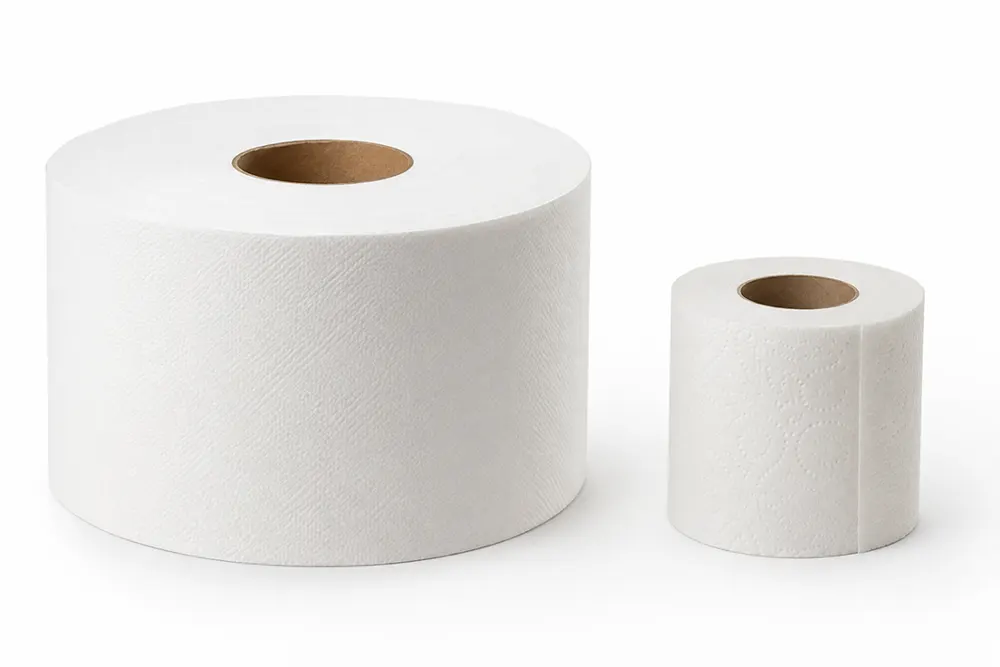
Commercial toilet paper vs residential toilet paper? The main difference lies in the system of use. Commercial toilet paper is designed for a larger number of users, higher capacities, and suitable dispensers, while residential toilet paper is intended for lower consumption and standard holders. Softness, number of plies, and composition are not reliable criteria for distinguishing these two categories.
Epa.gov, the U.S. Environmental Protection Agency, states that only human waste and toilet paper should be flushed through sewer and septic systems, regardless of the format or manufacturer. This rule applies equally to commercial and residential rolls because both types of paper must meet the basic requirement of disintegrating properly for the system to function correctly.
According to market analyses conducted by Mordor Intelligence, the tissue hygiene industry formally divides the market into two segments: “away-from-home” (commercial, outside the household) and the consumer segment for residential use.
The same source shows that the commercial segment is further divided by fiber type (virgin cellulose, recycled, or mixed) and number of plies (single-ply, two-ply, three-ply), confirming that “commercial” is not a single category but covers a wide range of products designed for different purposes.
Commercial toilet paper should be selected according to the purpose and capacity of the facility, and you can read in detail about all available types on our blog: Commercial toilet paper for business facilities: The perfect balance of a gentle touch, superior cleanliness, and optimal savings.
Do commercial and residential toilet paper differ in roll format?
Yes, significantly. The commercial format (standard or jumbo) contains considerably more paper per roll than the residential format because the goal is to reduce the number of replacements in high-traffic facilities. Residential toilet paper uses smaller, uniform rolls designed for the average consumption of a single household rather than for a large number of users throughout the day.
Is the roll winding density different in commercial and residential toilet paper?
Winding density is a genuine technical parameter, and a more tightly wound roll contains more paper within the same diameter. Commercial toilet paper, especially in jumbo format, often uses tighter winding to increase capacity without exceeding the size limit of the dispenser, while residential rolls usually prioritize easier unwinding rather than maximum density.
Does commercial toilet paper always have fewer plies than residential toilet paper?
Not always. Facilities with very high traffic (airports, stadiums) often choose single-ply paper to reduce the risk of clogging, while hotels and restaurants deliberately choose two-ply commercial toilet paper for guest comfort. The number of plies depends on the facility’s priorities, not on the paper category.
Does the fiber composition differ between commercial and residential toilet paper?
There is no fixed rule, although people often make generalizations. Some commercial products use recycled fibers to reduce the cost per unit, while some residential products favor virgin cellulose for softness. However, premium commercial products can also be made from 100% virgin cellulose when quality in a commercial environment takes priority over price.
Is commercial toilet paper as safe for the sewer system as residential toilet paper?
It depends on the specific product, not on the category. According to toilet system guidelines, only paper that disintegrates quickly should be flushed, regardless of whether it is labeled as commercial or residential. Facilities with sensitive infrastructure should check the product’s disintegration rate before purchasing it in large quantities.
Table: Comparison of commercial and residential toilet paper
| Feature | Commercial toilet paper | Residential toilet paper |
| Roll format | Standard roll or jumbo roll (higher capacity) | Smaller roll |
| Core/dispenser diameter | Wider, designed for commercial dispensers | Narrower, residential holders |
| Winding density | Often tighter, for higher capacity | Lower winding density |
| Number of plies | Depends on the facility’s priorities (1-3) | Usually 2-3, for comfort |
| Fiber composition | Varies: recycled fibers or 100% virgin cellulose | More commonly virgin cellulose |
| Design priority | Continuity of supply, cost-efficiency | Softness, user comfort |
Why is it important to keep commercial toilet paper in a dispenser?
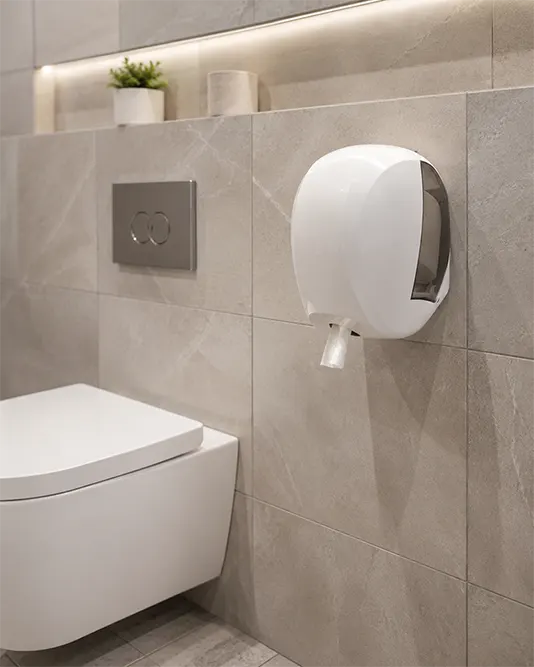
Commercial toilet paper should be used in a suitable dispenser because it protects the roll from direct contact, moisture, and external contaminants while allowing the paper to dispense properly. With larger formats, such as jumbo rolls, the dispenser also keeps the roll in the correct position and makes controlled use easier in facilities with a large number of users.
Is residential toilet paper used in dispensers?
In general, no, because residential toilet paper is most commonly used on standard roll holders. It can be placed in a dispenser if its dimensions and capacity match the roll format, but such a system is usually neither necessary nor economically justified in a household. Dispensers are more practical in business facilities, where a larger number of users requires paper protection and more organized dispensing.
Which commercial toilet paper fits which dispenser?
Each commercial toilet paper format requires a dispenser that matches its dimensions and dispensing method. Interfolded toilet paper is used in dispensers for individual sheets, toilet paper rolls are used in center-pull dispensers, while jumbo rolls require a mini-jumbo or maxi-jumbo dispenser of suitable dimensions.
| Type of toilet paper | Compatible dispenser | System of use |
| Interfolded toilet paper | Interfolded toilet paper dispenser or Stainless steel interfolded toilet paper dispenser | Individual sheet dispensing |
| Toilet paper roll 75 g | Center-pull toilet paper dispenser | Center-pull dispensing |
| Jumbo toilet paper roll | Mini-jumbo toilet paper roll dispenser or Stainless steel Maxi Jumbo dispenser | Jumbo roll |
Commercial toilet paper vs residential toilet paper – Recommended products
Toilet paper roll: 100% virgin cellulose, 3 plies, 75 g. Standard commercial format for small and medium-sized facilities with a center-pull dispenser.
Jumbo toilet paper roll: 100% virgin cellulose, 3 plies, 300 g. Higher capacity for high-traffic facilities, compatible with mini-jumbo and maxi-jumbo dispensers.
Commercial toilet paper vs residential toilet paper? – FAQ
Can commercial toilet paper be used at home?
Technically, yes, but it is not practical. Commercial rolls require a special dispenser that a standard bathroom does not have, and the larger format is not justified for the consumption of a single household. If the goal is simply to replace the roll less often, a residential mega roll is a more practical solution than genuine commercial toilet paper.
Does commercial toilet paper clog sewer systems faster than residential toilet paper?
Not always. The risk depends on how quickly the specific product disintegrates, not on the category. Some commercial products designed for facilities with sensitive infrastructure (e.g. old buildings or ships) are specially formulated to break down quickly, sometimes even faster than standard residential toilet paper.
Does the softness of commercial toilet paper differ from residential toilet paper?
It can, but it does not have to. The softness of commercial toilet paper depends on the product class and intended use. Economy ranges primarily focus on functionality and consumption control, while premium products for hotels and similar facilities provide greater softness and a higher level of comfort.
What should you consider when switching from residential to commercial format in a small facility?
First, check whether the roll diameter fits the existing dispenser because commercial formats often require a suitable type of dispenser. Then assess the level of consumption. A larger roll makes sense in high-traffic facilities, while the standard format is often a more practical choice for a smaller number of users.
Every facility has a different consumption pattern. Tell us yours, and we will recommend a format that matches it.
About the author:
Milja Tonić – SEO Content Strategist & Copywriter
Milja Tonić is an SEO Content Strategist and Copywriter at LUU. In collaboration with the sales and technical teams, she prepares content about commercial paper hygiene products, dispensers, and hygiene management in business facilities.
Subscribe to the LUU newsletter and stay up to date with the latest offers.