
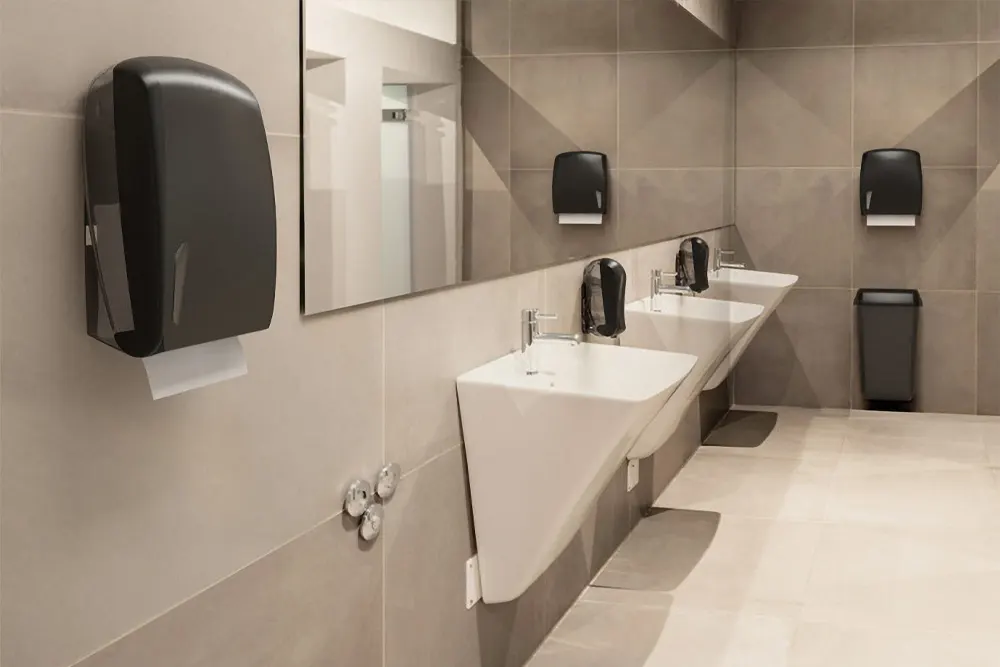
Table of Contents
Dispensers and paper hygiene products in commercial buildings enable hygiene control, reduce costs by up to 37%, and improve the user experience through contactless dispensers.
Choosing the right hygiene equipment is a strategic decision that directly affects the operational efficiency of your facility.
Every time a user enters a restroom, changing room, or canteen, they notice a system that communicates either control and trust or unpredictability and neglect.
To learn how to make the right equipment choice and raise hygiene standards in a commercial building, read our detailed Master guide.
What are dispensers and paper hygiene products in commercial buildings?
Dispensers and paper hygiene products in commercial buildings represent a system for the controlled distribution of hygiene supplies that enables:
- standardized consumption
- reduced direct contact between users and surfaces
- a stable level of hygiene across all facility zones regardless of usage frequency and business activity type
This system includes:
- soap dispensers
- paper towel dispensers
- toilet paper dispensers
- appropriate paper hygiene products
Its role is not only operational.
It establishes a standard that is repeated without deviation.
Why are dispensers and paper hygiene products in commercial buildings the foundation of hygiene?
Dispensers and paper hygiene products in commercial buildings form the foundation of the hygiene system because they enable:
- controlled dispensing of soap, paper towels, and toilet paper
- reduced user contact with surfaces and prevention of pathogen transmission through touch
- a consistent standard of cleanliness across all facility zones including canteens, changing rooms, and restrooms
All these benefits achieved through the installation of adequate contactless dispensers and paper hygiene products are maintained regardless of usage frequency.
Without a system, variation occurs.
With a system, a standard is created.
In facilities with high foot traffic such as shopping centres or logistics centres, every uncontrolled contact increases risk.
That is exactly why dispensers become an important control factor.
In addition to operational efficiency, this type of system directly helps meet legal standards.
According to the Occupational Safety and Health Law (Paragraf Lex), the employer is obligated to provide a work process adapted to hygienic conditions that do not endanger employee health.
Mapping hygiene zones in a commercial building
The placement of dispensers and paper hygiene products in commercial buildings must not be random because every zone has a different hygiene risk, usage frequency, and user expectation. That is why proper space mapping is an important parameter for a stable hygiene system.
Typical zones and their function:
- Entrances and hallways: transit hygiene
Focus is on the first impression and quick availability of hand sanitizing products - Lobby: representative hygiene
This is where brand perception is formed. Dispensers must be discreet, aesthetically aligned, and contactless - Restrooms: critical hygiene zone
The highest level of control. Dispensers for controlled dispensing and minimal contact are required. - Canteen: safety zone (HACCP)
Hygiene directly affects user health, making the standard stricter and controlled.
Proper zone mapping allows resources to be allocated where the risk is highest instead of distributing them equally everywhere.
How does hygiene affect brand perception and user experience?
Hygiene in commercial buildings directly affects user perception because the cleanliness of shared zones is subconsciously associated with the company’s level of professionalism, organization, and reliability.
Users do not analyze they feel.
Users recognize a high level of hygiene in commercial buildings through:
- constant availability of hygiene supplies (soap, paper towels, sanitizers)
- neatly and logically positioned sensor dispensers in all important zones
- contactless systems that reduce the need for touch
- a consistent level of cleanliness regardless of usage frequency
- the absence of interruptions (empty dispensers and overflowing bins)
- a neutral scent and feeling of freshness throughout the space
- visually coordinated, beautifully designed, and maintained hygiene elements
Hygiene then stops being an operational item.
It becomes part of the expected experience.
How to choose dispensers according to the type of commercial building?
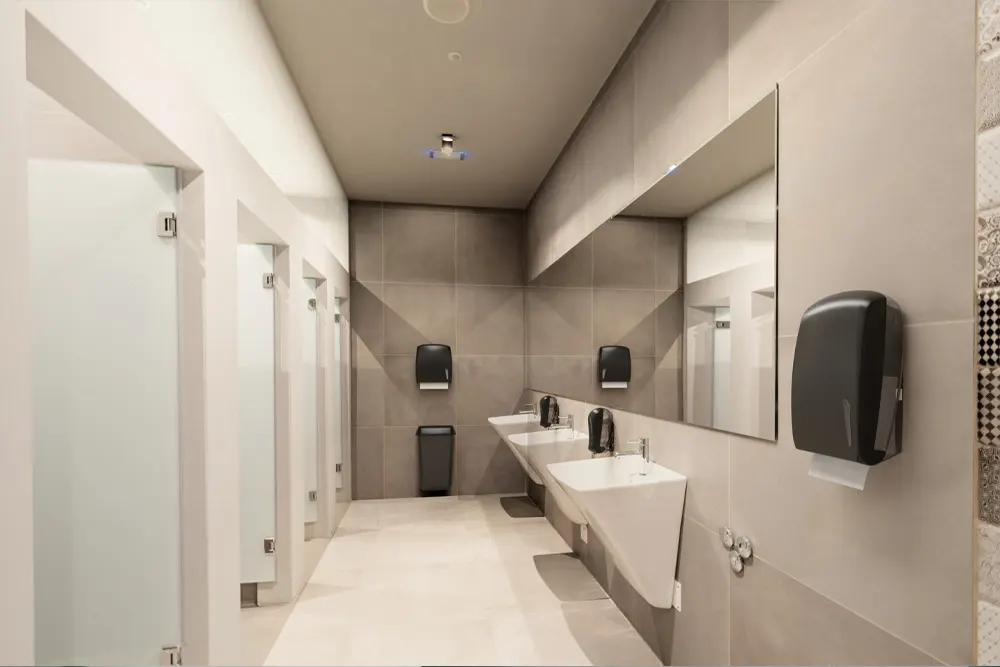
The right choice of dispensers in commercial buildings is based on:
- usage intensity
- user profile
- the level of control you want to achieve
- operational efficiency
Every facility has specific operational requirements.
Not every facility is the same, therefore the solution should not be either.
Without analysis, the selection becomes random, while with analysis it becomes a predictable and efficient system.
Table: Which dispenser is optimal for which commercial building?
| Commercial building | Recommended dispenser | Why? |
| Office building | Electronic soap and paper towel dispensers | A stable employee flow requires control and discreet design |
| Shopping centre | High-capacity dispensers with central pull dispensing | Despite the high user frequency, the dispenser requires minimal maintenance |
| Factory | Stainless steel dispensers | Resistance to wear and industrial conditions |
| Logistics centre | Robust ABS dispensers | Intensive use and the need for durability |
| Congress centre | Premium contactless dispensers | High level of representativeness and user experience |
| Exhibition hall | High-capacity dispensers | Temporary but intensive visitor peaks |
| Bank branch | Minimalist black stainless steel dispensers | Discreet luxury and a clean visual identity |
| Warehouse complex | Industrial dispensers | Functionality and durability |
| Distribution centre | Central pull paper towel dispensers | Fast use without delays |
| Automotive service centre | Reinforced dispensers | Resistance to dirt, oils, and moisture |
How do dispensers and paper hygiene products in commercial buildings turn costs into an investment?
Smart dispensers and paper hygiene products in commercial buildings turn costs into an investment and redefine maintenance economics through precise resource control and the elimination of unnecessary waste.
Implementing advanced dispensers not only reduces material consumption by up to 37% but also directly optimizes workforce efficiency by reducing refill frequency.
For large commercial buildings, transitioning from unpredictable costs to stable monthly expenses is an important predictor of operational efficiency and long-term budget sustainability.
Savings analysis: Where is the highest return on investment achieved?
The table below shows the savings percentages achieved by dispensers and paper hygiene products in commercial buildings compared to traditional solutions.
| Dispenser type | Commercial building (Example) | Savings percentage | Source of savings |
| Sensor soap dispenser | Shopping centre and exhibition hall | up to 40% | Elimination of excessive soap waste and precise foam dispensing |
| Sheet-by-sheet paper towel dispenser | Factory and logistics centre | up to 37% | Prevention of multiple towel pulling and waste reduction |
| Electronic toilet paper dispenser | Office building and congress centre | up to 35% | Controlled toilet paper length and reduced refill frequency |
| Jumbo toilet paper dispenser | Warehouse complex and automotive service | up to 30% | Reduction of toilet paper theft and lower labour costs |
Traditional vs electronic dispensers: Evolution of efficiency in commercial buildings
Switching to electronic dispensers represents a technological breakthrough in maintaining large facilities.
While traditional models rely on user estimation, electronic dispensers and paper hygiene products in commercial buildings introduce automation that eliminates mechanical fatigue and optimizes workflow.
The greatest advantage lies in programmability and predictability, allowing facility managers to precisely plan procurement and reduce waste.
Operational superiority: Technology in the service of maintenance
| Feature | Traditional dispenser | Luu electronic dispenser |
| Mechanical reliability | Prone to breakdowns due to rough manual pressing and pulling | Sensor activation without physical pressure extends the device lifespan |
| Inventory management | Unpredictable consumption makes warehouse stock planning difficult | Stable consumption enables precise monthly orders without surplus |
| Maintaining order | Frequent occurrence of scattered paper and soap dripping around dispensers | Automatic stop after dispensing prevents mess on floors and work surfaces |
| Adaptability | Fixed settings that do not follow the facility usage frequency | Ability to adjust towel length or soap quantity according to facility needs |
| Flow speed | User delays caused by repeated pulling or pressing attempts | Instant activation enables fast movement of people in high-traffic zones |
How to implement the system without mistakes?
Implementing a dispenser system in commercial buildings requires:
- facility and traffic analysis
- dispenser selection
- material compatibility
- staff training
Analysis solves most problems in advance.
The biggest mistake is skipping the analysis.
That is where control is lost.
Field experience: One year after implementation in the company Invekta
Exactly one year ago, the LUU team received a call to improve the hygiene system in the company Invekta.
A facility with offices, a large meeting room, a kitchen, restrooms, and a huge daily number of visitors was facing a serious operational challenge.
The situation we encountered:
The client was dealing with so-called idle gaps. Traditional dispensers were emptying faster than the staff could refill them. Employees and visitors, while using the restrooms, were taking and consuming more paper towels than necessary. Soap often dripped onto the sink, while toilet paper was unrolled in lengths of 30 to 40 cm and sadly hung out of plastic toilet roll dispensers.
This resulted in:
- untidy restrooms during the second part of the day
- uncontrolled consumption of paper towels, toilet paper, and soap that created unnecessarily high costs
Our approach and solutions:
We analyzed the movement of employees and visitors and introduced Luu dispensers designed to withstand heavy visitor traffic.
- Main restrooms: We installed the LUU Autocut paper towel dispenser, LUU Mini Jumbo toilet paper dispenser and the LUU Electronic liquid soap dispenser 0.5L. Our goal was to minimize the number of refills and ensure that toilet paper and soap never run out during peak hours and in the second part of the day.
- Kitchen: We implemented a Central pull paper towel dispenser
The results were immediately visible:
- no dripping on the floor
- no slippery surfaces
- no soap waste
- no paper towel waste and no messy floors caused by scattered toilet paper
Today, one year later, the numbers confirm the success of this investment:
The implementation of dispensers and paper hygiene products in this facility resulted in a consumption reduction of 37% to 39%.
- 37% consumption reduction: due to the implementation of dispensers and paper hygiene products in restrooms and the kitchen
- 39% reduction in soap consumption: through the implementation of the electronic soap dispenser
- More productive staff: Cleaning staff no longer run to refill toilet paper and paper towels every hour. The high-capacity dispenser allowed them to focus on the cleanliness of the rooms themselves
- User trust: Contactless dispensers became a standard that visitors and employees at Invekta expect and appreciate, which improved the company’s reputation
Dispensers and paper hygiene products in commercial buildings – FAQ
Are contactless dispensers necessary in commercial buildings?
Yes. In facilities with a large number of users, they significantly reduce contact and the risk of bacterial transmission.
Which dispensers are best for facilities with high traffic frequency?
High-capacity and central pull models allow continuous use without frequent refills.
How can hygiene costs be reduced?
By introducing dispensers with controlled dispensing, waste is reduced and costs become stabilized.
Does dispenser design affect user impression?
Yes. Visual consistency and material quality influence the perception of professionalism.
How often should the system be maintained?
Depending on facility traffic frequency. Regular inspection is the key to system stability.
Managing hygiene in large commercial systems must not be left to chance. The right choice of dispensers and paper hygiene products in commercial buildings directly affects your monthly costs, staff productivity, and the impression you leave on clients and employees.
If you want your facility to operate according to the highest efficiency standards, our team is ready to help you define specifications that match your real needs.
Take control of costs and hygiene.
Contact us for professional support in choosing the right solution.
Subscribe to the LUU newsletter and stay updated with the latest offers.