
Table of Contents
Soap and paper towel shortages do not occur overnight. They are the result of a lack of a system for timely dispenser refilling. When dispenser refilling is not precisely planned, disruptions in the hygiene process occur, which directly affects the health and functioning of the educational institution. Which dispensers are needed in school facilities and how to raise the hygiene standard read on our blog: Dispensers and paper products in education – how to raise hygiene standards in schools and kindergartens?
What does timely dispenser refilling mean?
Timely dispenser refilling implies continuous monitoring of consumable levels and refilling before the device is completely empty. The goal is that a student or teacher is never in a situation without soap or paper towels available.
It is not a reaction. It is a system.
Why is it important to know when dispenser refilling is needed?
Knowing when dispenser refilling is needed enables the maintenance of a stable hygiene system and prevents interruptions in the use of basic hand washing and drying supplies. Without this insight, unpredictable shortages occur and the risk of bacterial spread increases.
Continuity is key. Without it, there is no standard.
In order to ensure hygienic safety for students, it is necessary to comply with the official standards of the Institute of Public Health of Serbia “Dr Milan Jovanović Batut” which emphasize that toilets must be equipped with constant supplies of soap and paper.
How to recognize that dispenser refilling is needed?
Dispenser refilling can be recognized through several clear signals indicating a reduced level of material or uneven system performance. These indicators enable a timely response before problems occur.
The most common indicators that there are no paper towels or soap in dispensers:
- reduced pressure or weaker soap output
- irregular paper towel dispensing
- visibly low level through the dispenser window
- increased usage frequency during breaks
- user complaints
The problem is that these signals are often ignored.
Operational challenges in schools: How smart Luu dispensers save time and money?
Smart LUU dispensers change the economics of maintenance in educational institutions through three key factors: precise dosing that reduces consumption by up to 37%, transparent level indicators that reduce staff inspection time by 46%, and reserve roll systems that eliminate material waste. Instead of reactive refilling, the LUU system enables predictable inventory management, directly reducing operational costs and ensuring maximum hygiene standards without downtime.
Managing the hygiene system in schools presents a range of operational challenges that directly affect costs, staff efficiency, and hygiene levels, and the table below shows the most common problems and their modern solutions.
| Challenge (Problem) | Operational impact | Modern solution (LUU system) | Benefit for the institution |
| High labor costs | Staff spend hours manually checking each dispenser | Transparent inspection windows and high-capacity dispensers. Monitoring software | Fast visual inspection without opening devices; fewer maintenance work hours |
| “Stub Roll” problem (Waste) | Discarding half-used rolls (15-20% loss) to prevent running out of paper | Systems with a reserve roll and use of every last sheet | Full material utilization; direct savings in procurement |
| Unpredictable logistics | Chaotic procurement due to lack of insight into precise consumption | Standardization and precise dosing (e.g. exact number of doses per cartridge) | Predictable budget and easier inventory planning without unnecessary storage |
| Vandalism and failures | Frequent damage to low-cost equipment and constant replacement costs | Durable ABS plastic and secure locking systems | Equipment longevity; elimination of emergency repair and replacement costs |
| Excess waste (ESG) | Overflowing bins and high consumption of plastic bags | “One by one” dispensing system and controlled foam | Reduced environmental footprint: less waste and cleaner toilets throughout the day |
Experience from practice: Optimization of dispenser refilling in an elementary school in New Belgrade
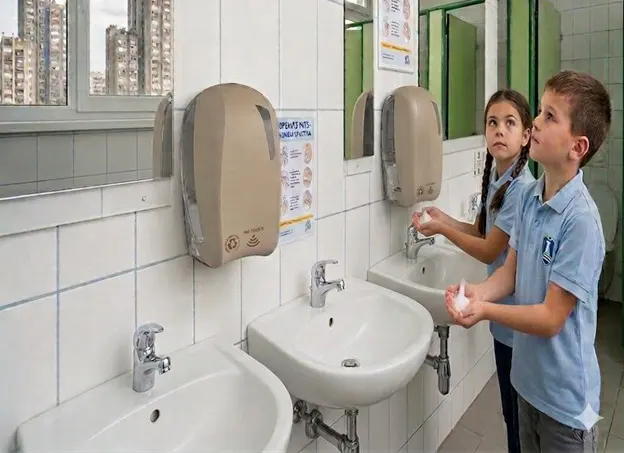
In cooperation with one of the largest elementary schools in New Belgrade, we carried out a complete transformation of the hygiene system by replacing traditional holders with smart LUU dispensers. Before installation, the school’s biggest challenge was unpredictable costs and overburdened staff who performed checks up to six times per day.
By introducing a system with transparent indicators and controlled dosing, we made the refilling process statistically predictable and reduced visual inspection to just a few seconds per restroom.
After the first six months of use, the following results were recorded:
- 35% reduction in total consumption of paper products thanks to the “one by one” dispensing system
- 46% less time required for staff to check and refill dispensers due to transparent inspection windows
- 18% material savings by eliminating the disposal of half-used rolls (solved “Stub Roll” problem)
- 0% complaints from students and parents about lack of soap during school shifts
- Significantly reduced waste volume in bins, which accelerated the cleaning and emptying process of restrooms
How to organize a system for timely dispenser refilling?
An efficient system for dispenser refilling is based on clear procedures that eliminate improvisation. When there is structure, surprises disappear.
Basic steps:
- defining daily or weekly checks
- standardizing dispenser types and consumables
- keeping consumption records
- assigning a responsible person
- planning refilling before the critical level
How do modern dispensers facilitate consumption tracking?
Modern dispensers enable precise monitoring and planning of refilling because they have built-in level indicators and controlled dosing, which eliminates sudden and unpredictable changes in consumption. The system becomes transparent.
Key advantages:
- transparent windows for visual control
- controlled dosing per user
- even consumption
- less waste
- easier procurement planning
Less control. More insight.
Comparison: traditional vs. electronic dispensers
| Characteristic | Traditional soap dispenser | Electronic soap dispenser |
| Dosing | Uncontrolled | Single dose |
| Consumption | Varies | Stable |
| Monitoring | Manual | Visual and predictable |
| Costs | Unpredictable | Up to 37% lower |
| Hygiene | Contact | Contactless |
Dispenser refilling – FAQ
How often should dispenser refilling be performed?
It depends on usage frequency, but daily checks are recommended in schools.
Does automation eliminate the need for inspection?
Not completely, but it significantly reduces frequency and the need for intervention.
What is the most common mistake?
Waiting for the dispenser to become empty instead of preventive refilling.
Do all dispensers have a level indicator?
No, but modern models increasingly include this feature.
Discover how to establish a dispenser refilling system that operates without interruptions and unforeseen shortages.
Learn more about solutions tailored to educational institutions or schedule free consultations to improve the hygiene system.
Sign up for the LUU newsletter and stay up to date with the latest offers.