
Table of Contents
Dispensers and HACCP standards represent an integrated system that directly affects contamination control, patient safety, and compliance with sanitary regulations in healthcare. The proper selection of dispensers is not a technical decision. It is an operational standard that determines the stability of the hygiene system.
Dispensers and HACCP standards define how risks are managed in everyday processes. From hand hygiene to consumption control, every contact and every dose must be predictable. Within this framework, dispensers become an active control point rather than passive equipment.
Which dispensers truly meet hygiene standards in healthcare? We have covered this in detail in a dedicated article on dispensers and paper products: Dispensers and paper products in healthcare: Hygiene standards, infection control and savings without compromise.
Why are dispensers and HACCP standards important when procuring equipment for healthcare institutions?
Dispensers and HACCP standards are important because dispensers represent critical control points that prevent contamination, enable dosing control, and ensure compliance with sanitary protocols in healthcare institutions.
When procuring equipment for healthcare, dispensers represent critical control points within HACCP standards. They are important because their closed design prevents contamination of hygiene resources, while touchless mechanisms eliminate pathogen transmission in food preparation and care areas.
By selecting certified systems, the following is ensured: easy decontamination and resistance to aggressive chemicals, thereby directly meeting legal sanitary protocols.
Investment in such equipment guarantees reliable inspection validation and maximum biological safety of the institution.
HACCP (Hazard Analysis and Critical Control Points) is not limited to patient nutrition.
Its principles apply to all processes where there is a risk of contamination.
This means that hospital dispensers must have the following characteristics:
- smooth surfaces without micro-cracks, easy to clean and disinfect
- a design without dead angles, which are often places where moisture and mold accumulate
- resistance to chemicals and corrosion
- use of materials such as stainless steel (inox 304 and 316) and high-quality polymers such as ABS plastic
- calibration and validation
The definition is clear: equipment must actively prevent risk rather than merely be passively present in the space.
How do dispensers become a critical control point?
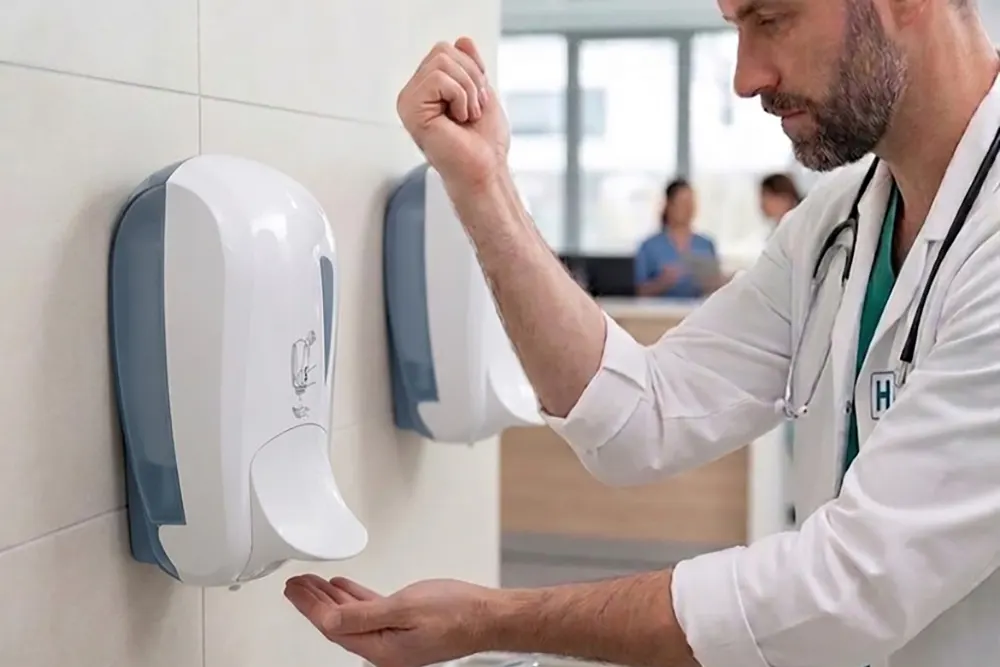
Dispensers become a critical control point because they directly influence the handwashing process, which is one of the most important HACCP steps in infection control.
If the user has to touch a pump with contaminated hands, cross-contamination occurs. This breaks the hygiene chain.
The solution is clear and measurable:
- touchless sensor dispensers
- elbow-operated mechanisms
- automated dosing
Zero contact eliminates the risk recognized by HACCP as critical.
Why are the materials used for LUU dispensers important for sanitary compliance?
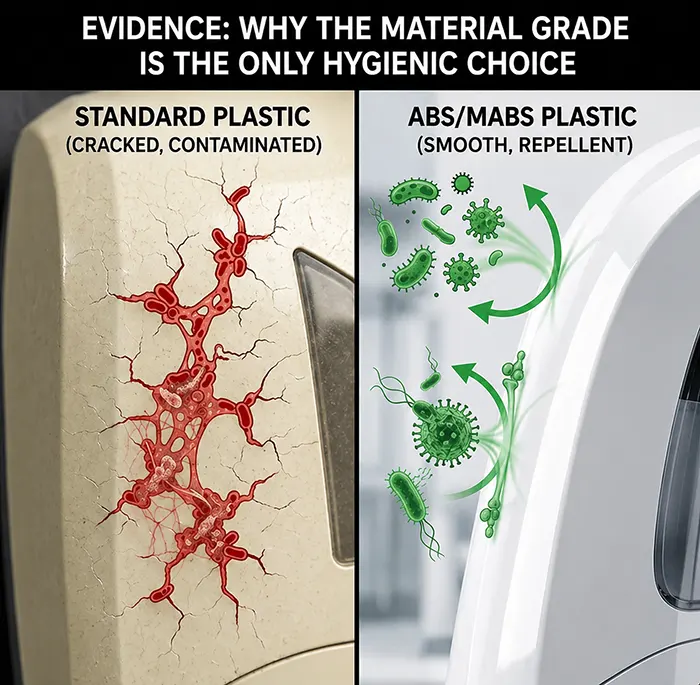
Materials determine whether equipment maintains hygienic integrity over the long term or becomes a hidden source of contamination.
The difference between standard and medical-grade plastic is functional, not aesthetic:
| Characteristic | Standard plastic | ABS / MABS plastic used in LUU dispensers |
| Surface | Becomes porous over time | Smooth and non-absorbent |
| Resistance | Cracks and degrades | Durable |
| Hygiene | Retains microorganisms | Prevents retention |
| Chemicals | Sensitive | Resistant |
Non-porosity is key. If the material absorbs, the HACCP system is compromised.
How do closed systems prevent contamination?
Closed systems prevent the entry of external contaminants into the dispenser reservoir and thereby preserve the sterility of the contents.
Traditional refilling by “pouring in” carries a high risk:
- entry of dust
- contact with air and moisture
- microbiological contamination
Closed systems on which LUU dispensers are designed use:
- hermetic cartridges
- air-inlet prevention valves
- controlled dispensing
The result is a stable and predictable system. HACCP requires exactly this level of control.
Why is a standardized dose important for HACCP?
A standardized dose ensures that each user receives a sufficient amount of product for effective disinfection without deviations in the process.
If the quantity varies, the process is not under control.
Calibrated LUU dispensers solve the problem through:
- precise dosing (e.g. 0.65 ml)
- repeatable results
- easier control and audit
- IR sensor adjusted for optimal hand detection
- Autocut system
- use of original paper and soap with appropriate density and texture
Compliance of LUU dispensers with HACCP standards
| HACCP Parameter | LUU Technology | Sanitary benefit (Critical point) |
| Zero contact | IR Sensor (Electronic) and Elbow lever (Mechanical) | Complete elimination of cross-contamination: hands remain sterile throughout the entire process. |
| Dose standardization | Calibrated pump at 0.65 ml – 0.7 ml | Ensures a sufficient amount of product for effective hand antisepsis without resource waste. |
| Waste control | Autocut dispenser (exactly 27 cm of paper) | Mechanically calibrated gears prevent uncontrolled pulling and contact with the remaining roll. |
| Quality consistency | Original LUU materials (Specific density and texture) | Ensures system predictability: inadequate refills compromise viscosity and hygienic integrity. |
| System integrity | Locking system and closed reservoir | Prevents intentional or accidental contamination of the contents (soap/disinfectant) by external factors. |
| Hygiene maintenance | Special anti-drip valves (0% spillage) | Dry and clean floors prevent biofilm formation and ensure a safe working environment, which is one of the most important rules of HACCP standards |
Our solutions are not merely an aesthetic choice but are strictly engineered to comply with Rulebook on detailed conditions for performing healthcare activities while the dosing mechanism is aligned with global WHO hand hygiene recommendations.
Dispensers and HACCP standards – How does visual control affect hygiene in the space?
Visual control enables quick identification of problems and directly affects the maintenance of sanitary standards in the space.
One of the key indicators is the condition around the dispenser
- no dripping
- no puddles
- no product residue
Anti-drip valves enable 0% spillage.
A clean floor is a signal that the system is functioning, and patients, doctors and hospital staff feel safer in such an environment.
Practical experience: Implementation of LUU dispensers in a cardiovascular center in New Belgrade
During the outfitting of a modern cardiovascular center in New Belgrade, the focus was on introducing zero contact in zones where invasive procedures are performed. LUU dispensers met the challenge through functionality and a sophisticated design that fits the interior of a premium clinic.
The problem was clear: contact in high-risk zones had to be eliminated.
Our response was the introduction of LUU equipment, achieving:
- Zero contact in preparation through the installation of electronic sensor dispensers at all entrances to medical and kitchen areas.
- Resolution of the problem of wet hands through the Autocut dispenser with a mechanism of exactly 27 cm which enables proper hand drying and prevents further pathogen transmission
- 37% savings in resources in the first quarter thanks to the introduction of original LUU soap with specific density and a calibrated dose of 0.65 ml
With this project, we demonstrated that sanitary standards are not merely an administrative burden but an opportunity for process optimization. A clean floor, dry hands and predictable consumption have become a standard that allows healthcare professionals to focus on patients while LUU technology unobtrusively takes care of all users of this healthcare institution
Dispensers and HACCP standards – FAQ
What is the HACCP standard in healthcare?
The HACCP standard in healthcare is a system for identifying and controlling contamination risks in all processes, including hand hygiene and equipment.
Why are dispensers important for HACCP?
Dispensers are a contact point in the hygiene process and can be either a source or a barrier to contamination.
Which dispensers comply with the HACCP standard?
Touchless, closed systems with precise dosing and materials resistant to chemicals.
Why is the towel length of 27 cm a standard in healthcare?
Exactly 27 cm is a calibrated length that ensures optimal hand drying without unnecessary waste, reduces moisture in the space and the risk of bacterial growth on wet surfaces
How is dispenser efficiency measured?
Through consumption control, hand hygiene in healthcare and dosing stability.
Discover how to improve hygiene standards through system solutions tailored to your institution. Call us for free consultations.
Subscribe to the LUU newsletter and stay up to date with the latest offers.