
Table of Contents
Did you know that the highest number of bacteria returns to your hands precisely at the moment you try to dry them? Contactless paper towel dispensers in healthcare reduce the transmission of bacteria by eliminating contact and represent one of the key measures in preventing hospital-acquired infections.
Sensor-based paper towel dispensers in healthcare eliminate this risk by removing contact from the equation and turning an ordinary restroom into a high-tech barrier against infection. Why they are important and how they will improve hygiene standards in your healthcare facility, read in our blog: Dispensers and paper products in healthcare: Hygiene standards, infection control, and savings without compromise.
Why are contactless paper towel dispensers in healthcare important for infection control?
Contactless paper towel dispensers in healthcare reduce the transmission of microorganisms by eliminating physical contact with contaminated surfaces used by a large number of people. They break the chain of transmission of pathogens and viruses in the most critical zones within healthcare facilities such as restrooms and handwashing areas where infections spread most easily.
Hospital-acquired infections occur precisely in places where hygiene is not stable and properly implemented. A single touch can be enough to cause contamination, which is why standards are increasingly shifting toward automated solutions.
Accordingly, sensor dispensers are not a design detail but part of essential medical equipment that plays an important role in infection control.
How do contactless paper towel dispensers in healthcare reduce contamination?
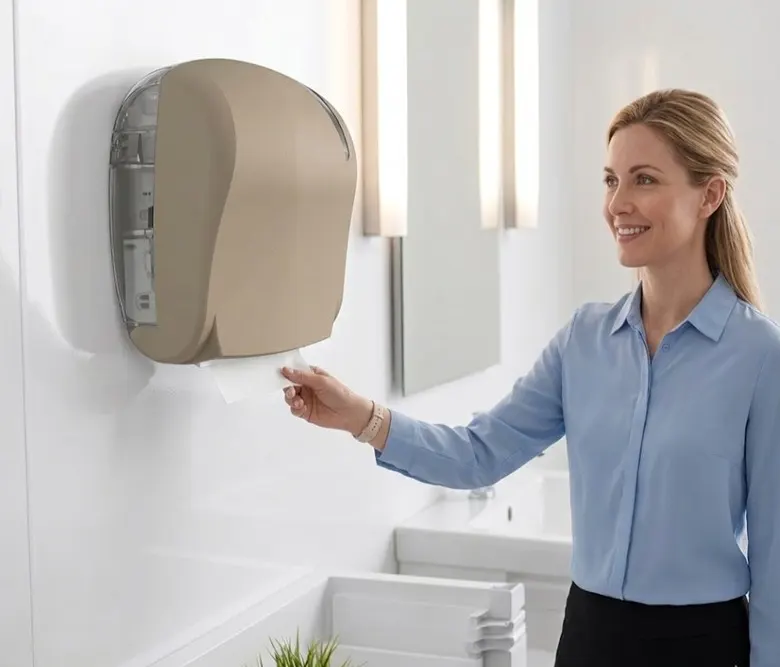
Contactless paper towel dispensers in healthcare function by allowing users to take a towel without touching the remaining content, thereby reducing the transmission of bacteria and viruses between users. This eliminates the need for pressing, pulling, or contact with contaminated surfaces.
Even after proper washing, microbes spread more easily on damp hands. Studies CDC confirm that adequate hand drying with paper towels after washing significantly reduces the number of remaining bacteria on the skin because paper mechanically removes microorganisms that water did not wash away
With manual dispensers, there are numerous factors that lead to contamination, such as:
- Contact with plastic and metal dispenser surfaces where many pathogens can survive for days
- Drying hands in this way negates the effect of washing
- With manual dispensers, towels are exposed to aerosols, which automatically contaminates them
- Spillage of a large number of towels on the floor, leading to untidy space and contamination
Sensor-based LUU dispensers for paper towels solve all these problems much more efficiently.
Key risk-reduction mechanisms when using contactless paper towel dispensers include:
-
- No contact with the dispenser thanks to IR sensor activation
-
- Precise dosing with Autocut dispensers that automatically cut paper with each pull (approximately 27 cm)
- Reduced surface moisture
- Smooth surfaces that are easy to maintain and sterilize
- Reduced retention of microorganisms
- ABS and MABS plastics used in LUU dispensers, resistant to frequent cleaning with disinfectants
This directly impacts the reduction of infection spread in hospital environments.
A simple solution. A big impact.
What do healthcare facilities gain by introducing contactless dispensers?
The introduction of contactless dispensers transforms hygiene from a passive cost into an active protection strategy. Instead of relying on individual discipline, healthcare facilities gain an automated process that eliminates critical contamination points and optimizes resources.
Table of key benefits of introducing contactless dispensers for healthcare facilities:
| Category | Benefit description | Operational outcome |
| Economic control | Standardized consumption: Sensor-based dispensing prevents excessive towel usage. | Efficient procurement planning and budget stability. |
| Environmental impact | Waste reduction: Towel length control prevents unnecessary waste. | Lower volume of municipal and medical waste. |
| Human resources | Operational efficiency: Larger roll capacity in Autocut dispensers requires less frequent refilling by staff. | Staff can focus on critical disinfection tasks. |
| Legal compliance | Protocol compliance: Systems meet HACCP, JCI, and national sanitary standards. | Protection against negative external audits and penalties. |
| Trust and image | Visual integrity: Modern, closed dispensers communicate professionalism. | Greater patient trust in the facility’s hygiene standards. |
Switching to contactless technology means hygiene is no longer subject to improvisation but becomes a standardized process with easily measurable results.
How to choose the right paper towel dispenser?
Selecting a contactless paper towel dispenser in healthcare is based on evaluating usage frequency, type of space, and compatibility with existing hygiene protocols. Not every dispenser is the same. The difference lies in the details.
Pay attention to:
- Capacity and “Stub-Roll” function: In high-frequency areas (surgical blocks and visitor restrooms), choose dispensers with a stub-roll function. This allows a new roll to be inserted before the old one is completely used, ensuring zero seconds without towels.
- Advanced sensor technology: Look for sensors with adjustable detection range and fast response (under 0.5 seconds). Poor sensors force users to wave their hands, increasing the risk of touching the device or surrounding surfaces, while sensor-based Compact Cut paper towel dispenser has an advanced mechanism for dispensing single sheets of 24 cm, allowing healthcare facilities to achieve significant monthly savings.
- Hygienic design and materials: The dispenser must be made of high-quality ABS plastic or stainless steel resistant to aggressive disinfectants. Rounded edges prevent dust accumulation and facilitate quick wiping.
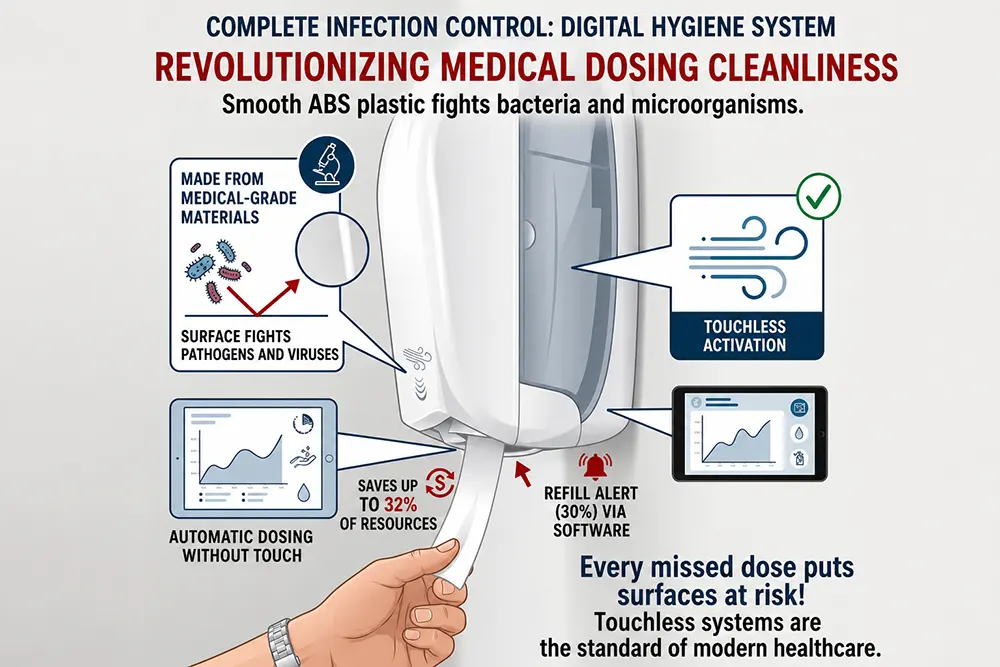
- Digital monitoring via software and proactive maintenance: Modern LUU contactless dispensers in healthcare go beyond standard battery indicators by introducing smart software for real-time resource monitoring. Integrated sensors provide precise insight into the status of each device and automatically send notifications to staff when paper or soap levels drop to 30% capacity. This approach eliminates the risk of system failure during shifts and reduces the need for unnecessary manual checks.
- Housing transparency: A viewing window for checking paper levels allows staff to assess status at a glance without opening the dispenser, saving time and maintaining internal cleanliness.
- Locking and security: A robust locking mechanism prevents unauthorized opening and contamination of the roll interior.
A good choice lasts for years, while a poor choice creates daily costs.
Practical experience
In collaboration with a private general hospital in Palilula in Belgrade, we conducted a pilot project replacing manual holders with smart contactless LUU dispensers in surgical blocks and patient restrooms.
The results after a quarterly report confirmed that technology directly drives savings:
- total paper consumption decreased by 32%
- thanks to software-based refill level monitoring (notifications at 30% capacity) the time required for technical staff to check dispensers decreased by as much as 42%
What surprised us the most was the subjective sense of safety among nurses and doctors, who reported significantly higher satisfaction with the work process because critical contamination zones were minimized.
Contactless paper towel dispensers in healthcare – FAQ
What are hospital-acquired infections? These are infections that patients acquire during their stay in a healthcare facility and were not present before admission.
Are contactless dispensers mandatory?
They are not always legally mandatory but are part of recommended infection control standards.
How much can be saved by switching to contactless systems?
In practice, savings range from 20% to 37% in paper towel consumption.
Is maintenance complicated?
No. Most dispensers are designed for quick and easy maintenance.
Switch from reactive maintenance to smart solutions that protect health and your budget. Ensure maximum hygiene with technology that eliminates contamination and optimizes resources at all times.
Ready for modernization? Request a free consumption analysis and discover where you are losing 30% to 39% of resources.
Subscribe to the LUU newsletter and stay up to date with the latest offers.