
Table of Contents
Factory hand sanitizer dispenser is classified according to the activation mechanism into:
- sensor-based (touchless)
- manual (elbow-operated)
- and freestanding systems
Each model is designed to address specific challenges of industrial operations. The main advantage of these devices is their ability to integrate hygiene protocols directly into the workflow without loss of time.
While sensor-based models eliminate cross-contamination through touchless technology, elbow-operated dispensers offer extreme durability in demanding working conditions.
The introduction of these dispensers enables factories to transition to proactive health protection by reducing operational risks and ensuring compliance with ISO and HACCP standards.
To learn why it is important to choose an adequate Factory hand sanitizer dispenser, read our blog: Dispensers and paper galanterie in commercial facilities: how to raise hygiene to a higher level?
Why is a hand sanitizer dispenser needed in factories?
A hand sanitizer dispenser in factories is needed because it serves as the first line of defense in preventing contamination of production lines and preserving the health of the workforce.
In industrial environments where employees share tools, machinery, and common spaces, these devices enable fast and efficient hand sanitization without interrupting the workflow.
Installing elbow-operated dispensers at facility entrances directly reduces sick leave rates caused by the spread of infections, while sensor-based models ensure maximum hygiene by eliminating the need to touch the device itself with contaminated hands.
Important reasons for installing a sanitizer dispenser in factories include:
- Preventing the spread of infections: Regular disinfection drastically reduces pathogen transmission among workers by 58%, which is essential in enclosed factory halls
- Reducing sick leave: A healthier workforce means fewer absences annually, which directly affects productivity and production stability
- Meeting strict standards: Many industries (such as food and pharmaceutical) legally require the presence of sanitization stations to comply with ISO 45001 and HACCP protocols.
- Protection of the final product: Disinfected worker hands prevent product contamination, thereby avoiding costly product recalls and damage to brand reputation
- Speed and practicality: Unlike washing hands with soap and water, a hand sanitizer dispenser in a factory enables quick hygiene on the go without the need to leave the workstation for an extended period
- Raising hygiene awareness: A visibly positioned dispenser strengthens the culture of responsibility and workplace safety, giving employees the feeling that the company cares about their health
Which types of sanitizing dispensers are used in factories?
Factories use specific types of dispensers designed to withstand intensive use, specific microclimatic conditions such as dust and humidity, and strict sanitary protocols.
The most commonly used are touchless (sensor-based) dispensers that eliminate the risk of cross-contamination, as well as robust elbow-operated models that are the standard in the food and pharmaceutical industries.
The selection of the appropriate device type directly depends on:
- the position within the factory
- frequency of use
- the specifics of the production process
Modern solutions are moving toward fully enclosed dispensers that protect the sanitizer from external influences such as industrial dust or fumes, allowing the disinfectant to retain its effectiveness down to the last drop.
Use various types of dispensers in industry, but consider their clear limitations depending on working conditions:
Overview of sanitizing dispensers used in factories
| Dispenser type | Activation method | Characteristics and application |
| LUU mechanical elbow-operated | Lever pressed with the elbow | Industrial standard for stable production environments. Operates without electricity and batteries |
| Sensor-based touchless | Infrared touch-free sensor | The infrared sensor detects the hand and automatically dispenses the sanitizer. Ideal for maximum hygiene |
| Manual contact dispenser | Hand pressure on the pump | The simplest model, but with the highest risk of cross-contamination |
Where should a hand sanitizer dispenser be placed in factories?
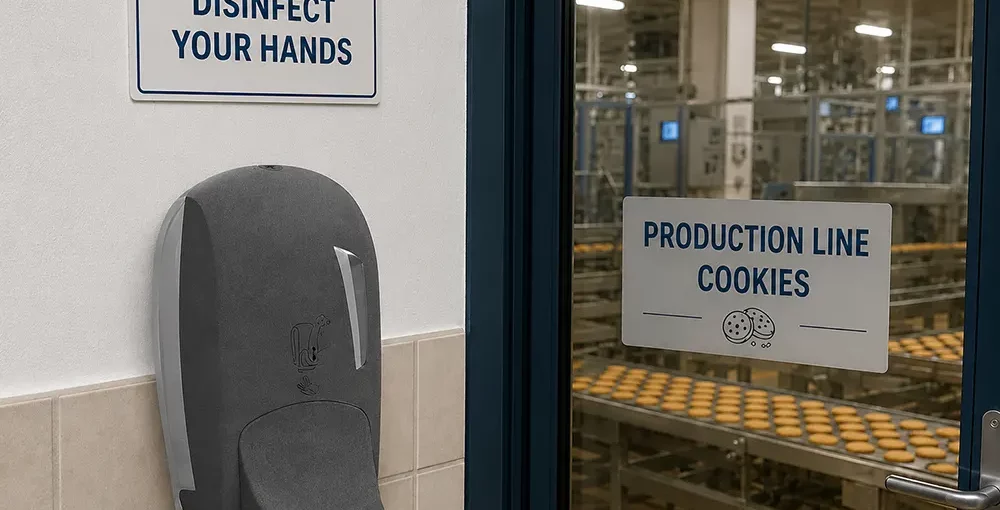
In factories, hand sanitizer dispensers are installed at specific contact points and transitional zones where the risk of cross-contamination is highest.
The focus is on creating a hygienic barrier that enables workers to disinfect their hands quickly and easily while moving through the facility without leaving their workstation, thereby directly protecting workforce health and fulfilling strict standards such as HACCP or ISO protocols.
| Location | Why is this location important? | High-risk location |
| Entrances to production halls | Serve as the primary hygienic barrier for every employee before entering the workplace | In narrow passageways where the dispenser may obstruct movement or become physically damaged |
| Zones next to machines and workstations | Enable quick disinfection after contact with raw materials or tools during work | Near heat sources or open flames: due to the flammability of alcohol-based sanitizers |
| Logistics sectors and warehouses | Critical points where workers come into contact with external packaging that may be a source of contamination | Behind doors or obstacles: where the dispenser is not visible or easily accessible to workers |
| Canteens and break areas | Handling food in shared areas requires the highest level of hygiene discipline | Directly above electrical installations: to avoid the risk of short circuits caused by liquid leakage |
| Next to elevators and staircases | High-traffic zones where touch surfaces are most susceptible to pathogen transmission | Locations with extreme dust levels: (when using sensor-based models) which may block sensor operation |
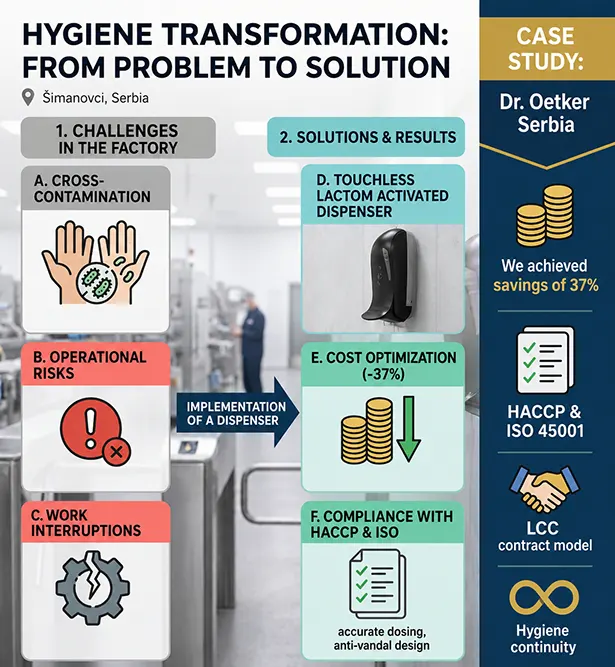
Factory hand sanitizer dispenser – Practical experience: Dr. Oetker Serbia
Implement mechanical elbow-operated dispensers in high-traffic employee zones at the Dr. Oetker production facility in Šimanovci. The goal was to reduce hand contact and ensure stable dispenser operation without relying on batteries and electronics in conditions of increased humidity and dust.
Challenge:
Ensuring uncompromising hand and facility sterility in accordance with HACCP and ISO 45001 standards while eliminating the risk of failures in a dynamic factory environment.
Implementation:
We introduced complete LUU equipment:
-
- mechanical elbow-operated dispensers for sanitization containing an 80% alcohol liquid solution that kills all bacteria and viruses in less than 15 seconds and leaves no residue on the hands. We installed them at the factory entrance and in front of production facility entrances.
- electronic foam soap dispensers that deliver up to 12.000 doses without battery replacement and reduce water consumption by 30% because foam rinses off more easily
- waste bins and automated spray air freshener dispensers in restrooms featuring day/night continuous operation across all three shifts, programmed intervals for releasing aerosol air fresheners every 7.5, 15, or 30 minutes without the need for manual adjustment
Result:
Maximum protection without cross-contamination was achieved. Thanks to the LUU contractual model, precise consumption control with savings of up to 39% and absolute hygienic continuity without administrative burden were ensured.
Factory hand sanitizer dispenser – FAQ
Do sanitizing dispensers support liquid, gel, or foam?
LUU sanitizing dispensers intended for factory facilities use a liquid alcohol solution (80% alcohol) because it enables the fastest disinfection (less than 15 seconds) and leaves no sticky residue, which is important for workers handling tools or packaging.
How are the 39% savings mentioned in the text achieved?
The savings are the result of precise factory dosing. LUU dispensers eliminate human error. Each press or sensor activation releases the exact dose required for effective hygiene, thereby directly preserving the budget.
Are sanitizing dispensers resistant to industrial dust and humidity?
Absolutely. Models intended for factories feature hermetically sealed housings that protect the sanitizer from external influences. This is especially important in halls with a high level of airborne particles because the sanitizer remains chemically pure and maximally effective down to the last drop.
How complicated is the installation of sanitizing dispensers in large facilities?
The process is fast and does not disrupt production. Dispensers can be installed on all wall types. Our team performs assessment and positioning to ensure maximum accessibility for workers.
What does the LUU contractual cooperation model include?
This model provides the factory with complete peace of mind. We take responsibility for installation, regular maintenance, and precise inventory monitoring. In this way, hygiene ceases to be an administrative burden for management and becomes an automated process with guaranteed continuity.
How do these systems help fulfill HACCP and ISO 45001 standards?
The installation of professional dispensers at key locations directly fulfills requirements regarding cross-contamination control. By ensuring clear hygienic barriers, the factory documents proactive care for product safety and employee health, which is crucial during external audits.
Develop LUU mechanical dispensers for industrial environments with high-intensity use where stability, controlled consumption, and simple maintenance play an important role in the hygiene system.
Contact us for consultations and a solution proposal for your production facility through a cost-effective and transparent contractual model.
Subscribe to the LUU newsletter and stay updated with the latest offers.